Related: How to Find a Stud in a Finished Garage Wall
Every garage storage system I have ever torn out failed for the same reason, and it was never the shelf. It was the mounting. I have been a general contractor in Columbus for twenty years, and I have pulled more sagging wire shelves out of garages than I can count, usually with a homeowner standing behind me saying the box claimed it held 200 pounds.
The box lies. The bracket does not. That is the lens I use for everything below, and it is why this guide is built around four pieces that do four different jobs instead of one ranked list. A garage storage system is really a stack of decisions: what stands on the floor, what hangs on the wall, what locks, and what you can move when your needs change.
Here is how I would put these four together, and who should skip each one.
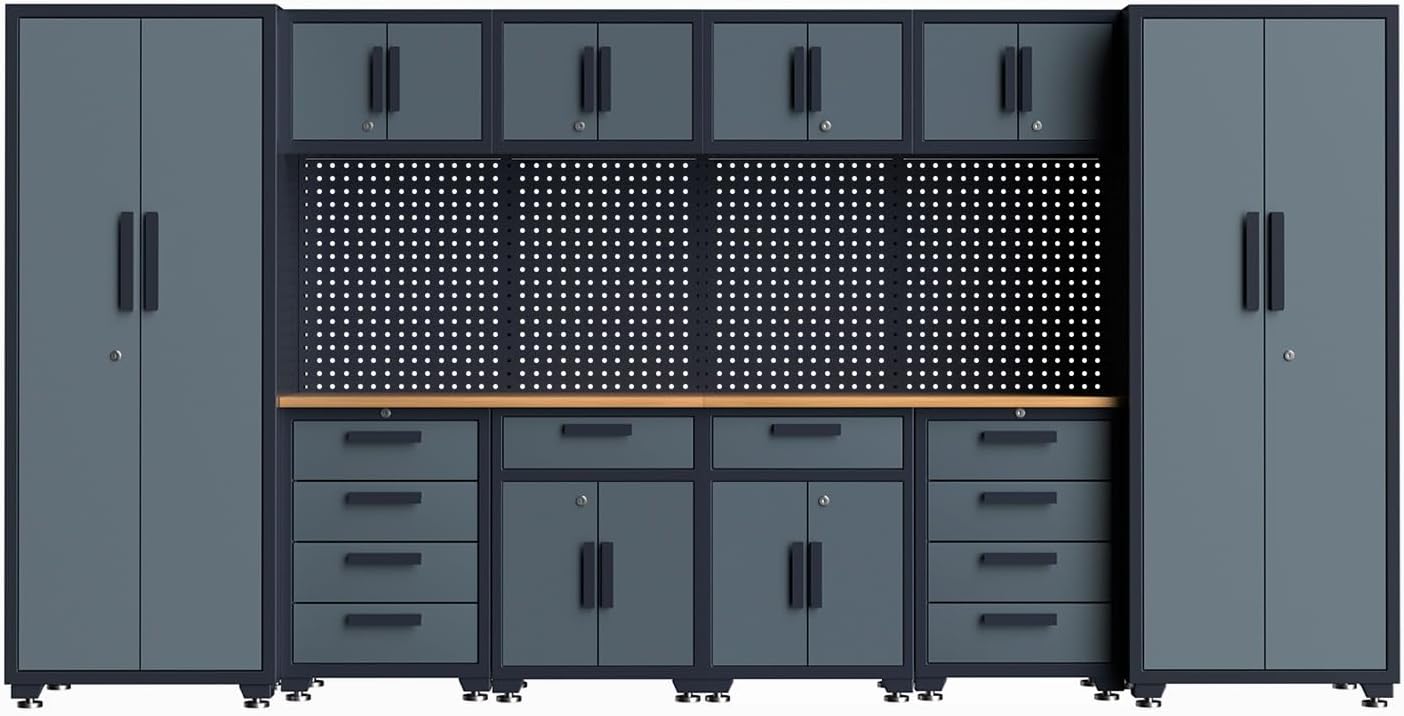
The full wall option: Garage Storage Cabinet System 16-Pcs Workshop Set, Gray
Some garages need a system, not a shelf. This is the one that covers a wall in a single purchase: a 16-piece workshop set in gray, meant to be laid out as a matched run of cabinets rather than a collection of mismatched boxes you accumulated over a decade. If you have ever stood in a garage where every cabinet is a different height and depth, you know why that matters. Uniform depth means uniform clearance. You can slide a tool chest along the run without hitting anything.
Cabinets beat open shelves for anything you do not want covered in sawdust, and in a working garage that is most of your stuff. Closed doors also hide the mess, which sounds cosmetic until you are the guy whose neighbors can see his extension cords from the street.
Two things before you commit. First, measure the wall and draw the layout on paper, including door swings and the space you need to pull a drawer all the way out. Second, check your floor. Garage slabs are pitched toward the door on purpose, so a long run of cabinets will need shims or adjustable feet to sit level and to keep doors from swinging open on their own. If you cannot shim it, do not buy a run of cabinets.
This is the biggest purchase in this guide and the one that most rewards planning. If you are not ready to plan a wall, start smaller and come back to it.
The locking cabinet: SISESOL Black Metal Storage Cabinet with Drawers and Lock
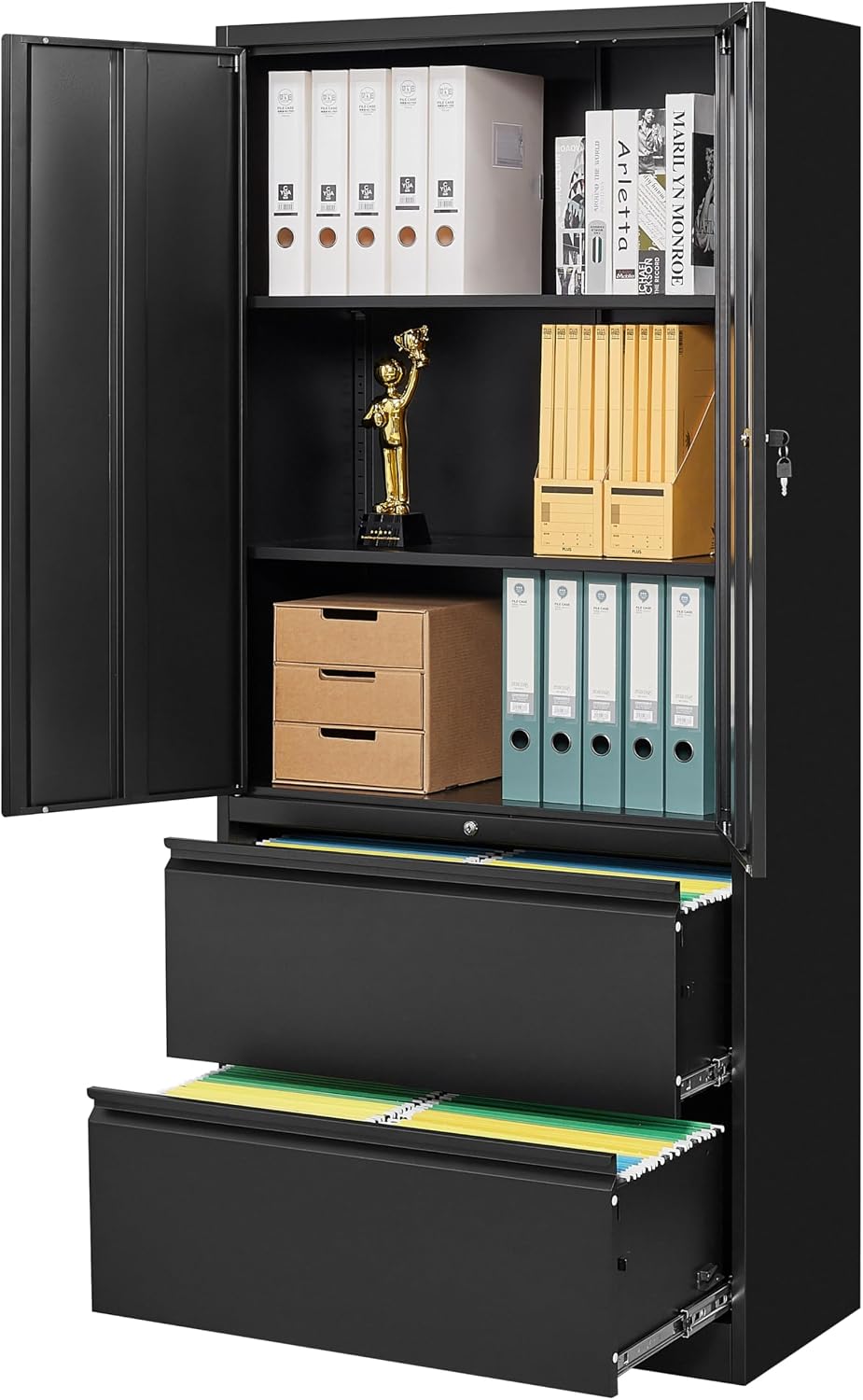
Every garage needs one cabinet that closes and locks. Not because your neighbors are thieves, but because solvents, chemicals, and anything with a sharp edge should be behind a door when kids are in the driveway. This SISESOL unit is a 71 inch steel cabinet with doors, shelves, and two drawers, and the lock is the whole point.
The drawers are what separate it from a plain locker. Small stuff is what actually destroys garage organization: drill bits, tape measures, and the box of screws you bought three of because you could not find the first two. Drawers give that clutter a home instead of letting it pool on top of the cabinet.
At 71 inches tall it is a full height unit, so treat it like furniture. Anchor it to a stud. A tall steel cabinet with drawers pulled open is front heavy, and front heavy plus a pitched slab is how cabinets end up flat on the garage floor. Two lag bolts into a stud, or a proper cabinet anchor strap, and it is not going anywhere.
Steel is the right material here. Plastic cabinets in an unconditioned garage crack at the hinge after a couple of hard winters, and a cracked hinge on a locking cabinet defeats the lock.
The shelving backbone: Sakugi Storage Shelves, 5 Tier Shelf Organizer
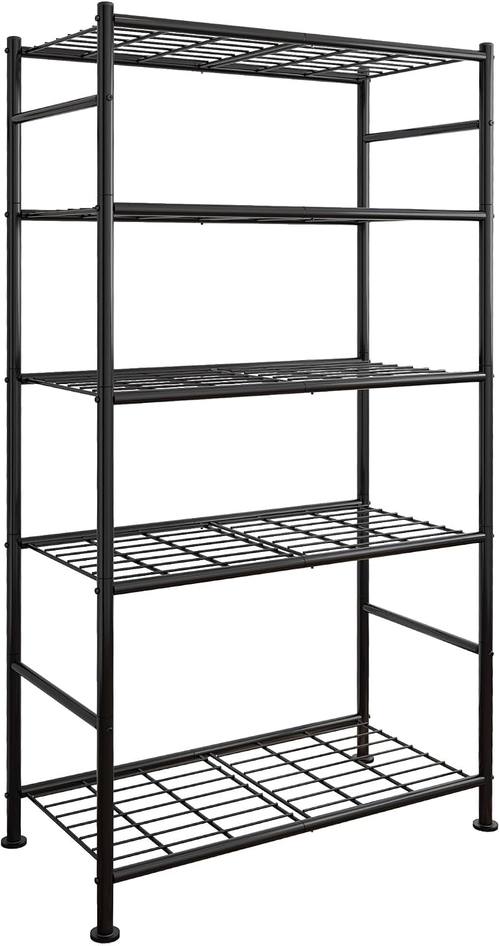
This is the piece I would buy first. The Sakugi is a 5 tier steel shelving unit at 33.0 inches wide, 12.6 inches deep, and 72.0 inches tall, with leveling feet, and that 12.6 inch depth is the number that matters. Deep shelves eat the floor space you need for a car door. A narrow unit hugs the wall and gives you five tiers of vertical storage in a footprint that barely intrudes.
Five tiers is a real system if you use it like one. Weekly stuff at eye level. Seasonal boxes up top. Heavy bins at the bottom, because a tall narrow unit is more stable when the weight sits low. That is the whole method, and it works on any shelving you already own.
The load path here runs straight to the floor, which is why this one does not care about your studs. Leveling feet handle the slab pitch, and they are the reason a modest looking shelf can still sit rock solid. Skip the leveling and let the unit rock, and the joints work loose and the shelf starts to lean. Level it, then load it.
It is built as a heavy duty unit, and the frame will take more than most people expect. The frame is not what fails on shelving like this, though. The connection points fail, and they fail faster when the unit is rocking on an unlevel floor.
The wall layer: PIYILO 48 in Garage Tool Organizer Wall Mount
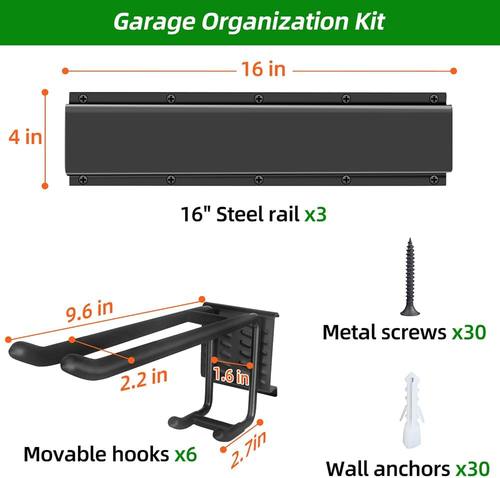
The floor is expensive real estate. Anything you can hang on the wall is floor space you get back, and this PIYILO rack is a 48 inch wall mounted tool organizer with adjustable storage, which means you can move the holders around as your tool collection changes.
Forty eight inches is a good working width because it spans three studs at standard 16 inch spacing. That matters more than any weight rating printed on the box. A wall rack's real capacity is decided by what you bolt it to. Drywall anchors are not a mounting system for a tool rack, no matter what the packaging suggests. Find the studs, mark them, and use lag bolts or heavy duty structural screws. If your garage is finished and you cannot find studs, a magnetic stud finder and a thin finishing nail will tell you the truth in about two minutes.
Adjustability is the feature I care about most. A static rack is just a shelf on the wall. An adjustable one lets you hang long handled tools on one side and hand tools on the other, then change your mind in the spring when the rake comes out of the shed.
How I judge garage storage
I do not judge storage with a box of Christmas lights. That proves nothing. Here is what I look at instead.
Bracket and track material. Steel beats plastic, always. Plastic track is fine for bikes and shovels, and I will say that out loud, but anything holding real weight needs steel behind it.
The mounting hardware. This is where systems fail. A rating printed on a box means nothing if the included anchors are meant for drywall and you are mounting into drywall. Match hardware to the substrate every time, and over build the anchor rather than trusting the spec sheet.
The load path. Floor standing units carry weight to the slab. Wall units carry it into studs. Ceiling units carry it into joists, which is a different conversation with a different failure mode. Know which one you are buying before you buy it.
Reconfigurability. A garage system you cannot reconfigure is just expensive shelving. Life changes. The bike collection grows, the kids leave, the lawn equipment gets bigger. Adjustable beats fixed.
Sawdust. Cabinets win. Anything on an open shelf in a working garage will be dusty by Sunday, and you will clean it once and then stop caring.
The reference table
Here is the same information in one place, organized by what each piece does and where its weight goes. The mounting notes are the ones I would give a homeowner standing in the garage with a drill in hand.
| Product | Type | Load path | Best for | Notes | Price |
|---|---|---|---|---|---|
 Visit on Amazon → Visit on Amazon →Garage Storage Cabinet System 16-Pcs Workshop Set, Gray |
Matched cabinet run | Floor standing, anchored to the wall | Covering a full wall with uniform storage | Plan the layout and shim for floor pitch before buying | $2,399.99 |
 Visit on Amazon → Visit on Amazon →SISESOL Black Metal Storage Cabinet with Drawers and Lock |
Locking steel cabinet | Floor standing, anchored to a stud | Tools, chemicals, and anything that should lock | 71 in tall with doors, shelves, and two drawers | $199.99 |
 Visit on Amazon → Visit on Amazon →Sakugi Storage Shelves, 5 Tier Shelf Organizer |
5 tier shelving unit | Floor standing, leveling feet | Bulk bins and seasonal storage | 33.0 W x 12.6 D x 72.0 H, narrow enough to hug a wall | $44.98 |
 Visit on Amazon → Visit on Amazon →PIYILO 48 in Garage Tool Organizer Wall Mount |
Wall mounted tool rack | Wall, into studs | Long handled and hand tools off the floor | 48 in wide and adjustable, spans three studs | $30.98 |
What I would actually do
If your garage is a disaster and you have one weekend, buy the shelving unit and the wall rack. Get the floor clear, get the long handled tools on the wall, and get the bins onto five tiers. That is the fastest route from cannot park in here to can park in here, and neither piece requires you to plan a wall layout first.
If your problem is that tools wander off or chemicals sit within reach, add the locking cabinet. It solves a different problem than shelving does, and it solves it completely.
If you are finishing a garage or building a shop, the 16 piece set is the move, and you should plan it the way you would plan a kitchen. Draw the wall, measure the pitch, decide where the workbench goes, and leave clearance for car doors. Doing that before you buy is the difference between a system and a pile of cabinets.
You can mix all four. Most garages I work in end up with a matched run on one wall, shelving on the opposite wall, and a rack over the workbench. That is a system, and every piece of it can move.
Should you buy the 16-piece workshop set?
Yes, if you are building out a wall and you want it to look deliberate instead of assembled. Uniform depth and height are worth more than people expect, and a matched set makes a garage feel finished rather than improvised. Plan the layout first, check the floor pitch, and give yourself two weekends. This is not a one afternoon project if you want it right.
Should you buy the SISESOL locking cabinet?
Yes, if you have anything that should sit behind a lock or a door. The 71 inch height gives you real vertical storage, the drawers handle the small stuff that otherwise pools on every flat surface, and steel holds up in an unconditioned garage. Anchor it. That is not optional for a cabinet this tall.
Should you buy the Sakugi shelving unit?
Yes, and I would buy it first. The 12.6 inch depth is the reason. It stores vertically without stealing parking space. Leveling feet deal with a pitched slab, and the load goes to the floor, so you do not need to find a stud. Load heavy things low and seasonal things high.
Should you buy the PIYILO wall rack?
Yes, if you have wall space and a stud finder. Forty eight inches spans three studs at 16 inch spacing, and the adjustable holders mean you are not locked into one layout. Bolt it into studs with real hardware and it will outlast the garage. Use drywall anchors and you will be writing a review about how it fell down.
The bottom line
A garage storage system is not a product. It is a plan, a load path, and the right hardware. Find the stud, match the anchor to the substrate, put the heavy stuff low, and keep the floor clear. Do that and any of these four will do its job for years. Skip it and the best cabinet on this page will still end up leaning against the wall with a bent door.