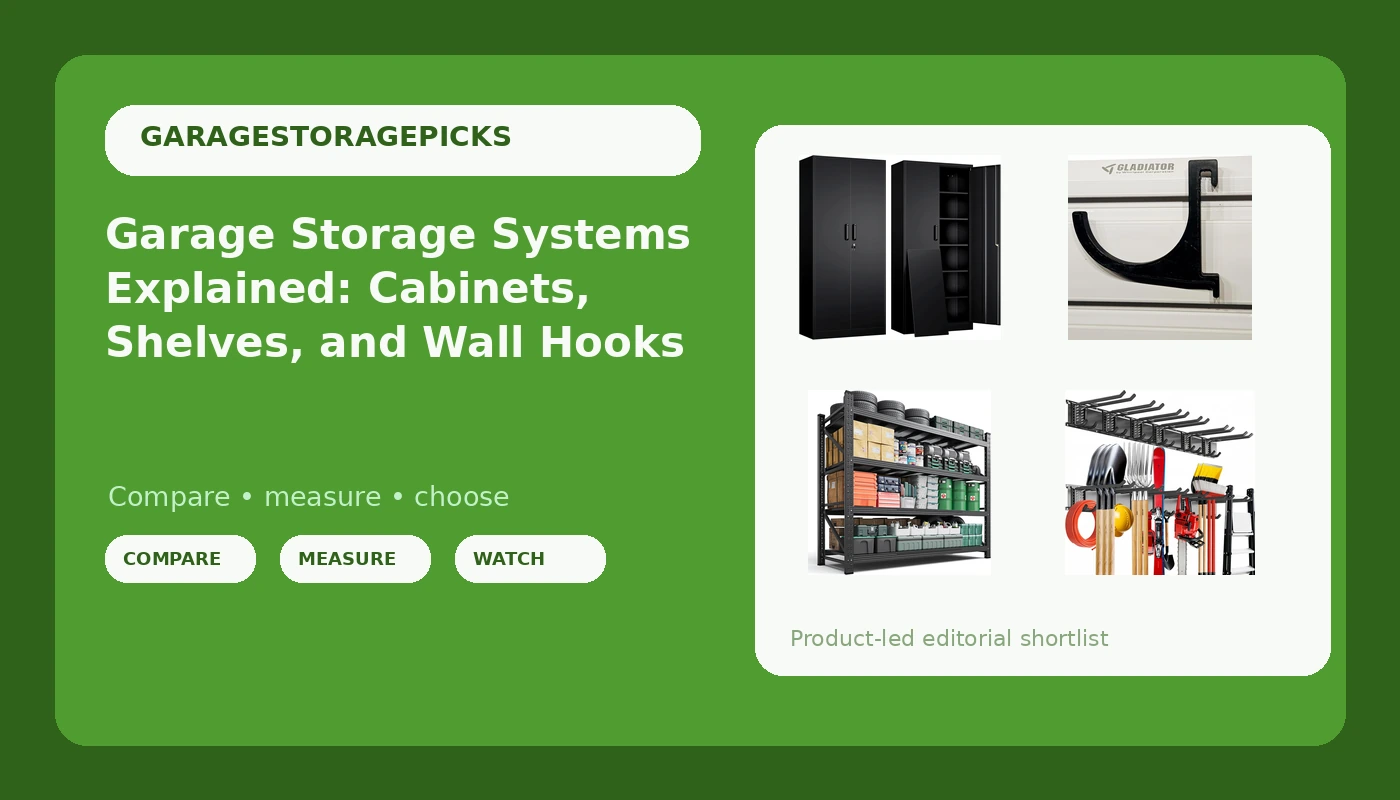
Most garages do not fail at storage because the owner bought a bad shelf. They fail because one product got handed three different jobs. Garage storage systems work when you split the problem into what needs to be closed up, what needs to be stacked heavy, and what needs to hang at grab height. A cabinet, a rack, and a wall rail are not competing answers to the same question. They answer different questions, and most garages need at least two of the three.
This explainer covers four products that fill those roles: an enclosed locking cabinet, a four-tier industrial rack, a 48-inch wall-mounted tool bar, and a set of J-hooks for an existing wall track. None of them replaces the others. The point is to understand which job each one does, what its mounting actually requires, and where the trade-offs sit before you spend a weekend drilling holes.
Related: How to Find a Stud in a Finished Garage Wall →
Quick answer
Match the product to the job and the mounting to the load. An enclosed steel cabinet is the right call for tools, chemicals, and anything you do not want coated in sawdust. A four-tier heavy duty rack is the right call for totes, bulk goods, and long material. A wall-mounted rail with hooks is the right call for shovels, rakes, and other long-handled tools you want off the floor. A J-hook set is the right call only if you already own a compatible track system, because the hooks do nothing without the track. In every case, the anchor and the stud behind it decide whether the rating holds.
Four useful options
| Model | Best fit | What stands out |
|---|---|---|
| Yizosh Metal Garage Storage Cabinet with 2 Doors and 5 Adjustable Shelves | Tools, chemicals, and dust-sensitive gear | 71-inch enclosed steel cabinet with two locking doors and five adjustable shelves |
| Letaya 71.3" W Metal Storage Shelves | Totes, bulk goods, and long material | Four-tier steel rack, 71.3 x 24 x 70 inches, with a 5000 lb listed capacity |
| Garage Tool Organizer Wall Mount, 48inch | Shovels, rakes, and yard tools | 48-inch rail with six adjustable double hooks |
| 4-Pack - 3" Dia. J-Hook Set | Adding capacity to an existing Gladiator track | Four 3-inch J-hooks, 20 lb rating each, made in the USA |
The enclosed cabinet: Yizosh Metal Garage Storage Cabinet with 2 Doors and 5 Adjustable Shelves
Cabinets beat open shelving for anything you do not want covered in sawdust, and that is the entire argument for this one. The trade-off is that a tall cabinet is a sail. It is 71 inches of flat steel panel, and an unanchored cabinet tips when a door is open and someone leans on it. Anchor it into studs at the top, shim the base to match the pitch of the floor, and keep the heaviest contents on the lower shelves so the center of gravity stays down. The five adjustable shelves are the useful part here, because shelf spacing is what decides whether the cabinet actually fits your stuff or just sits there looking organized.
The bulk rack: Letaya 71.3" W Metal Storage Shelves
A capacity figure like 5000 lb describes the structure of the rack under a load spread evenly across the shelves. It does not describe your floor, and it does not describe your wall. Freestanding racks carry their own weight, which is why they are the honest answer for heavy totes, but the load still has to land somewhere: a garage slab that slopes toward the door will put a twist into a rack that is not shimmed, and a tall rack that is not tied into a stud is a tipping hazard the first time someone pulls a heavy tote off the top tier. Heavy on the bottom, light on top, anchored at the top rail, and the rack does what it says.
The wall-mounted organizer: Garage Tool Organizer Wall Mount, 48inch
Wall rails are where most garage projects go wrong, and it is almost never the rail's fault. The rail is only as strong as the fasteners holding it, and the fasteners are only as strong as what is behind the drywall. Six hooks holding shovels and a snowboard is a moderate load spread over a 48-inch span, which is manageable when the rail is screwed into studs or into a properly rated hollow-wall anchor, and not manageable when it is hung on the little plastic plugs that come in a picture-hanging kit. Mount it so the rail crosses at least two studs, put the heaviest tool closest to a fastener, and the adjustable hook spacing lets you keep the tools you use weekly at eye level.
The track add-on: 4-Pack - 3" Dia. J-Hook Set for Gladiator Gearwall and Geartrack Storage System
Prices and availability may change. Product images, names, and retailer links are matched to verified listings. No current price, rating, stock status, or measured result is stated here without current evidence.
Proprietary accessories are a real trap in garage storage, and this is the clearest example in the group. These hooks are excellent value per hook, but they are worthless without the track they were designed for. If you already run Gladiator GearWall or GearTrack, adding four hooks is a few minutes of work and no new holes. If you do not own that track, this pack is not a starter kit, and buying it means committing to a system. A 20 lb rating per hook also tells you what belongs on it: cords, hoses, hand tools, and light yard gear. It is not a hook for a tool chest or a stack of lumber.
What a weight rating actually measures
Every rating you read on a garage storage product describes that product's own structure under an evenly distributed load. It says nothing about the wall, the ceiling, or the floor it attaches to. Wall-mounted items push their load into fasteners, and fasteners push it into whatever is behind the surface. Drywall alone holds a picture frame. It does not hold a loaded rail with six tools on it, and it absolutely does not hold anything overhead.
Point loads are the second half of the story. A shelf rated for hundreds of pounds can still dent or deflect if all of that weight sits on one small foot in the middle of the span. Spread the load, put the heavy items near the ends where the structure is, and keep the middle of a shelf for lighter things.
Pitch matters more than most people expect. Garage floors are poured with a slope toward the door so water drains out, and that slope means a freestanding rack or cabinet starts out unlevel. Shim the feet, check the doors on a cabinet, and check the rack with a level before you load it. A twisted rack stays twisted once the weight lands on it.
Planning the layout before you buy anything
Layout is the part people skip, and it is the part that decides whether a system stays usable. Work in zones: yard tools and anything that leaves the garage near the door, automotive supplies near where the car parks, hand tools and fasteners near the bench. Then work in heights. Weekly items go between knee and shoulder. Seasonal and rarely touched items go up high. Heavy items go low, always, both for your back and for the stability of the unit.
Measure the wall before you order. A 71.3-inch rack does not fit a 68-inch gap, and a 48-inch rail needs 48 inches of clear span plus room for the tools hanging off it. Leave a walking path wide enough to carry a tote through, because a garage you cannot move in is a garage you stop using.
Five steps before you drill
- Find the studs with a stud finder, and mark each one with tape so you can see the layout at a glance.
- Identify the wall type: drywall over studs, exposed framing, masonry, or an existing track system. Each one takes different hardware.
- Estimate the real load, including the heaviest single item, not just the average.
- Confirm the included hardware matches both the wall type and the load, and upgrade it if it does not.
- Dry-fit and level the unit before you commit, shimming for floor pitch as needed.
Practical guidance for a garage that stays organized
- Keep the heaviest items on the lowest shelf or the bottom of the cabinet, every time.
- Anchor tall racks and cabinets into studs at the top, even when the unit stands on its own feet.
- Leave a few inches of clearance under the bottom shelf so you can sweep and so moisture does not wick into stored goods.
- Label totes on the end facing out, so you stop pulling three boxes to find one.
- Re-check fasteners and anchors after the first season, and again after any big temperature swing.
Which option should you choose?
Choose the Yizosh Metal Garage Storage Cabinet with 2 Doors and 5 Adjustable Shelves when you need tools, chemicals, or dust-sensitive gear behind a closed and lockable door. Choose the Letaya 71.3" W Metal Storage Shelves when the load is totes, bulk goods, or long material that would overwhelm a wall bracket. Choose the Garage Tool Organizer Wall Mount, 48inch when the problem is long-handled yard tools eating floor space near the door. Choose the 4-Pack - 3" Dia. J-Hook Set when you already own a compatible Gladiator track and just need more places to hang things.
The caveat is straightforward. Every capacity figure and rating mentioned here comes from the manufacturer's product description, not from an independent measurement, and no listing can tell you what your specific wall is made of. Treat the published numbers as a starting point and let the stud layout, the anchor, and the floor pitch have the final word.
The bottom line
Garage storage systems are not a single purchase, they are a division of labor. Enclosed cabinets handle the things you want protected and out of sight. Heavy duty racks handle the weight that should never hang from a bracket. Wall rails and hooks handle the long, awkward tools that otherwise live in a pile by the door. Buy for the job, mount for the load, and the system will still make sense when your tool collection changes shape in two years.