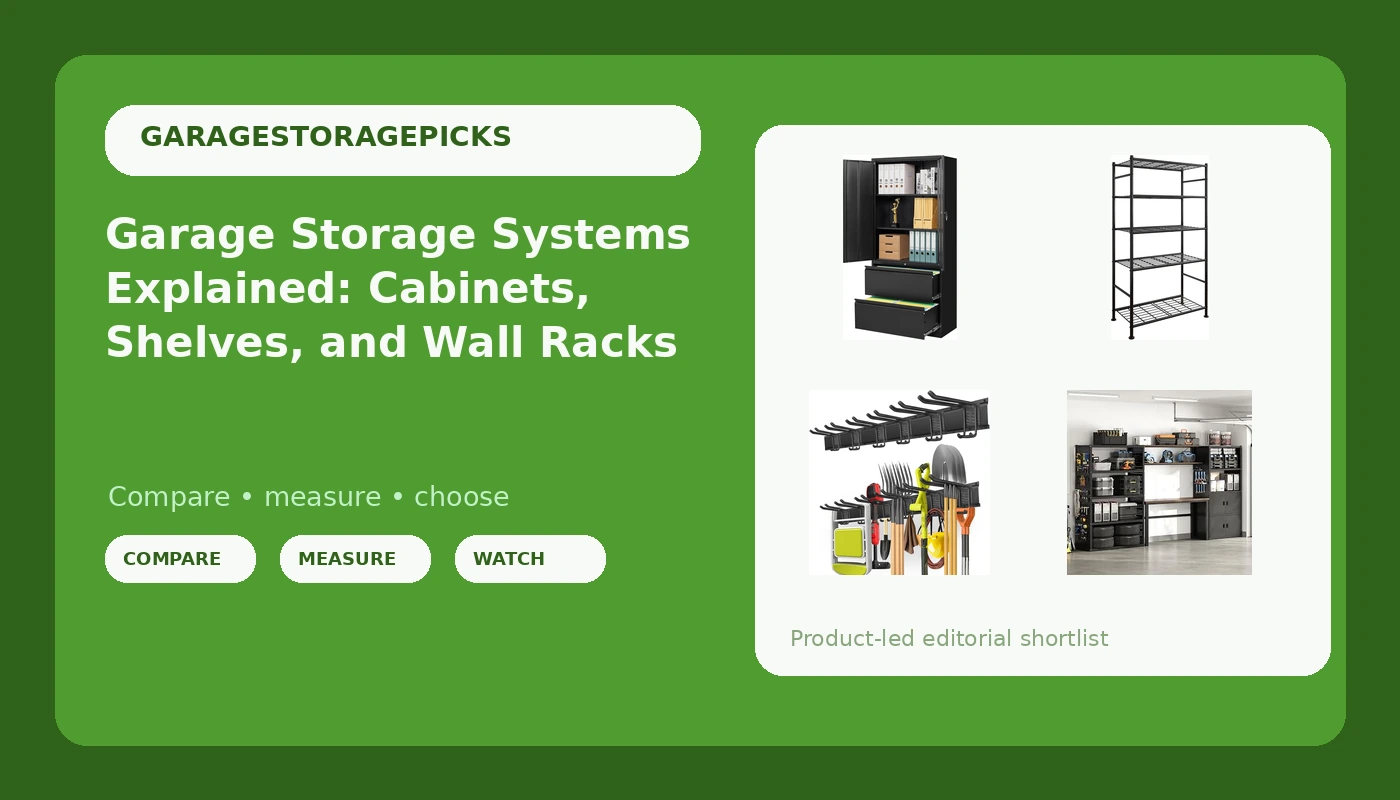
Most garages do not have a storage problem. They have a routing problem. Everything lands in the same three square feet by the door because nothing in the room has been assigned a job. A garage storage system fixes that by giving each category of stuff its own address: hand tools on the wall, bulk and seasonal goods on shelves, anything that needs to stay clean or locked behind a door, and a flat surface where work actually happens.
The four products below cover those four addresses. They are not four versions of the same purchase. Picking between them is less about which one wins and more about which job you are trying to solve first, and how much wall and floor you are willing to give up to solve it.
Related: Wall Track vs Overhead Rack: Where Garage Storage Actually Belongs →
Quick answer
No single product here covers a whole garage, and none of them is meant to. A wall-mounted rack handles the tools you reach for daily, a five-tier shelf unit handles bulk and seasonal storage, a locking steel cabinet handles anything that needs doors and a lock, and a modular workbench cabinet handles counter space and enclosed storage in one footprint. If you are starting from an empty wall, the wall rack and the shelf unit are the two pieces to plan first.
Four useful options
| Model | Best fit | What stands out |
|---|---|---|
| FLEXIMOUNTS 129" L Modular Garage Storage Cabinet with Workbench, Black | A bench and enclosed storage sharing one footprint | Modular cabinet run with an integrated workbench surface |
| SISESOL Black Metal Storage Cabinet with Drawers and Lock | Tools and supplies that need doors and a lock | 71-inch steel cabinet with two drawers, shelves, and locking doors |
| Sakugi Storage Shelves, 5 Tier Shelf Organizer | Bulk goods, bins, and seasonal storage | Five tiers on a 33.0 x 12.6 x 72.0 inch frame with leveling feet |
| PIYILO 48 in Garage Tool Organizer Wall Mount | Long-handled tools and daily-use hand tools | 48-inch wall-mounted rail with adjustable tool positions |
The workbench cabinet: FLEXIMOUNTS 129" L Modular Garage Storage Cabinet with Workbench, Black
A long cabinet run is the one purchase where the floor matters as much as the wall. Garage slabs are poured with a pitch toward the door, so a 129-inch run can sit dead level at one end and rock at the other. Shim under the low side before you bolt anything to a stud, then check that the doors and drawers still clear their frames. If the run is going against a wall that gets wet, keep a small gap at the back rather than pushing it tight to the drywall.
The locking cabinet: SISESOL Black Metal Storage Cabinet with Drawers and Lock,Locking Steel Storage Cabinet with Doors and Shelves,71" Office File Cabinets for Home Office,Warehouse,Garage,School (Black, 2 Drawers)
A garage is a dusty, occasionally damp room with a door that opens to the weather, so the value of doors is not cosmetic. Anything you cut, sand, or spray in that space throws material into the air, and open shelving collects it. A tall steel cabinet also needs to be anchored. A 71-inch box with a loaded drawer pulled open is front-heavy, and the wall anchor is what keeps it upright, not the cabinet's own weight. Put the drawers at a height you can see into without bending, and keep the heaviest items on the bottom shelf.
The tall shelf unit: Sakugi Storage Shelves - 5 Tier Shelf Organizer, Heavy Duty Garage Shelving Unit with Leveling Feet, Stable Metal Shelves Organizer for Pantry, Kitchen and Closet, 33.0" W x 12.6" D x 72.0" H, Black
Open shelving is the fastest way to add capacity, and it is also the format that punishes bad habits. The top tier is a trap. It is the easiest shelf to load and the hardest one to reach, so it collects the things you will not touch again until you move. Reserve the top for seasonal bins and empty coolers, put the mid tiers at eye level for weekly items, and keep anything genuinely heavy near the bottom where it does not have to be lifted overhead. A narrow 12.6-inch depth is deliberate: it fits a side wall without eating parking space, but it also means deep tubs will overhang, so measure your bins first.
The wall tool rack: PIYILO 48 in Garage Tool Organizer Wall Mount, Adjustable Tool Storage Rack
Wall racks live or die on two things: where you put them and what you fasten them with. A 48-inch rail spans multiple studs, and you should hit every one of them, not just the two at the ends. Shovels, rakes, and a fully loaded trimmer hang as a lever arm pulling down and out, which is a different load than a static shelf. If your wall is finished drywall over studs, the studs carry it. If it is block or concrete, that is a different anchor entirely, and the included hardware is usually not the answer for either case.
Prices and availability may change. Product images, names, and retailer links are matched to verified listings. No current price, rating, stock status, or measured result is stated here without current evidence.
How a garage storage system divides the load
Think of the room in horizontal bands, not in products. The band from the floor to about knee height is where heavy things live because lifting is the expensive part. The band from knee to shoulder is the working zone, and it should hold whatever you touch weekly: the tools on the wall rack, the bins you pull down for a project, the drawer with the tape and the pencils. The band above shoulder height is for light and seasonal goods, which is exactly where open shelves earn their keep. The bench surface is its own zone and it should stay clear, because a workbench covered in storage is just a shelf with a nicer top.
Then decide open versus closed. Open shelving is cheaper per square foot and faster to load, and it shows you what you have at a glance. Closed storage costs more and hides the mess, but it also protects contents from sawdust, overspray, and the general grit that a garage generates. A useful rule is that anything with a motor, a blade, or a finish goes behind a door, and everything in a labeled bin can stay in the open.
Studs, floor pitch, and the hardware nobody reads about
Wall systems are only as strong as the studs behind them, and the mounting hardware is where most installations fail. The weight rating printed on a box describes the product in ideal conditions. The bracket and the fastener describe what happens in your garage. If a rail or cabinet comes with plastic drywall anchors, treat them as a suggestion, not a plan. A stud finder and a box of proper structural fasteners cost less than replacing what falls.
Floor pitch is the other quiet problem. Garage slabs slope toward the door for drainage, so a level shelf on an unlevel floor will rock, and a tall cabinet will lean. Leveling feet solve it on shelving, shims solve it under cabinet runs, and ignoring it means doors that never quite close right.
Five steps cover almost every install:
- Empty the wall completely and mark the floor line where the unit will sit.
- Find and mark every stud across the span, then verify with a thin nail before you drill.
- Assign zones on paper before you buy, so you know which band each product is filling.
- Match the fastener to the load and the wall type, not to what came in the box.
- Load from the bottom up, then recheck level once everything is in place.
Install order and load discipline
- Install wall-mounted items first, while the floor is still clear and you have room to work.
- Set tall shelving and cabinets against side walls, not across the door you park through.
- Anchor every tall unit to a stud, even the ones that feel stable empty.
- Keep the top tier for light goods and the bottom tier for the heavy ones.
- Label bins before they go up, or the system quietly turns back into a pile.
Which option should you choose?
Choose the FLEXIMOUNTS 129" L Modular Garage Storage Cabinet with Workbench, Black when you want a real work surface and enclosed storage in the same run of wall. Choose the SISESOL Black Metal Storage Cabinet with Drawers and Lock,Locking Steel Storage Cabinet with Doors and Shelves,71" Office File Cabinets for Home Office,Warehouse,Garage,School (Black, 2 Drawers) when the priority is keeping tools and supplies covered, organized in drawers, and behind a lock. Choose the Sakugi Storage Shelves - 5 Tier Shelf Organizer, Heavy Duty Garage Shelving Unit with Leveling Feet, Stable Metal Shelves Organizer for Pantry, Kitchen and Closet, 33.0" W x 12.6" D x 72.0" H, Black when you need a lot of capacity against a side wall and you are willing to keep it organized in bins. Choose the PIYILO 48 in Garage Tool Organizer Wall Mount, Adjustable Tool Storage Rack when the floor is the problem and long-handled tools are what is tripping you.
The one thing these four do not share is a mounting method, so do not assume the hardware transfers between them. Ratings, included fasteners, and instructions vary by listing and by the wall you are attaching to, and none of that can be settled from a product page. Verify your own studs, your own floor, and your own loads before you commit.
The bottom line
A garage storage system is not one purchase, it is four jobs assigned to four surfaces: wall, shelf, cabinet, and bench. Get the wall rack up first for the daily tools, add shelving for bulk and seasonal goods, bring in a locking cabinet for anything that needs a door, and finish with a workbench run when you want the surface and the storage to share a footprint. The products hold up their end. The studs behind them are your responsibility.