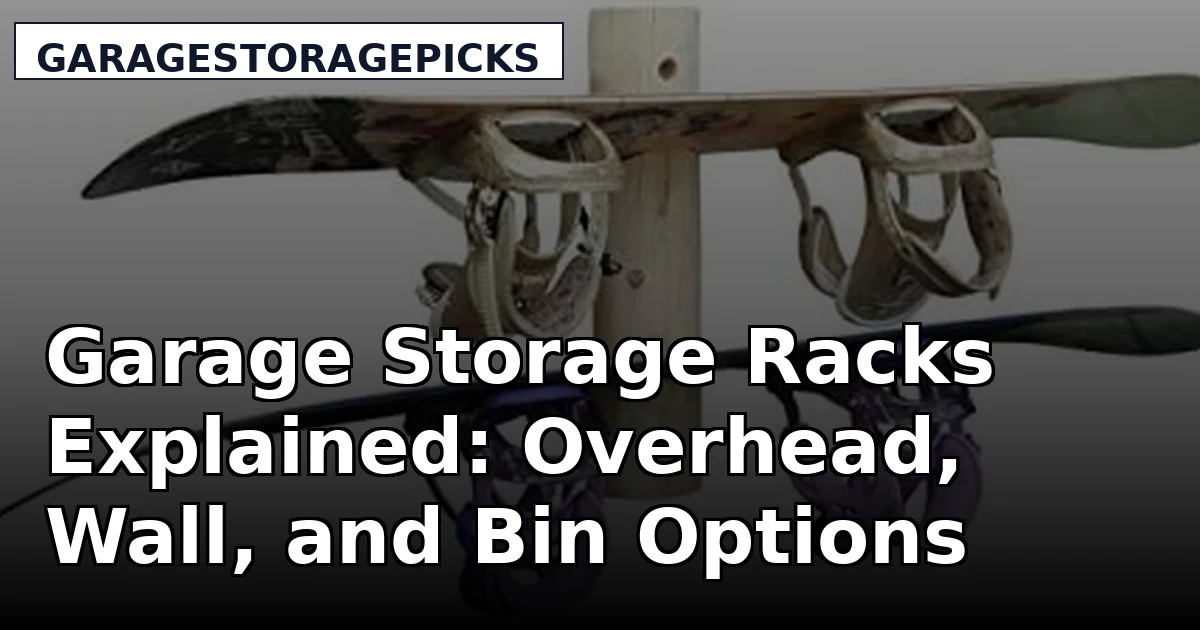
Most garages do not have a storage problem so much as a distribution problem. The floor is packed, the walls above waist height are mostly bare, and the ceiling is doing nothing but holding up the roof. Garage storage racks exist to move things into the two zones you are not using: the wall above your head and the ceiling bay above the car. The catch is that those zones have very different limits, and the racks built for them are not interchangeable. A wall rack holding two snowboards and a ceiling rack rated for 500 pounds are different products solving different problems, and treating them as the same thing is how shelves sag and brackets pull out of drywall.
Related: How to Find Joists Before You Mount Anything in the Garage →
Quick answer
Match the rack to the load and to the structure behind it, not to the photo on the box. For long, awkward, heavy items like lumber, ladders, and holiday bins, an overhead ceiling rack is the right category, and the FERO 4x8 rack carries a stated 500 lb capacity. For boards, wakeboards, and skateboards, a wall-mounted rack keeps them vertical and off the floor, with a 7-place version for a full quiver and a 2-place version for one or two boards. For loose items that need a home, a tote is the container half of the system. In every case, the rack is only as strong as what it is bolted to.
Four useful options
| Model | Best fit | What stands out |
|---|---|---|
| FERO Overhead Garage Storage Rack 4x8, 500 lb Heavy-Duty Capacity | Long and bulky items that cannot live on a wall | 4x8 platform with a stated 500 lb heavy-duty capacity |
| 7-Place Wall-Mounted Snowboard Log Rack, Wakeboard Racks, Skateboard Holder Wall Mount, Vertical Snowboard Wall Mount Sport Storage for Garage, Skateboard Rack Walls, Wood Storage Racks - Canyon Brown | Households with several boards | Seven storage positions in one wall-mounted unit |
| 2-Place Wall-Mounted Snowboard Log Racks - Vertical Snowboard Wall Mount Garage Racks, Indoor & Outdoor Snowboarding Holders for Walls, Wooden Snowboards Storage Rack Garage - Unfinished | One or two boards, or a tight wall | Two storage positions in unfinished wood |
| Tote | Loose items and small parts | Simple container format for the odds and ends |
Overhead storage: FERO Overhead Garage Storage Rack 4x8, 500 lb Heavy-Duty Capacity
Overhead storage is the highest-value square footage in a garage because nothing else can use it. The car pulls under it, the door track runs past it, and the space above is otherwise wasted. The trade-off is that a ceiling rack puts its entire load into the structure above, and that structure is usually a joist system you cannot see. A stated 500 lb capacity describes the rack frame and the platform, not your ceiling. Hitting two joists with proper lag hardware and spreading the load across the 4x8 footprint is what turns a rating into reality. Before ordering anything, measure the open space between the ceiling and the top of your garage door when it is fully raised, and confirm the rack clears the door track and the opener rail. Long items such as ladders, extension poles, and dimensional lumber are the natural residents of this rack; they are also the items that make floor space unusable, which is the whole point.
Full-quiver wall storage: 7-Place Wall-Mounted Snowboard Log Rack - Canyon Brown
Vertical board storage works because boards are long and thin and the wall above the workbench is long and empty. Standing them on edge in a rack keeps the edges off the concrete, keeps them out of the walking path, and makes the whole collection visible at once, which matters more than people admit. The trade-off with a seven-position rack is weight distribution: seven boards plus bindings add up, and all of that load transfers into two or three mounting points. This is a stud-and-lag job, not a drywall anchor job. It also helps to leave a little air between boards so they dry after a wet day rather than sitting against each other, and to keep the rack off any wall where a car door is going to swing.
Small-footprint wall storage: 2-Place Wall-Mounted Snowboard Log Racks - Unfinished
A two-place rack is the right call more often than people think. Two boards on a wall take up less width than a single snowboard leaning in the corner, and the rack disappears once it is loaded. The unfinished wood is a genuine advantage if the rack is going somewhere visible: seal it, stain it, or hit it with the same paint as the wall and it stops looking like a hardware store purchase. If it is going outdoors, the finish matters more, because bare wood and weather are not a long-term arrangement. The main thing to check is position. Mount it high enough that the tails clear the floor and low enough that a shorter rider can still lift a board off it.
Loose-item storage: Tote
A rack is a frame; a tote is what makes the frame useful. Loose items on an overhead platform turn into a pile, and piles are what make people give up on a storage system in the first place. Grouping things into containers before they go up means the rack stays orderly, the weight stays predictable, and you can pull one tote down without unloading the whole platform. The honest caveat here is that the listing title is minimal, so treat the product page as the source of truth for size, material, and lid configuration, and measure your rack spacing before you buy a stack of them.
Prices and availability change, and product listings get updated. Confirm current dimensions, included mounting hardware, and weight limits on the product page before you drill anything.
What a weight rating actually tells you
A capacity number describes the rack, not your garage. When a rack is rated for 500 pounds, that figure assumes the load is spread across the frame and that the frame is attached to something capable of carrying it. The attachment is where almost every failure happens. Garage ceilings and walls are framed with joists and studs at regular spacing, and the sheathing between them is not structural in any meaningful sense. A rack bolted into drywall with plastic anchors can look perfect for a month and then let go all at once, usually with a car underneath.
Two load types matter. Dead load is what the rack holds forever: bins, lumber, the box of seasonal decorations nobody has opened since the move. Live load is the moment you lean on it or drop a heavy item onto it. A rack should be sized for the dead load plus some margin, not for the best-case day.
Direction of the framing matters too. Ceiling joists run one way, wall studs run the other, and a rack that spans across members rather than along them needs a mounting strategy that accounts for the gap. On ceilings, the garage door track, opener rail, wiring, and plumbing are all potential obstructions in the same bay you want to use, and drilling into the wrong one is an expensive lesson.
Finally, the hardware is the weak point. Brackets, lag bolts, and washers carry the entire load into the structure, and they are frequently the cheapest part of the kit. If the included fasteners do not match your framing, replace them. That is a ten dollar decision that determines whether the rack is still on the ceiling in five years.
Ceiling rack or wall rack?
The decision comes down to what you store, how often you touch it, and what your framing will accept. Work through it in this order:
- Measure the candidate space. For a ceiling rack, check the height between the ceiling and the top of the fully raised garage door, plus clearance around the door track and opener rail.
- Find the framing. Locate joists or studs with a stud finder, mark the centerlines, and note the spacing and direction before you choose a rack size.
- Add up the real weight. Weigh or estimate what is actually going up there, including the containers, and compare it to the stated capacity with margin left over.
- Match the mounting hardware to the framing. Use structural fasteners into solid members, spread the load across multiple attachment points, and do not rely on drywall anchors for anything overhead.
- Confirm you can reconfigure it. A rack that cannot move when the board collection grows or the bikes change is just expensive shelving.
Layout and installation notes
- Put the items you touch weekly at eye level on the wall, and send seasonal items up to the ceiling rack.
- Keep ceiling storage away from the path of the garage door and the opener rail; check the full travel, not just the closed position.
- Leave gaps between vertical boards so they can dry, and never stack wet gear tight against a wall.
- Group loose items into totes before they go on a rack, and label the exposed end so you can identify them without pulling everything down.
- Re-check fasteners a month after installation. Wood settles, and a quarter turn on a lag bolt is cheap insurance.
Which option should you choose?
Choose the FERO Overhead Garage Storage Rack 4x8, 500 lb Heavy-Duty Capacity when your problem is long, bulky items that cannot live on a wall and you have verified ceiling framing and clearance. Choose the 7-Place Wall-Mounted Snowboard Log Rack - Canyon Brown when you have a household's worth of boards and one long, empty wall. Choose the 2-Place Wall-Mounted Snowboard Log Racks - Unfinished when you have one or two boards, a narrow wall, or you want a finish that matches the room. Choose the Tote when the racks are already up and the remaining problem is loose items with no home.
One limitation applies across all four: none of these products can compensate for framing that will not carry the load. Verify the structure first, and if the ceiling or wall is questionable, get a second opinion before you drill.
The bottom line
Garage storage racks are not competing with each other so much as occupying different zones. Overhead platforms take the bay above the car, wall racks take the vertical space above the workbench, and totes keep the small stuff from turning either one into a junk pile. Pick the zone that matches what you are storing, confirm the framing can carry it, and use mounting hardware that is at least as serious as the rack itself. That combination is what keeps a rack on the wall and a car underneath it.