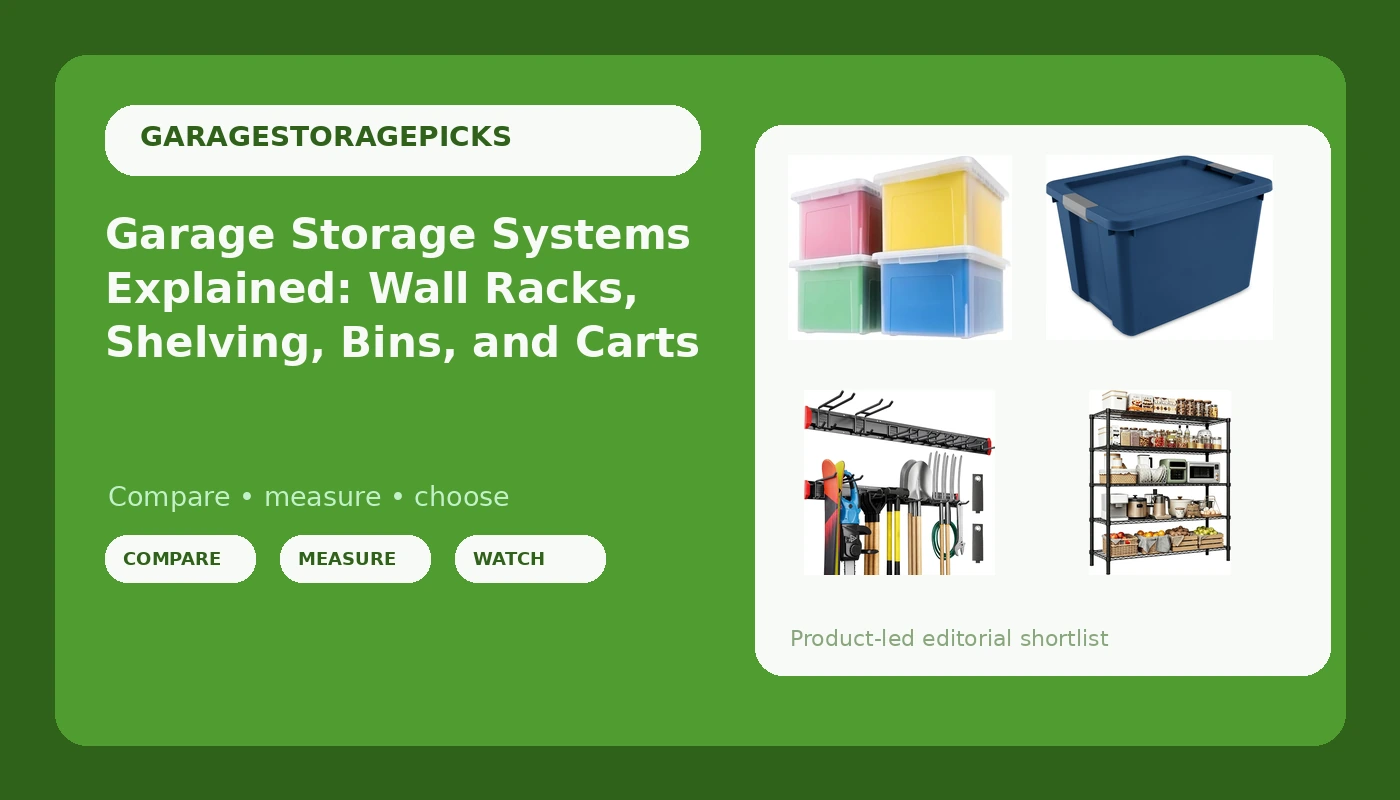
Most garages do not run out of space. They run out of separation. Long-handled tools, heavy bulk storage, small fasteners, and seasonal bins all end up in the same pile, and once they do, nothing is findable and nothing is safe to stack on. Garage storage systems fix that by giving each job its own hardware: a wall-mounted rack for the things that hang, a rated shelving unit for the things that stack, a lidded box for the things that should stay sealed, and a rolling cart for the things that need to travel to the work. This explainer walks through four options that cover those four jobs, what each is actually rated to do, and how to tell which one your garage is missing. No weekend promises. Two weekends, realistically.
Related: Wall Track vs. Freestanding Shelving: Which Fits Your Garage? →
Quick answer
There is no single best garage storage product, because the four jobs are genuinely different. A wall-mounted tool rack holds hand tools and long handles where you can see them. A five-tier metal shelving unit carries bulk weight and boxed goods. A large lidded plastic box contains loose, dusty, or seasonal items that need a lid. A rolling drawer cart keeps small parts and fasteners mobile so they come to the work instead of the other way around. Most garages need two or three of these, not one. Match the hardware to the load, mount into framing rather than drywall, and leave yourself room to move shelves later. A system you cannot reconfigure is just shelving with a nicer box.
4 useful options
| Model | Best fit | What stands out |
|---|---|---|
| monTEK 48" Garage Tool Organizer Wall Mount, 500 LBS Heavy Duty Tool Rack | Hanging hand tools and long handles | Manufacturer lists a 500-pound capacity on a 48-inch wall-mounted rack |
| Garvee 3300LBS 5-Tier Metal Shelving for Garage Storage, 47" Wx17.7 D×72" H | Bulk storage and boxed goods | Five tiers at 47" W x 17.7" D x 72" H, with a manufacturer rating of 3,300 lbs |
| 20-gallon large plastic storage box with integrated handle, blue | Seasonal and loose items that need a lid | 20-gallon capacity with an integrated handle for carrying |
| IRIS USA 6-Drawer Rolling Storage Cart, Black/Clear | Small parts that need to move | Six drawers on a rolling cart, with clear fronts for visibility |
Wall-mounted storage: monTEK 48" Garage Tool Organizer Wall Mount, 500 LBS Heavy Duty Tool Rack
This is the piece that changes how a garage feels on day one, because it moves the tallest, most annoying objects into vertical space you were not using. The catch is always the same: a 500-pound rating describes the rack, not your wall. That number assumes solid attachment into framing. If the rack lands on drywall alone, the rating is fiction and the rack becomes a shelf that falls down with your tools on it. Before you buy anything wall-mounted, find the studs with a stud finder and mark them. Then read what mounting hardware ships in the box and decide whether it matches your wall. Long-handled tools want the high spots where nothing else can reach anyway.
Bulk storage: Garvee 3300LBS 5-Tier Metal Shelving for Garage Storage, 47" Wx17.7 D×72" H
Shelving is where the bulk of a garage actually lives, and the spec that matters most is the depth. At 17.7 inches deep, this unit fits a standard plastic tote footprint without eating half the bay, and at 72 inches tall it stacks five tiers of storage into a footprint that would otherwise hold two. The 3,300-pound figure is a total across the unit, so distribute the load sensibly: heavy boxes low, light and seasonal up high, nothing on the top tier you cannot lift down safely. Freestanding shelving also has to deal with your floor pitch. Garage slabs slope toward the door for drainage, so a tall unit can sit visibly out of level. Shim the feet before you load it, not after, because a loaded 72-inch rack is not something you want to tip to fix.
Lidded containment: 20-gallon large plastic storage box with integrated handle, blue
Open shelving is honest until you put something on it that you care about. Sawdust, road grit, and the general airborne mess of a working garage settle on everything, which is why lidded boxes earn their place in a system. The integrated handle matters more than it sounds: a 20-gallon box loaded with anything dense gets heavy fast, and a molded handle is the difference between carrying it and dragging it across the floor. This is the unit for holiday decorations, camping gear, and the boxes your household keeps asking you to deal with. It pairs directly with the shelving above, since a 20-gallon footprint is close to the standard tote size that shelving is dimensioned around. Buy them in matching sizes so they stack predictably instead of into a leaning tower.
Mobile small parts: IRIS USA 6-Drawer Rolling Storage Cart, Black/Clear
Every garage has a category of small stuff that defeats big storage: screws, anchors, tape, sandpaper, spare hardware, batteries. Put that in a deep shelf and it becomes a permanent excavation site. Drawers fix it, and clear fronts mean you can see what is in a drawer without pulling it open, which is the entire point of drawer storage. The rolling base is the second half of the value: instead of walking a fastener to the project, you roll the drawer stack to the project. This is a cart, not a load-bearing structure, so keep it to the small stuff and leave the heavy items to the wall rack and the shelving.
Prices and availability may change. Product images, names, and retailer links must be matched by verified product identifiers. Do not state a current price, rating, stock status, or measured result without current evidence.
Weight ratings are only as honest as the bracket
A weight rating printed on a box describes the product in ideal conditions, and ideal conditions rarely exist in a garage. Three things break that number in practice. The first is the substrate. A rack or shelf anchored into drywall alone has almost no pull-out strength, which is why the stud finder is the most important tool in this entire category and the one everyone skips. The second is the mounting hardware. Bolts and brackets are the weak point in almost every wall system, and the capacity of the assembly is the capacity of its weakest link, not the number on the packaging. If the included hardware does not match your wall type, the fix is a trip to the hardware store, not a leap of faith.
The third is load distribution. A 3,300-pound shelving rating is a total across five tiers, and it assumes the weight is spread evenly and the unit is level. Put all of it on one shelf, or lean a rack against an out-of-level slab, and the real limit drops fast. That is also where dead load comes in: what a structure can hold forever, not just on install day. Wood creeps under sustained load. Metal fatigues at bad joints. If you would not stand under it, do not stack it.
Zone the garage before you buy anything
The fastest way to waste money on storage is to buy hardware before deciding what lives where. Sort your garage contents into four rough groups instead: things you touch weekly, things you touch seasonally, things that are heavy and rarely move, and things that are small and always needed. Weekly items belong at eye level and within arm's reach of the door you actually use. Seasonal items belong high, in lidded containment, where a twice-a-year reach is fine. Heavy items belong low on rated shelving, so nothing above them becomes a hazard. Small fasteners belong in drawers, near the bench, on wheels if the bench is not where the work happens.
That zoning exercise tells you what to buy. If most of your clutter is loose and dusty, boxes come first. If it is boxed and stacked on the floor, shelving comes first. If long handles are falling out of a corner every time you park, the wall rack comes first. The order of purchase should follow the size of the problem, not the size of the sale.
- Measure the wall, the floor footprint, and the ceiling height before you shop, and write the numbers down.
- Find and mark the studs in every wall you plan to mount anything to.
- Read the mounting hardware list for each product and confirm it suits your wall construction.
- Sort contents into weekly, seasonal, heavy, and small before you assign them a home.
- Load heavy items low, level freestanding units on the slab pitch, and leave one empty tier for growth.
Practical guidance for a garage that stays organized
- Mount wall hardware into framing. If a stud is not where you need it, add a ledger board rather than trusting an anchor.
- Keep lidded boxes in matching sizes so they stack straight instead of into a leaning tower.
- Shim and level tall shelving before loading it, because a full 72-inch unit is not movable afterward.
- Reserve the top tier for light, seasonal items only, and keep a step stool within reach of it.
- Put the rolling cart near the workbench so small parts travel with you instead of collecting in a pile.
- Leave at least one empty drawer and one empty tier. A system with zero slack gets reconfigured by chaos.
Which option should you choose?
Choose the monTEK 48" Garage Tool Organizer Wall Mount, 500 LBS Heavy Duty Tool Rack when long-handled tools and hand tools are eating floor space and you have solid framing to mount into. Choose the Garvee 3300LBS 5-Tier Metal Shelving for Garage Storage, 47" Wx17.7 D×72" H when the bulk of your clutter is boxed and stacked on the floor and you need vertical capacity in a small footprint. Choose the 20-gallon large plastic storage box with integrated handle, blue when the problem is loose, dusty, or seasonal items that need a lid more than they need a shelf. Choose the IRIS USA 6-Drawer Rolling Storage Cart, Black/Clear when small parts and fasteners keep disappearing into deep storage and you want them mobile.
In practice, these are complementary rather than competing. A wall rack, one shelving unit, a stack of matching lidded boxes, and a rolling cart cover the four jobs a garage actually presents, and buying them in that order lets you stop as soon as the problem is solved.
Every capacity figure here is a manufacturer rating for the product, not a measurement of your wall, your slab, or your ceiling. Your framing, your hardware, and your load distribution set the real limit, and only you can verify those on site. Confirm the mounting hardware suits your construction before you load anything, and treat any rating as a starting point rather than a guarantee.
The bottom line
Garage storage works when you stop asking one product to do four jobs. Hang the long stuff on a rated wall rack, stack the boxed bulk on level shelving, seal the loose and seasonal items in lidded boxes, and keep small parts in drawers that roll to the work. Read the rating, then read the bracket, then read your wall. Find the stud, use hardware that matches it, and the system will outlive the garage. Get that part wrong and no capacity number on any box will save you.