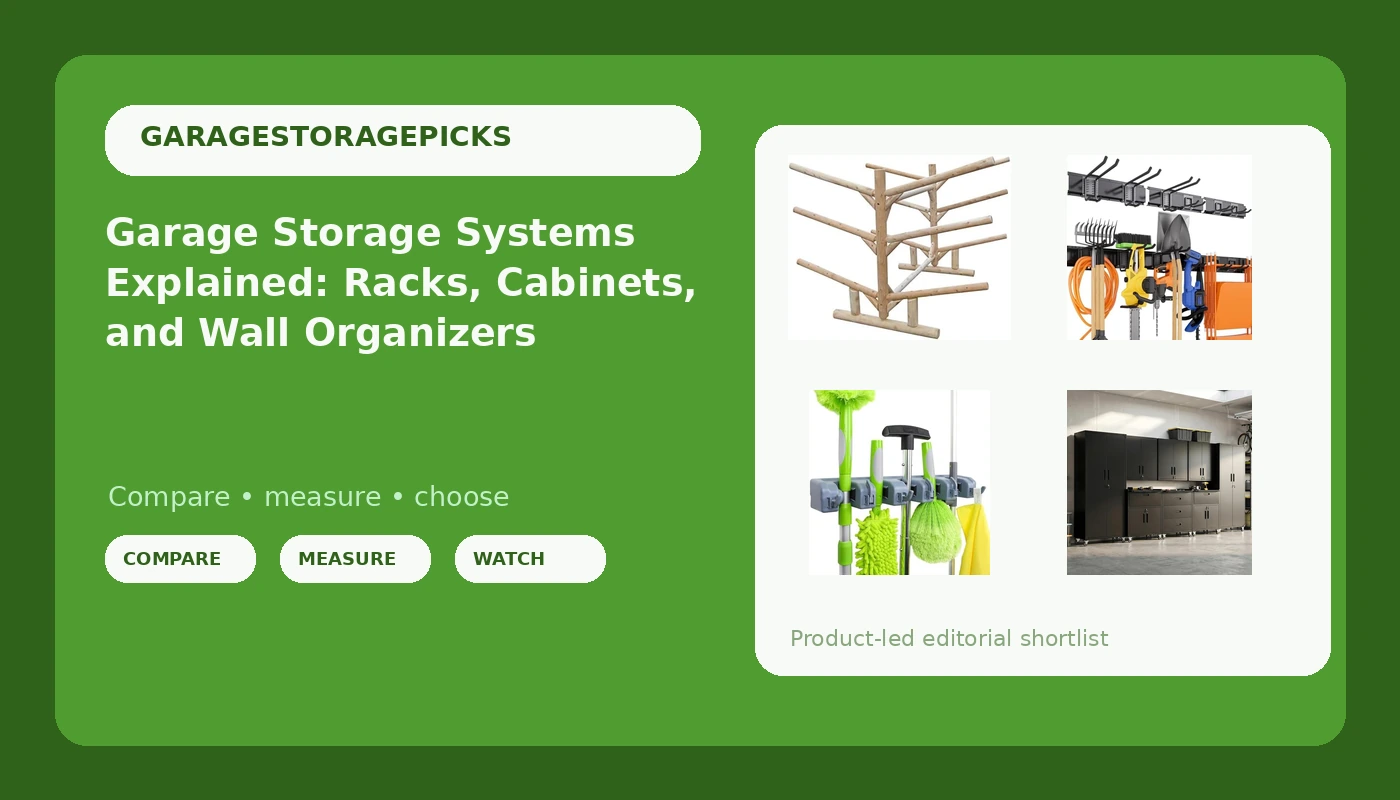
A garage that works is not a garage with more shelves. It is a garage where every load sits on hardware chosen for that load. Garage storage systems tend to fail in a predictable order: the bracket bends, the track pulls out of the drywall, the shelf sags, and then the whole wall gets written off as a bad idea. The fix is usually not more storage. It is matching the mount to the weight and to the structure behind it. The four options below cover four separate jobs, paddlecraft, long-handled yard tools, brooms and mops, and a full modular cabinet run, and each one asks something different of your walls and your ceiling.
Related: Overhead Garage Storage: Check Your Ceiling Before You Bolt Anything Up →
Quick answer
Match the rack to the load, then match the anchor to the wall. Freestanding racks carry canoes, kayaks, and paddle boards without touching a stud. Wall-mounted organizers are only as strong as the fasteners holding them, so a heavy rating means little until the rail is lagged into studs or into blocking you added on purpose. Cabinets are the answer when you want contents out of sight and out of the sawdust. None of these four products replaces the others; they solve different problems in the same room.
Four useful options
| Model | Best fit | What stands out |
|---|---|---|
| Garage Cabinet System, Heavy Duty Steel All-in-One Modular Garage Cabinet Set with Tool Bench | A workshop that needs closed storage plus a work surface | Modular all-in-one steel set that includes a tool bench |
| 2 Canoes + 4 Kayak/SUP Log Racks, Freestanding Log Kayaks Garage Storage Rack | Paddlecraft that lives indoors | Freestanding log-style rack, so no wall mounting is required |
| INCLY Garden Tool Organizer, 48 Inch Garage Tool Organizer Wall Mount | Long-handled yard tools | 48-inch wall organizer with 3 storage racks and 6 adjustable hooks |
| Amazon Basics Rectangular Heavy Duty Wall Mount Broom and Mop Holder | Brooms, mops, and short handles | Compact wall holder with hooks and slots |
The full system: Garage Cabinet System, Heavy Duty Steel All-in-One Modular Garage Cabinet Set with Tool Bench
Cabinets do something racks cannot: they put a door between your tools and the dust that settles on everything in a garage. That matters more than most people expect, because a garage is a room with a car-sized opening in it and a concrete floor that sheds grit year round. A cabinet run also gives you a bench, which is the surface you actually use when you are sharpening a blade or sorting fasteners. The trade-offs are weight and footprint. A steel cabinet set occupies floor space that a wall rack would leave open, and it has to sit on a slab that is almost certainly pitched toward the door, so plan on shimming the run level. Buy cabinets when the problem is clutter you want hidden. Skip them when the problem is a kayak.
The paddlecraft rack: 2 Canoes + 4 Kayak/SUP Log Racks, Freestanding Log Kayaks Garage Storage Rack
This is the one category where going freestanding is a genuine structural advantage. Boats are long, awkward, and heavy, and hanging them from a wall means you are loading the wall in a direction it was never framed for. A freestanding log rack stands on the slab and carries the load down to the floor, which is the part of your garage that is actually designed to hold weight. The trade-off is floor area: the rack takes up a footprint in the middle or along a wall, and you have to be able to walk around it. Check your ceiling height against the length of your boats before you commit, and leave enough room to lift a hull on and off without scraping the door track.
The long-tool rail: INCLY Garden Tool Organizer, 48 Inch Garage Tool Organizer Wall Mount
Long-handled tools are the hardest thing to store well because they are all handle and no body. Leaning them in a corner means they fall over, and a five-gallon bucket is not storage, it is a trip hazard. A 48-inch rail with adjustable hooks lets you space the hooks to the tools you actually own instead of fighting a fixed pattern. The number on this listing is 390 pounds, and that figure is only meaningful if the rail is fastened into studs or solid blocking. Distributed along a rail lagged into two or three studs, that is a realistic load. Concentrated into one hook with the supplied drywall anchors, it is not. The adjustability is the feature that matters most here, because your tool collection will change.
The small holder: Amazon Basics Rectangular Heavy Duty Wall Mount Broom and Mop Holder
Not every storage decision needs a structural conversation. Brooms, mops, and dusters weigh almost nothing, and the reason they end up on the floor is that nobody gave them a home. A compact holder solves that in about a square foot of wall. It is also the piece that travels well between rooms, which is why the listing mentions laundry and kitchen alongside the garage. Do not expect it to carry a shovel collection; that is what the 48-inch rail is for. Do expect it to clear the corner where the mop has been falling over since you moved in.
Prices and availability may change. Product images, names, and retailer links are matched to verified listings. No current price, rating, stock status, or measured result is stated here without current evidence.
Why the mounting hardware is the whole game
Every wall-mounted organizer here hangs from something, and that something decides whether the printed rating means anything. Garage walls are typically framed with 2x4 studs at 16 inches on center, sometimes 24, and the drywall between them holds very little in tension. The plastic anchors that ship in the box are the wrong answer for anything heavier than a broom. Lag bolts or structural screws driven into studs, or into blocking you added yourself, are the difference between a rail that lasts and a rail that visits the floor. Masonry changes the rules again, and there you need anchors rated for solid concrete or block rather than hollow-wall hardware. The floor is the other quiet factor. Garage slabs are pitched toward the door so water drains, which means a freestanding rack or a cabinet run may need shims to sit level. A rack that leans is a rack that is loading unevenly, and uneven loading is how joints and welds fail early.
How to read a weight rating without getting fooled
Ratings describe a best case, and they describe it on the box rather than on the bracket. A 390-pound figure means a distributed load on a rail that was fastened correctly, not one 390-pound item dangling from one hook. Dynamic loads are harder on hardware than static ones: a rake dropped onto a hook, a kayak shoved into a cradle, a mop pushed sideways all concentrate force in ways a slow pull never does. Point loads gather at a single bracket, which is why the fastener pattern matters as much as the steel. Ceiling storage has its own separate limit in dead load, meaning what a joist can hold indefinitely rather than what it survives on install day. Treat every printed number as a ceiling, not a target, and discount it when your mounting is weaker than the manufacturer assumed.
- List what the space has to hold, sorted by weight and by how often you touch it.
- Find the studs before you buy anything, and mark them with tape so the pattern is visible.
- Choose the mount type first: freestanding for boats and heavy awkward items, wall for tools you grab weekly, ceiling only when you can verify the joists.
- Match the fastener to the load and the substrate, and upgrade the included hardware when it does not match.
- Plan for reconfiguration, because the bike collection and the tool collection both grow.
Practical guidance for laying out the room
- Put weekly-use items between knee and eye level, and send seasonal items up or into cabinets.
- Keep heavy items low, especially in a cabinet run, so the load sits over the base rather than over the doors.
- Measure the garage door travel before mounting anything on the ceiling or high on the side walls.
- Leave the floor clear under wall racks so you can sweep, park, and walk without ducking.
- Shim freestanding racks and cabinet runs level rather than trusting the slab to be flat.
- Group by activity, not by material, so yard tools live together and paddle gear lives together.
Which option should you choose?
Choose the Garage Cabinet System, Heavy Duty Steel All-in-One Modular Garage Cabinet Set with Tool Bench when the clutter you want gone is the kind you would rather not look at, and you want a work surface as part of the same run. Choose the 2 Canoes + 4 Kayak/SUP Log Racks, Freestanding Log Kayaks Garage Storage Rack when your problem is boats and you would rather not load a wall with them at all. Choose the INCLY Garden Tool Organizer, 48 Inch Garage Tool Organizer Wall Mount when the shovels and rakes have taken over a corner and you have studs to fasten into. Choose the Amazon Basics Rectangular Heavy Duty Wall Mount Broom and Mop Holder when you just need the mop off the floor and out of the way.
A caveat worth stating plainly: the ratings and capacities above come from the product listings, not from an inspection of your wall. Whether any of them holds what it claims depends on the framing behind the drywall, the fasteners you use, and how evenly the load is spread. A stud finder and the right screws cost less than replacing a rack and the tools it was holding.
The bottom line
Garage storage systems are not really about containers. They are about load paths. Freestanding racks send weight straight down to the slab, wall rails send it into studs, and cabinets send it into a base that sits on a pitched floor. Pick the path that matches what you are storing, then spend your attention on the fasteners, because that is where these projects succeed or fail. Get the mounting right and the storage stops being a project you redo every spring.