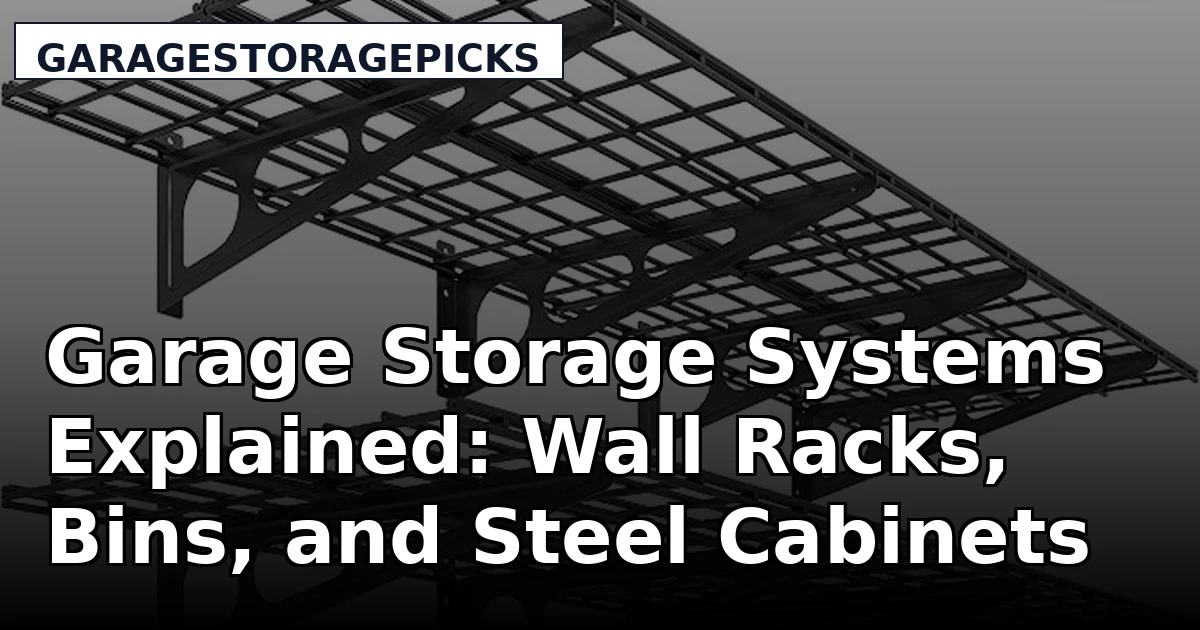
A garage that works starts with one decision: what goes on the wall. Wall mounted garage storage comes in a handful of very different shapes, and the shape you choose decides how much weight the system can carry, how easily you can reconfigure it later, and whether your tools end up behind a closed door or out in the open where sawdust settles on everything.
Most homeowners shop this backward. They buy a rack, install it where it looks right, and only then find out that the shelf they picked is too shallow for a cooler, that the track has nothing to do with where the bikes actually live, or that the mounting hardware in the box was never meant for the load they had in mind. The four options below are genuinely different answers to the same problem, and the right one depends far less on brand than on what you are asking the wall to hold.
Related: How to Find Studs and Joists Before You Mount Anything →
Quick answer
Match the system to the load before you match it to the wall. For heavy, bulky items that never move, a pair of deep wall shelves gives you the most usable surface. For long-handled tools and gear that changes with the season, a track-based hanging kit gives you a system you can rearrange without patching drywall. For fasteners, fittings, and small parts, a wall-mounted bin rack keeps hardware visible instead of buried in a coffee can. For a workshop you want to look finished and keep clean, a steel cabinet set with a built-in bench is the all-in-one answer. In every case, the bracket and the stud behind it decide what the system really holds, not the number printed on the box.
4 useful options
| Model | Best fit | What stands out |
|---|---|---|
| FLEXIMOUNTS 2-Pack 2x6ft Garage Shelving | Heavy, bulky loads that stay put | Two 24-by-72-inch shelves with a 1400-pound listed load capacity |
| Rubbermaid FastTrack Garage Storage System Tool Hanging Kit | Long-handled tools and seasonal gear | Built around the FastTrack system for garden and lawn tools |
| HORUSDY Wall Mounted Storage Bins Parts Rack 30PC | Small parts, fasteners, and shop hardware | 30-piece plastic bin rack in blue, orange, and red |
| Garage Cabinet System | A finished, enclosed workshop | Heavy duty steel modular cabinet set with a tool bench |
The heavy-duty shelf option: FLEXIMOUNTS 2-Pack 2x6ft Garage Shelving
Two 72-inch shelves give you roughly twelve linear feet of storage at whatever height you choose, and the 24-inch depth is the part worth thinking about before you drill anything. Deep shelves hold coolers, stacked totes, and lumber offcuts. They also collect whatever you toss at them, and a deep shelf mounted high on the wall is a reliable way to store things you will not see again for three years. Set them so the bottom of the shelf clears the tallest thing you park underneath, including an open hatch or a bike handlebar.
The 1400-pound figure is where people get into trouble, because a load rating describes the shelf, not your wall. A shelf rated for that much, lagged into two or three solid studs with hardware sized for the job, is a completely different animal from the same shelf hung with whatever general-purpose anchors were rattling around in a drawer. The rating is a ceiling, and the fasteners set the floor. If you cannot find solid framing where you want the shelf, move the shelf rather than downgrade the hardware.
The flexible hanging option: Rubbermaid FastTrack Garage Storage System Tool Hanging Kit
Track systems exist because garages change. The rake goes up in October, the bikes come down in April, and a shelf bolted to the wall at a fixed height cannot follow any of that. A track gives you a rail with hardware that moves along it, so reconfiguring is a matter of sliding something over instead of spackling holes. FastTrack is the value end of that idea, and it earns its place for shovels, hoses, trimmers, and bikes.
The trade is material. A track system is only as strong as the rail and the fasteners holding it, and the honest way to think about it is this: long-handled tools and garden gear are light, awkward loads, not heavy ones. They need somewhere to hang so they stop leaning in a corner, and that is exactly what a hanging kit does well. If you want to hang a loaded tool chest or a stack of tires, this is not that product, and no amount of clever hooks changes it. Mount the rail into studs or solid blocking, spread the load across two or more fasteners, and this is the option that keeps paying you back every time the seasons turn.
The small-parts option: HORUSDY Wall Mounted Storage Bins Parts Rack 30PC
Every garage has a hardware problem, and it is never about volume. It is about the fact that the one anchor you need is at the bottom of a bucket containing four hundred other anchors. A bin rack fixes that by sorting small parts into individual containers and hanging them where you can see the contents. Thirty bins is enough to separate screws by length, keep anchors apart from washers, and stop the box of random electrical connectors from becoming a permanent mystery.
Small parts are also the one category where a wall system can be forgiving. Bins hold ounces, not hundreds of pounds, so the mounting demands are modest compared with a shelf or an overhead rack. That said, a rack loaded with thirty bins of screws and bolts is still a load on a wall, and gravity does not care that each individual piece is small. Hit studs if the rack is wide enough to reach them, use fasteners rated for the total weight, and mount it at eye level near the bench so you are not bending down every time you need a #8 screw.
Prices and availability may change. Product images, names, and retailer links must be matched by verified ASIN. Do not state a current price, rating, stock status, or measured result without current evidence.
The enclosed option: Garage Cabinet System
Open shelves are honest and cheap. Cabinets are neither, and they are worth it for one reason: doors. Anything stored on an open shelf in a working garage collects sawdust, overspray, and the fine grit that finds its way into every corner. If you cut, sand, or grind anywhere near your storage, closed storage means you open a door to clean tools instead of wiping down everything you own.
A cabinet set is also the option with the biggest footprint commitment, so measure before you commit. You are giving up wall length and floor depth, and you are buying a piece of furniture that has to sit on a slab that probably pitches toward the door. Cabinets that are not shimmed level will rack, and doors on a racked cabinet do not close cleanly no matter how good the hinge is. Set them on a level base, leave yourself a bench height that suits how you actually work, and treat the modular layout as a plan you are committing to rather than a kit you can rearrange on a whim. If your needs change often, a track system plus shelves is the more flexible use of the same wall.
What a load rating actually measures
A load rating on a storage product describes the shelf or the rack, tested or calculated in isolation. It says nothing about the structure you attach it to, and that is where almost every garage storage failure starts. Garage walls are usually framed with studs at 16 or 24 inches on center behind half-inch drywall. Drywall alone holds a picture frame. It does not hold a shelf rated for hundreds of pounds, and it certainly does not hold an overhead rack, which is why drywall anchors marketed for ceiling storage are one of the most reliable ways to damage a garage ceiling and whatever is under it.
Two numbers matter more than the rating on the box. The first is fastener pull-out strength, which is a function of how deep the screw or lag goes into solid wood and how much wood it engages. The second is how the load is distributed. A 1400-pound shelf spread evenly across two or three studs behaves very differently from the same shelf loaded with one 200-pound engine block in the middle of the span. Concentrated loads bend brackets and pull fasteners in ways an evenly loaded test does not.
There is also the question of what a system holds over time, not on install day. Shelves creep. Fasteners loosen. Wood shrinks as it dries out. Anything mounted overhead deserves a check with a level a month after installation and once a season after that, and any rack that has visibly sagged should come down and be remounted rather than trusted. Weight ratings are a starting point for planning, not a promise about your wall.
Planning the wall: zones, heights, and reach
The fastest way to make a garage feel organized is to stop thinking in products and start thinking in zones. Weekly items belong at eye level, roughly between hip and shoulder height, where you can grab them without a ladder or a squat. Seasonal items go high, close to the ceiling, where they are out of the way for months at a time. Heavy, awkward items belong low, on the floor or on a shelf near it, because lifting a cooler down from head height is how people get hurt.
The vertical space above a parked car is the most wasted real estate in most homes, but it comes with rules. Anything overhead needs a clear path to the garage door tracks, the opener rail, and the door itself in its raised position. A shelf that looks fine when the door is down can be a collision when it comes up.
A five-step approach that works on almost any wall:
- Find the studs first, with a stud finder and a confirmation nail, and mark them with tape so you can see the framing while you plan.
- Measure the wall and decide which zone each category of stuff belongs in: weekly, seasonal, heavy, small parts.
- Match the mounting method to the load, not to the product. Heavy loads get lag hardware into studs, always.
- Check clearance for doors, cars, mirrors, and the garage door travel before you commit to a height.
- Install the heaviest item first, load it, and check it with a level before you build around it.
Practical guidance before you buy
- Measure your wall in linear feet and your stud spacing before shopping, because a 72-inch shelf has to land on framing to be worth owning.
- Decide up front whether you need flexibility or capacity. Track systems reconfigure; deep shelves hold more.
- Keep 24 inches or more of clear floor depth in front of anything you will need to reach regularly.
- Plan for the pitch of the slab. Cabinets and benches need shims to sit level, and doors do not close well on an unlevel box.
- Group small parts near the bench at eye level, not across the garage, or the bins become decoration.
- Recheck overhead mounting hardware after the first month and again when the seasons change.
Which option should you choose?
Choose the FLEXIMOUNTS 2-Pack 2x6ft Garage Shelving when you have bulky, heavy items that stay put and a wall with accessible studs. Choose the Rubbermaid FastTrack Garage Storage System Tool Hanging Kit when your storage needs shift with the seasons and you want to rearrange without patching holes. Choose the HORUSDY Wall Mounted Storage Bins Parts Rack 30PC when the problem is small hardware rather than big objects. Choose the Garage Cabinet System when you want the mess behind doors, you have the floor space for a bench, and you are ready to commit to a layout.
One caveat applies to all four: the ratings and descriptions here come from the product listings, not from a controlled load test on your wall. Your framing, your fasteners, and your slab decide the outcome.
The bottom line
A garage storage system is not a product, it is a set of decisions about weight, height, and access. Shelves hold the heavy, awkward things. A track system handles the long tools you swap out twice a year. Bins organize the small parts that otherwise live in a bucket. Cabinets hide the whole operation behind a door. Pick the shape that matches what you actually own, mount everything into solid framing with hardware that matches the load, and the system will outlast the garage.