Related: Best Overhead Garage Racks for Real Loads
I have framed, wired, and finished garages around Columbus for twenty years, and I have never once seen garage storage cabinets and bins fail because of the cabinet. They fail because of the wall behind them. A shelf does not sag on its own. It sags because somebody put a bracket into drywall, hung a tool chest on it, and called it a day.
So when I lay out a garage now, I work in three layers. Closed storage for anything you do not want covered in sawdust. Open shelving for the things you grab every week. Totes and bins for the seasonal pile that keeps growing no matter how many times you swear it will not. The four products below cover all three layers, and none of them need a proprietary accessory to do their job.
None of this is a weekend project. Budget two weekends, a stud finder, a level, a shim pack, and a helper. The helper matters more than the level.
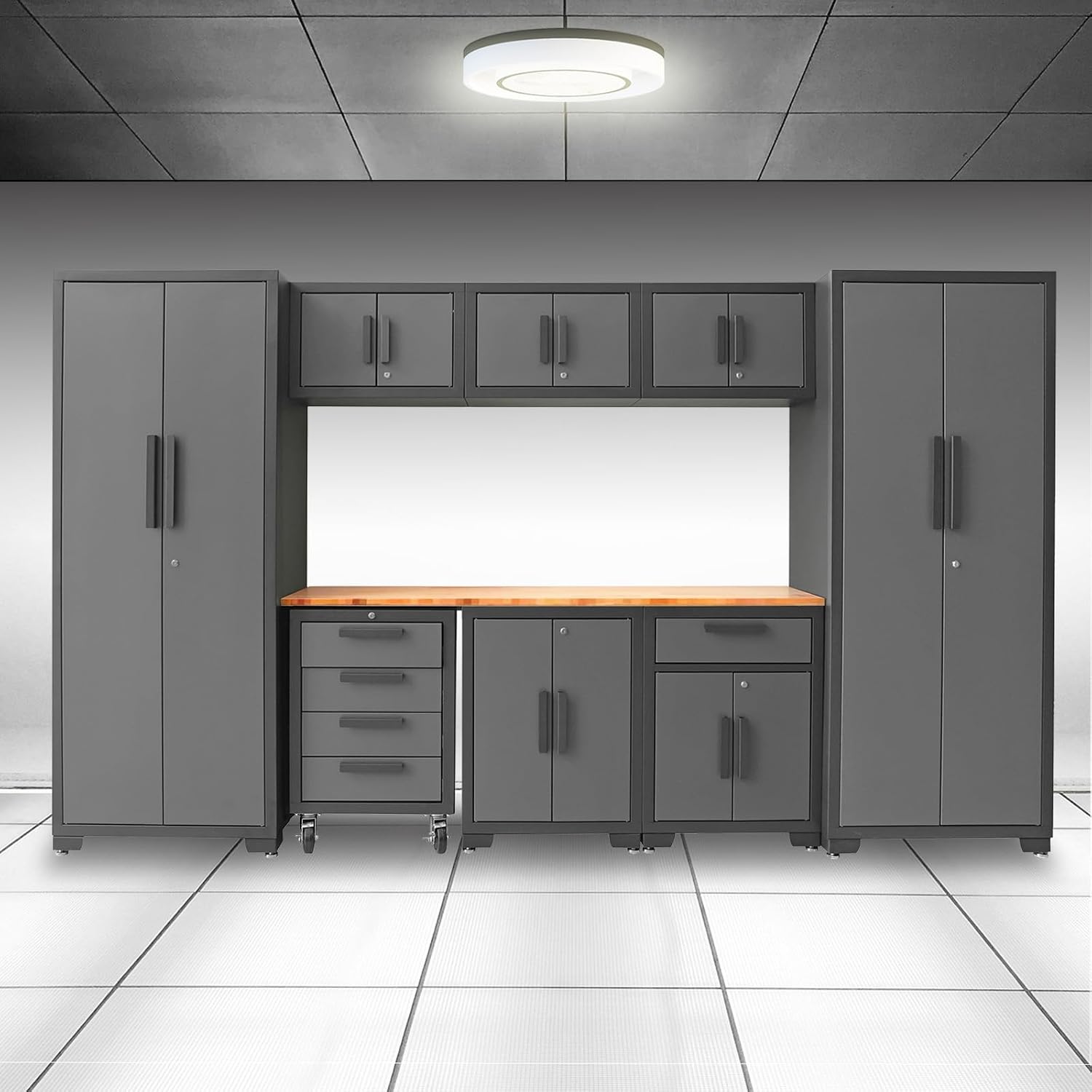
The cabinet wall: Torin Garage Storage Cabinets System, 9 Piece Workshop Cabinet Set in Black
A nine piece set is the difference between a garage that has storage and a garage that has a system. Cabinets beat open shelves for anything you do not want covered in sawdust, and that list is longer than most people admit: power tools, paint cans, camp gear, the good extension cords.
The reason to buy a matched set instead of four mismatched boxes is layout. Nine pieces means you can run a wall of base units with uppers over them, leave a gap for the shop vac, and still have a drawer bank near the door. You are building a wall, not buying a shelf. If your garage is a two car with a workbench at the back, this is the layer that makes the rest of the plan possible.
Two things I would tell you before you order. First, steel cabinets of any brand need to sit on a flat plane, and a garage floor pitches toward the door for drainage. Shim the front until the doors swing evenly, or you will fight the hinges forever. Second, budget steel is honest steel. The welds are not furniture welds. They hold, they are just not pretty, and you are the only person who will ever look at them. Torin is the best budget steel I have run across for this exact reason: it does not pretend to be something it is not.
Get a helper for the upper units. Not because they are heavy, but because holding a cabinet level while you mark holes is a two person job.
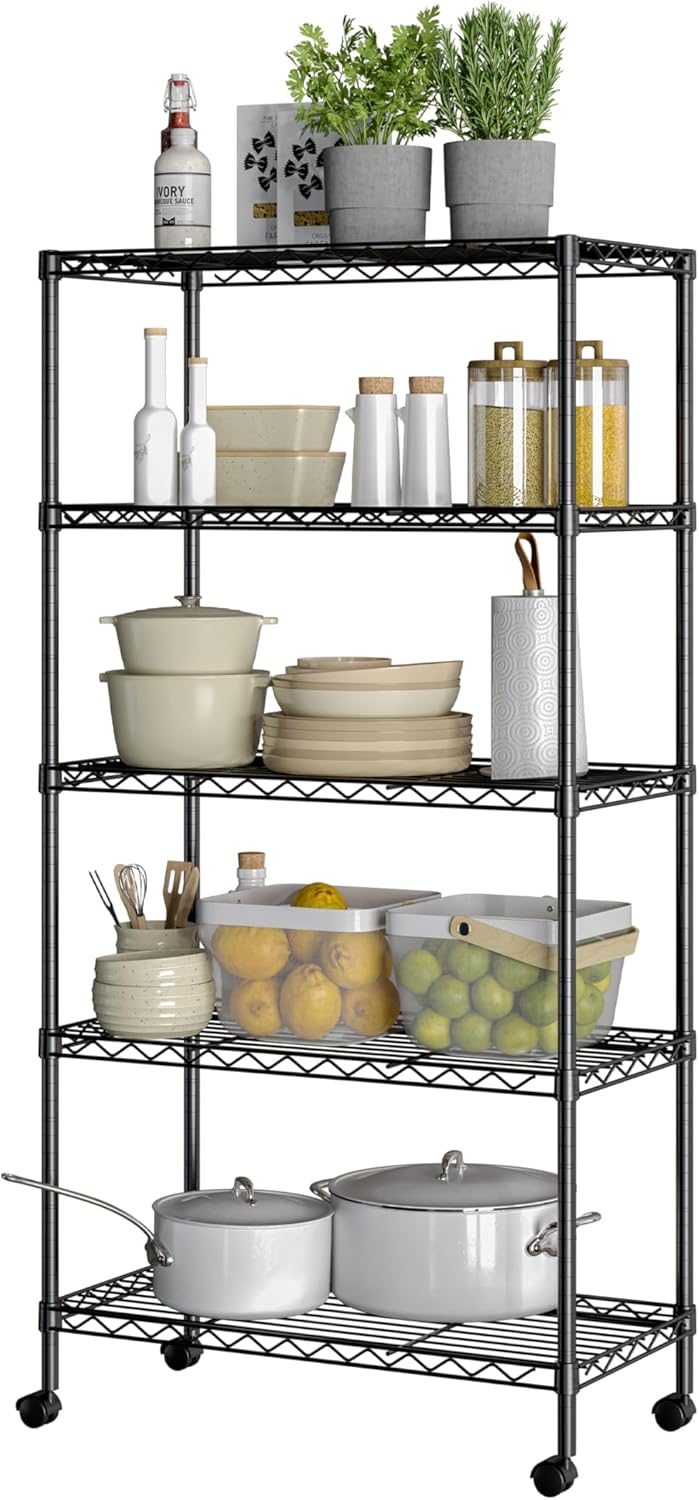
The grab shelf: 5-Tier Steel Wire Shelving, 30" W x 14" D x 61.5" H, Black
Fourteen inches of depth is the number that matters here. A shelving unit that deep tucks against a wall or beside the water heater without stealing parking space, and 30 inches wide means you can walk past it with an armload. Five tiers at 61.5 inches tall puts the top shelf just under eye level for most adults, which is exactly where seasonal stuff belongs.
Wire has two advantages over solid shelving in a garage. Dust and grit fall through instead of collecting on the shelf, and you can see what is on the third tier without pulling everything off the second. In a garage, visibility is organization. If you cannot see it, you buy a second one.
The feet are the part people skip. These units have adjustable feet for a reason, and that reason is your garage floor. Level the unit first, then load it. And load it from the bottom up. Heavy items low, light items high, and nothing over the top tier unless you want to find out what a tipped shelving unit sounds like at 6 a.m.
This is the unit I would put next to the workbench. It is not a substitute for the cabinet wall, and it is not supposed to be. It is the layer you touch every day.
The deep storage workhorse: Sterilite Tote, Plastic Storage Bins with Snap Lids, 30 Gallon, 6-Pack
I give plastic storage a hard time, and I stand by most of it. Where I do not stand by it is totes. A tote is a box that closes, and a box that closes is the only thing standing between your holiday decorations and a family of mice.
Snap lids are the feature to look for. A friction lid sits on top of the bin and hopes. A snap lid grabs the rim on all four sides, which keeps dust out and makes the stack stable when you slide one out from the middle. Six identical totes is not a coincidence either. Identical bins stack square, and a square stack against a wall reads as a system instead of a pile.
Thirty gallons is the size that holds a full season of decorations, a set of winter coats, or roughly one teenager's worth of sports gear. Label the short end, not the lid. You will be reading the stack from the aisle, and you will never want to unstack six totes to find out which one has the lights in it.
Do not put these on the top shelf of anything. They are light when empty and heavy when full, and that is the worst combination for overhead storage.
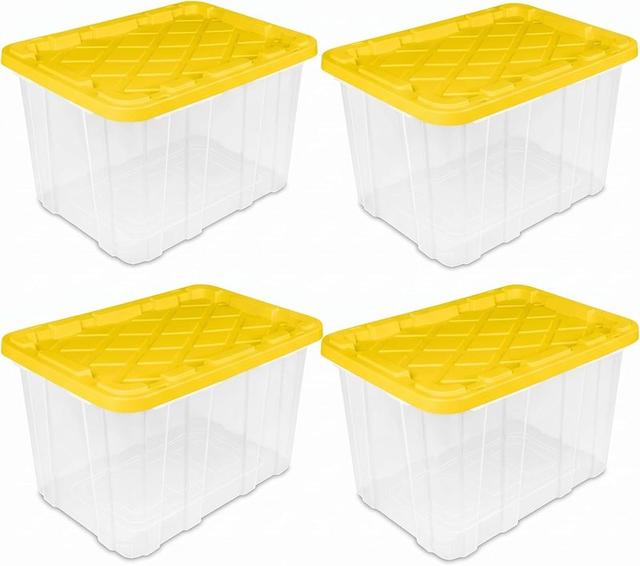
The heavy layer: Large Industrial Storage Bins with Lids, 27 Gallon Clear Plastic Tote, Yellow, 4-Pack
These are the bins that live on the floor, and the floor is where the real weight goes. Heavy duty stackable totes in a 27 gallon size are built for the bottom layer of the pile: the camping gear, the tile saw, the boxes of flooring you swear you will use someday.
Clear sides are the upgrade people underestimate. With opaque bins you label and hope. With clear bins you look. When you are hunting for one specific thing in a stack of four, clear plastic saves you ten minutes and one bad mood.
Yellow lids are also a small organizational win. Color coding is not decoration, it is a filing system. If yellow means camping and the clear snap-lid stack means holidays, you have just built a search index out of plastic. Stack these two high, three if the bottom one sits directly on concrete. Above three, the stack tips, and a tipped stack behind a car is how people end up with a cracked tail light.
How I size up a garage storage system
Four questions, in this order.
What are the brackets and frames actually made of? Steel beats plastic, always, and the parts you cannot see are the parts that matter. A shelf rated for heavy loads with a plastic bracket is a shelf rated for a brochure.
Does the mounting hardware match the load? Weight ratings printed on the box tell you about the shelf. They tell you nothing about the two drywall anchors in the bag. If a system is going on a wall, it goes into studs, or it goes into proper anchors rated for the load, or it does not go up. Studs are typically 16 inches on center, and a stud finder is the cheapest tool in this entire article.
Can I reconfigure it later? A system you cannot rearrange is just expensive shelving. Shelving units and freestanding cabinets move with you. Wall systems only pay off if you actually move the hooks around as your junk changes.
Would I trust it with my tools? That is the real test. A shelf that holds a box of Christmas lights proves nothing. A shelf that holds a loaded tool chest, or a tile saw, or a stack of lumber, is a shelf you can stop thinking about.
One more thing that is not on any spec sheet: a garage is a climate. It freezes, it sweats, it gets humid in July. Anything you store out there should be in something that closes, and anything metal should be off the floor or on a rack with feet you can level.
Analysis: what the specs do not tell you
The pitch of your floor decides whether cabinets need shims. It is not a defect, it is drainage, and every garage has it. Set the cabinet, check the doors, shim the front corners until they swing even. Ten minutes of shimming saves a year of doors that never quite close.
The ceiling is the other variable. Overhead storage is free real estate until the ceiling sags, and the hardware is the whole game. Do not hang a rack from drywall anchors. Find the joists, bolt into them, and remember that dead load is what your ceiling holds forever, not just on install day. I keep a level on the rack for the first month because sag shows up slowly and quietly.
And then there is the order of operations. Most people buy bins first because bins are cheap and satisfying. That is backwards. Lay out the closed storage and the shelving first, see how much floor you actually have left, then buy totes to fit that footprint. Buying the bins first is how you end up with a wall of plastic and nowhere to walk.
The garage storage reference table
This is the same breakdown I sketch on a scrap of plywood before I order anything. Match the product to the layer, and the layout draws itself.
| Product | Layer | Best for | Where it goes |
|---|---|---|---|
 Visit on Amazon → Visit on Amazon →Torin Garage Storage Cabinets System, 9 Piece Workshop Cabinet Set in Black |
Closed storage | Tools, paint, anything that collects sawdust | Back wall, shimmed level, uppers over base units |
 Visit on Amazon → Visit on Amazon →5-Tier Steel Wire Shelving, 30" W x 14" D x 61.5" H, Black |
Grab shelf | Weekly items, boxed goods, shop supplies | Beside the bench, feet leveled, heavy low |
 Visit on Amazon → Visit on Amazon →Sterilite Tote, Plastic Storage Bins with Snap Lids, 30 Gallon, 6-Pack |
Deep storage | Seasonal decor, coats, soft goods | Mid stack against a wall, labeled on the short end |
 Visit on Amazon → Visit on Amazon →Large Industrial Storage Bins with Lids, 27 Gallon Clear Plastic Tote, Yellow, 4-Pack |
Heavy floor layer | Camping gear, tools, tile, flooring | On concrete, two to three high, never overhead |
Shelving versus cabinets
Wire shelving wins on air, visibility, and price. Cabinets win on dust, security, and looks. If your garage doubles as a shop and everything you own gets covered in sawdust, cabinets are not a luxury, they are maintenance. If your garage is mostly boxes and bikes, shelving and bins will do the job for a fraction of the footprint.
Bins versus totes
Snap-lid totes are the stackable archive. Industrial bins with clear sides are the working layer you dig through. Buy totes for the things you open twice a year, and clear bins for the things you open twice a month. And keep both off the top of anything you had to bolt to a ceiling.
Should you buy the Torin 9 piece cabinet set?
Yes, if you want a closed wall and you are willing to shim it. It is the layer that keeps sawdust off your tools, and a matched nine piece set lets you lay out a real wall instead of lining up four mismatched boxes. Budget steel, honest welds, doors that close.
Should you buy the 5-tier wire shelving?
Yes, for the daily stuff. Fourteen inches deep, five tiers, adjustable feet, and nothing hanging off a stud. Level it, load it from the bottom, and put it where you can reach the third tier without a ladder.
Should you buy the Sterilite snap-lid totes?
Yes. Snap lids are the whole point, and six identical 30 gallon totes stack square against a wall. Label the short end. Do not stack them on a top shelf.
Should you buy the 27 gallon industrial bins?
Yes, for the floor layer. Clear sides, yellow lids, heavy duty walls, and a size that holds real gear. Two high on concrete, three if you are feeling lucky, and never on a rack above your head.