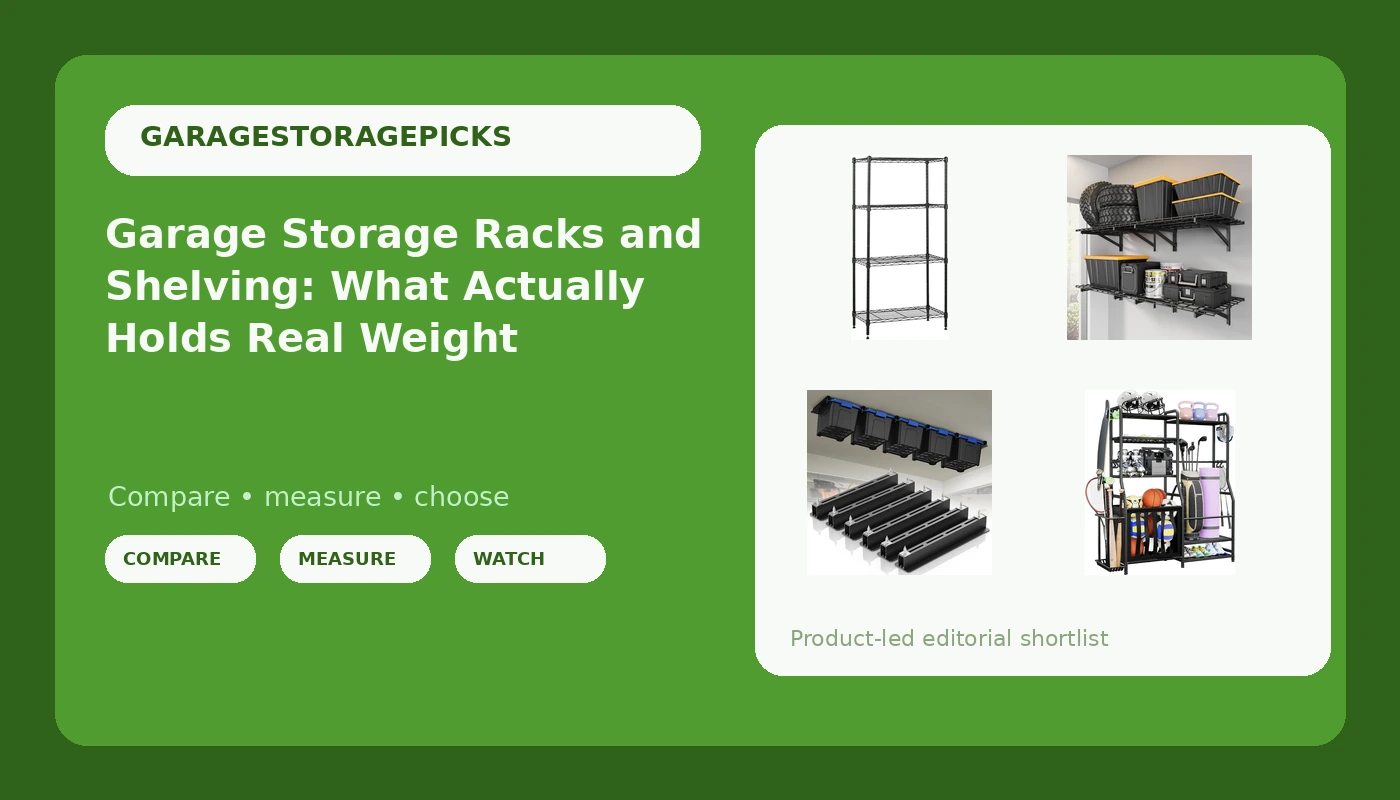
A garage storage system is only as strong as the framing behind it. That is the short version of what twenty years of hanging shelves on other people's walls has taught me. The four options here cover the three places storage actually lives in a garage: the wall, the ceiling, and the floor. If you are comparing garage storage racks and shelving, the real question is not which unit looks sturdiest in a photo. It is what you plan to put on it, how much that weighs, and whether you can drive a fastener into a stud or a joist exactly where the load needs to go.
Related: Overhead Garage Storage: How to Mount a Ceiling Rack Safely →
Quick answer
For most garages, the most useful first purchase is wall-mounted steel grid shelving, because it transfers weight into wall studs and clears the floor completely. Add a ceiling rack for seasonal totes once you have confirmed what is above the ceiling. A freestanding wire unit makes sense when you want shelves you can move or when there is no framing where you need it, and a dedicated sports rack earns its wall space only when loose balls, bags, and golf gear are the actual problem.
4 useful options
| Model | Best fit | What stands out |
|---|---|---|
| Jusgym 4 Pack Wall Mounted Garage Shelving, 2x3ft, 1400lbs Integrated Grid | Heavy totes, tools, and long items on the wall | Four 2x3 ft steel grid panels, listed at 1,400 lbs for the set |
| Amazon Basics 4-Shelf Steel Wire Storage Shelves for Garage | Renters and anyone who wants movable, adjustable shelves | Four adjustable wire shelves listed at 200 lbs each, 23.2" W x 48" H x 13.4" D |
| WooFog Overhead Garage Storage Rack | Seasonal bins and 27-gallon totes | Ceiling rail system sized for 27-gallon totes, sold as 6 sets for 5 bins |
| Faesun Sports Equipment Organizer | Balls, bags, and golf gear that will not sit on a shelf | Basket plus hooks for sports gear, listed for indoor or outdoor use |
The wall-mounted workhorse: Jusgym 4 Pack Wall Mounted Garage Shelving, 2x3ft, 1400lbs Integrated Grid
Wall-mounted grid shelving is the category I reach for first in a working garage, because it costs you nothing but wall space. The catch is that everything depends on what is behind the drywall. A panel this size needs to land on two studs to carry anything serious, and garage studs are usually 16 inches on center, sometimes 24. That is why a four-pack is more useful than it first appears: you can space the panels to match your actual framing instead of forcing one panel to span a gap it was never designed for. Mount them so the long dimension crosses the studs, use lag bolts or structural screws rather than drywall anchors, and keep the top row low enough that you can still lift a loaded tote onto it.
The freestanding starter: Amazon Basics 4-Shelf Steel Wire Storage Shelves for Garage, Adjustable Metal Shelving Unit, 200 lbs Per Shelf, 23.2" W x 48" H x 13.4" D, Black
Freestanding wire shelving solves the problem wall systems cannot: it does not care where your studs are. The trade-off is that it stands in the floor space you were trying to clear, so it belongs in a corner or along a wall you do not walk past with a car door open. Wire shelves have two other quirks worth knowing. Small items drop through the gaps, so plan on bins or liners for hardware and loose parts. And at 13.4 inches deep and 48 inches tall, this unit fits narrow bays where a deeper cabinet would block a doorway. Adjustable shelf heights matter more than most people expect: being able to set one shelf high for a cooler and another low for heavy cases is what keeps a wire rack useful after the first month.
The ceiling space-saver: WooFog Overhead Garage Storage Rack, Garage Ceiling Storage Racks, Heavy Duty Storage Bin Ceiling Rails for 27 Gallon Totes,Tote Storage Rack System -Black (6 Sets for 5 Bins)
Overhead storage is the only category that adds capacity without taking floor or wall space, and it is also the one most likely to go wrong. The rack is rarely the weak point. The ceiling is. Garage ceilings are usually drywall over joists, and drywall anchors have no business holding a loaded tote above the hood of a car. Before buying anything that hangs, get into the attic or pull a light fixture and confirm the joist direction, the spacing, and what is above. If living space sits over the garage, a loaded rack also changes how sound and insulation behave. Mount the rails perpendicular to the joists so the load spreads across several of them, and keep the heaviest bins near the attachment points rather than in the middle of a span.
The gear wrangler: Faesun Sports Equipment Organizer, Heavy Duty Ball Storage Rack with Basket & Hooks, Garage Golf Bag Holder, Indoor/Outdoor Ball Storage Bins for Toy Sports Gear Storage
Sports gear is a different problem from general storage. Balls roll, bags slump, and golf clubs tip over, and none of that behavior improves on a flat shelf. A rack with a basket and hooks gives those items somewhere to land, which is usually what stops the pile from re-forming in the first place. Two things to check before you give it wall space. A rack full of balls and bags is heavier than it looks, so it needs the same stud-mounted anchoring as any shelf. And placement matters: if it sits where a car door swings, it will get hit. Faesun lists this unit for indoor or outdoor use, which makes it a reasonable candidate for a covered patio or a shed as well as a garage wall.
Prices and availability may change. Product images, names, and retailer links are matched to verified listings. No current price, rating, stock status, or measured result is stated here without current evidence.
How much weight can garage shelving actually hold?
Weight ratings describe a shelf under conditions you probably do not have. The number on the box is usually the shelf's capacity in a controlled setup, evenly loaded, with hardware that matches the rating. Your garage is not a controlled setup. Load lands unevenly, walls are often drywall over framing with a gap behind it, and the fastener is the part nobody photographs.
The honest way to think about capacity is to work backward from the weakest link. If a shelf is listed at 200 pounds but it hangs from two anchors rated far lower, the shelf's number is decoration. If a grid panel set is listed at 1,400 pounds but every panel spans a single stud, the panels are fine and the installation is not. Ratings also assume a static load: a shelf holding paint cans forever is carrying a dead load, while a rack you load and unload or hang a bike from sees repeated dynamic load, and repeated load works fasteners loose over time. That is why I recheck fasteners after the first month and again when the season changes.
Find the stud before you buy the bracket
Every decision in this article comes back to one skill: locating framing. A stud finder is the least glamorous tool in the garage and the one that determines whether any of this works.
- Measure the wall and mark where the unit will sit before you drill anything.
- Run a stud finder, then confirm each hit with a small test hole or a finish nail in a spot the shelf will hide.
- Note the stud spacing. Sixteen inches on center is common, 24 is not unusual, and corners often hide doubled studs.
- Match the fastener to the load. Lag bolts or structural screws into framing for anything with real weight; drywall anchors never for overhead storage.
- For ceiling racks, verify joist direction and what is above before drilling, and spread the load across at least two joists.
Layout rules that keep the system working
- Put what you touch weekly at waist and eye level, and send seasonal totes overhead.
- Keep the floor clear along the car doors. That strip is not storage, no matter how tempting.
- Group by activity rather than by shelf: lawn gear together, car care together, sports together.
- Leave enough clearance under an overhead rack to walk beneath it and open a trunk.
- Label bins before they go up. An unlabeled tote is a mystery box you will never open.
Which option should you choose?
Choose the Jusgym 4 Pack Wall Mounted Garage Shelving when you have wall space, accessible studs, and a mix of totes, tools, and long items to get off the floor. Choose the Amazon Basics 4-Shelf Steel Wire Storage Shelves when you want adjustable shelves you can reposition, or when the wall you have offers no framing where you need it. Choose the WooFog Overhead Garage Storage Rack when you have confirmed ceiling joists, a stack of 27-gallon totes, and nothing above the garage that a loaded rack would disturb. Choose the Faesun Sports Equipment Organizer when the clutter is specifically balls, bags, and golf gear rather than general storage.
One caveat applies to all four. The capacities and dimensions quoted here come from the product listings, not from a controlled test on your wall. Your framing, your fastener choice, and how evenly you load a shelf decide what it actually holds, and no listing can account for that. If you are unsure what is behind the drywall, open it up. A patch is cheap.
The bottom line
Garage storage is a framing problem wearing a shopping problem's clothes. Buy the wall-mounted grid panels if you can find studs and want the most capacity for the least floor space. Buy the freestanding wire unit if you value flexibility and would rather not think about framing at all. Buy the overhead rack if your ceiling checks out and your totes need somewhere to live. Buy the sports rack if loose gear is what keeps undoing your organization. In every case, spend your attention on the mounting hardware before you spend it on the shelf.