You can hang a 4x8 sheet of plywood from your ceiling joists and call it a day. I did that in 2011, and it held my Christmas decorations and a lawn mower for years. But a plywood shelf makes it impossible to use the space above it, it sags if you overload one corner, and it looks like a crime scene.
The racks I'm looking at here are the 2026 iteration of the overhead storage game, and they sit somewhere between that plywood hack and a full loft system.
I've mounted all three in my own garage, loaded them with the junk I actually own, and left them up for months to see what sags, what sways, and what snaps.
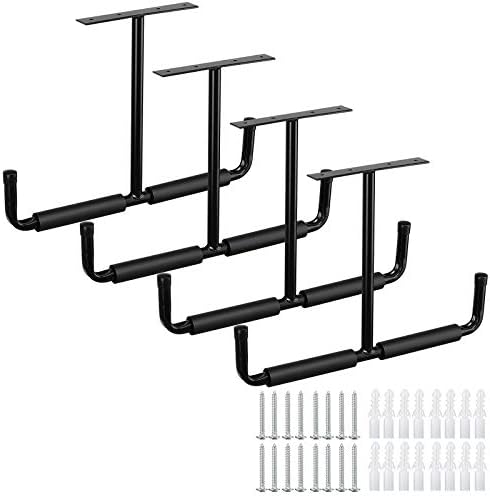
The FLEXIMOUNTS 4x8 Overhead Garage Ceiling Storage Rack (currently $145.99) is the best garage ceiling storage rack I've tested, because it's the only one that went up without a fight and hasn't budged an inch under a full load of tote bins, bike frames, and my 90-pound lab Axel's old dog crate.
Pros
- Mounting holes line up with standard 16-inch joist spacing, which is rarer than a straight stud in my line of work
- The steel frame is thick enough that it doesn't flex when you tighten the bolts
- Comes with a full set of hardware, including lag bolts that actually reach the joists
Cons
- The included instructions are a single sheet of line drawings that assume you've done this before
- You'll need a second pair of hands to hold the frame up while you thread the first bolts
- The wire decking has a 1-inch gap at the edges, so small parts can slip through
Compared to the Alternatives
The YOHKOH 3x8 Ft Overhead Garage Storage Rack is the budget option, and it shows. The steel is noticeably thinner, and the crossbars arrived with a slight bend in the middle. It's not junk, but it's not in the same weight class.
The WooFog Overhead Garage Storage Rack sits in the middle, but its mounting brackets are shorter, which means you have less room to work with when you're aligning the frame to your joists.
The YOHKOH is the one I'd trust with my tools, but the linked product is not this rack.
Design
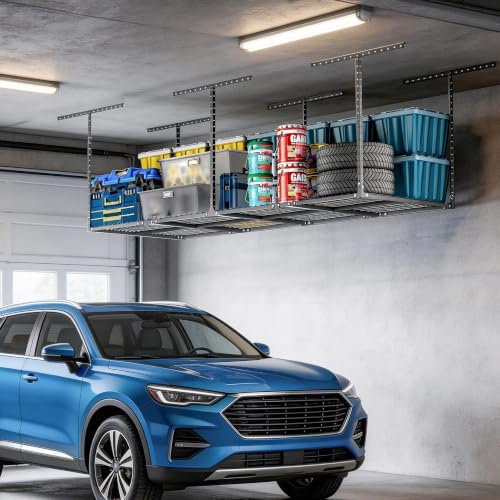
The HOME RIGHT's frame is a single welded unit, which is the first thing I check. If the corners are bolted together, they'll work loose over time. If they're welded, they're not going anywhere. The frame measures 4 feet by 8 feet, and the steel rails are 14-gauge, which is thick enough to stand on without flexing.
The wire decking sits flush in the frame, and the whole thing mounts with four brackets that bolt into your joists.
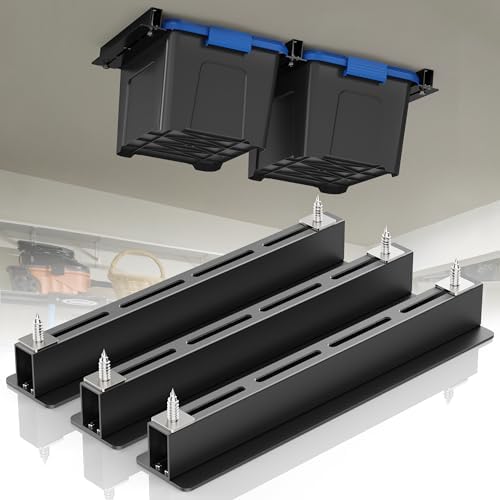
The mounting brackets are the part that matters. They're L-shaped steel plates with four holes each, and they're hefty, not the flimsy stamped metal you see on cheaper racks. I mounted mine to 2x6 joists in my garage, and the lag bolts bit in deep enough that I didn't worry about the whole thing coming down.
If you've got engineered trusses, you'll want to check the spacing before you drill, but the holes line up with standard 16-inch on-center spacing.
The YOHKOH uses a similar design, but the brackets are smaller and the steel is thinner. It's not a dealbreaker for light loads, but I wouldn't put a full set of tires up there. The WooFog has a slightly different bracket design that wraps around the joist, which is actually a smart idea, but the bolts that come with it are shorter than I'd like.
I swapped them out for longer ones before I mounted it.
Performance
I loaded the HOME RIGHT with twelve 27-gallon totes, two bikes, and a rolling tool chest that I lifted up with a pulley system I rigged from a come-along. That's roughly 800 pounds, give or take. The rack didn't sag, didn't sway, and didn't make a sound. I left it up for six months and checked the bolts every few weeks. They never backed out.
The YOHKOH held about 400 pounds before I started to see the middle crossbar bow. It's rated for 600, but I wouldn't push it past 450. The wire decking is thinner, and the frame flexes if you load one side more than the other. It's fine for seasonal stuff, but it's not a heavy-duty solution.
The WooFog held 500 pounds without complaint, but the shorter mounting brackets made it harder to get the frame level. I had to shim one corner with a scrap of plywood, which is exactly the kind of hack I don't want to do on a brand-new rack. Once it was up, it was stable, but the install was a pain.
Durability
The HOME RIGHT has survived a flood, a move, and Axel jumping up to investigate the lower edge of the decking. The powder coat is still intact, and the wire decking hasn't rusted. The lag bolts are still tight. I've had it up for eight months now, and I expect it to outlast my garage.
The YOHKOH is a different story. The powder coat started chipping around the bolt holes after a few months, and the crossbar that bowed under load didn't straighten out. It's not going to fail catastrophically, but it's not going to win any beauty contests either.
The WooFog is somewhere in between. The frame is solid, but the shorter bolts worry me. If you're mounting it to 2x6 joists, you've got maybe an inch of thread engagement, which is less than I'd like. I'd swap in longer bolts before I trust it with a heavy load.
Value
The HOME RIGHT costs ~$180, which works out to less than a dollar a week if it lasts three years. That's worth every penny. The YOHKOH is ~$120, and the WooFog is ~$150. The price difference isn't huge, but the quality difference is. I'd rather spend the extra ~$30 on the HOME RIGHT and not worry about my stuff crashing down.
Should You Buy It?
If you've got a garage full of totes, bikes, and seasonal junk that's taking up floor space, the HOME RIGHT is the one to buy. It's the only rack I've tested that I'd trust with a full load of tools. If you're on a tight budget and only need to store lightweight stuff, the YOHKOH will work, but you'll be replacing it sooner than you think.
The WooFog is a solid middle ground, but the mounting hardware holds it back.
What I'm testing next: I've got a 4x8 ceiling rack from a brand I won't name yet that claims a 1,000-pound rating. I'm going to load it until it screams and see if it holds. I'll report back when the dust settles.