Twenty years of building and reorganizing garages taught me one thing: the difference between garage storage shelves and hoists that survive a decade and the ones that end up on the curb is almost never the shelf. It is the mounting hardware and the load math. I have pulled sagging wire racks off walls where the bracket gave out long before the shelf did, and I have watched a ceiling hoist drop a bike because somebody trusted a drywall anchor on a garage ceiling. This comparison covers four units I would actually consider for a two-car garage: two freestanding shelf systems and two overhead lifting options. Different jobs, same question. What is holding the weight, and what does it look like in year three?
The best first purchase for most garages is the Amazon Basics 4-Shelf Steel Wire Storage Shelves, because 200 pounds per shelf on a narrow 23.2 inch footprint buys four tiers of storage without giving up a parking space. If your problem is overhead rather than floor level, the winch lift kit is the one that changes how the whole garage works.
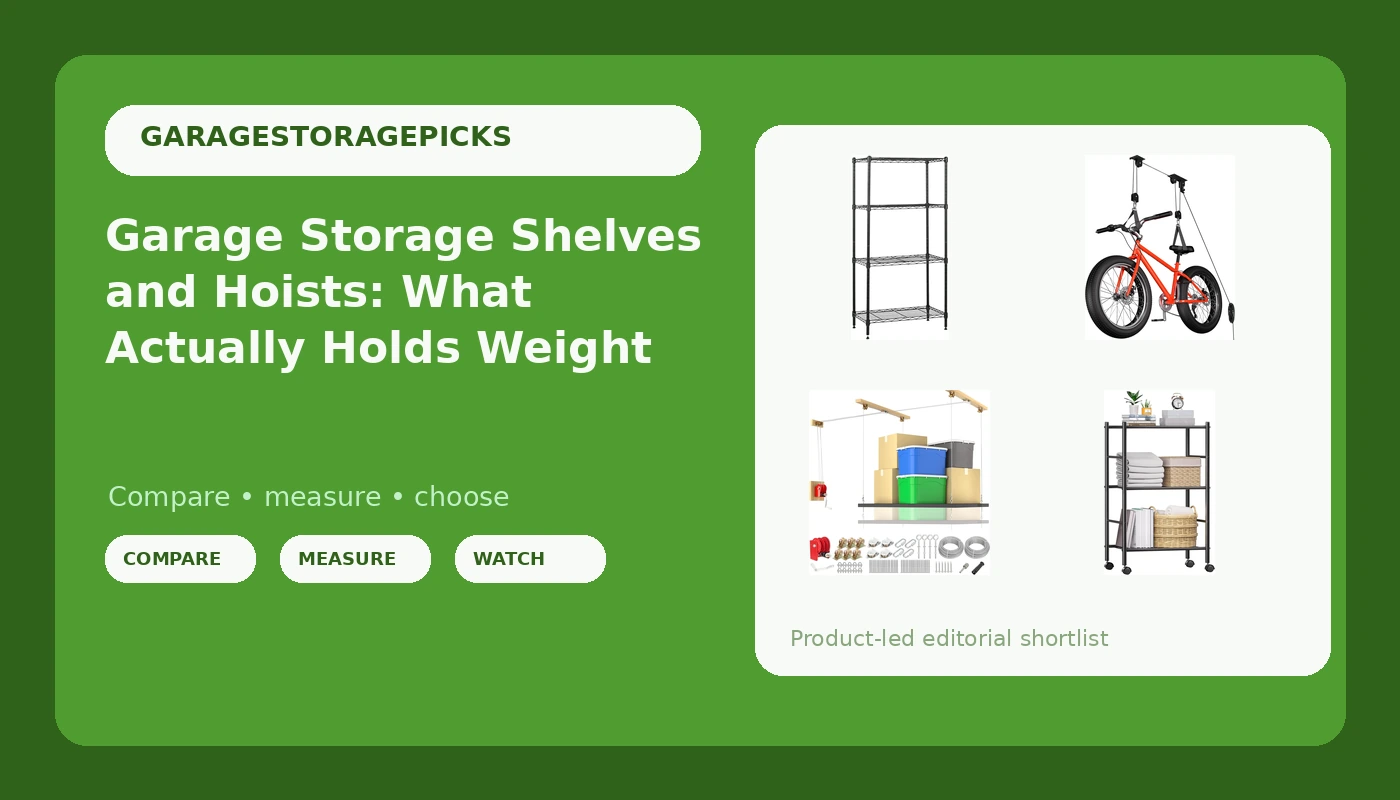
Amazon Basics 4-Shelf Steel Wire Storage Shelves for Garage
200 lbs per shelf rating on a 23.2 inch wide, 13.4 inch deep footprint, four adjustable tiers, and a height of 48 inches that fits under most wall cabinets
Wire lets small parts and screws fall through, there are no wheels, and the rating means nothing if you skip the studs
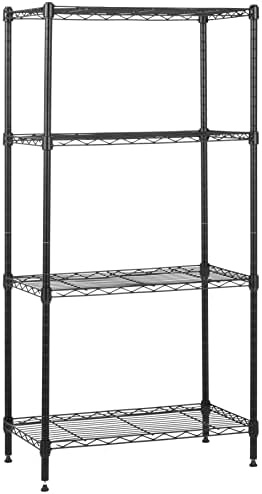
TRUSOON Bike Hoist, Heavy Duty Ebike Pulley System for Garage Ceiling, 85lb
An 85 lb capacity that actually covers a modern ebike, and a pulley system that clears the floor where bikes eat the most space
One bike per hoist, it demands real ceiling joists, and hoisting a heavy bike overhead is a two-hand job every time
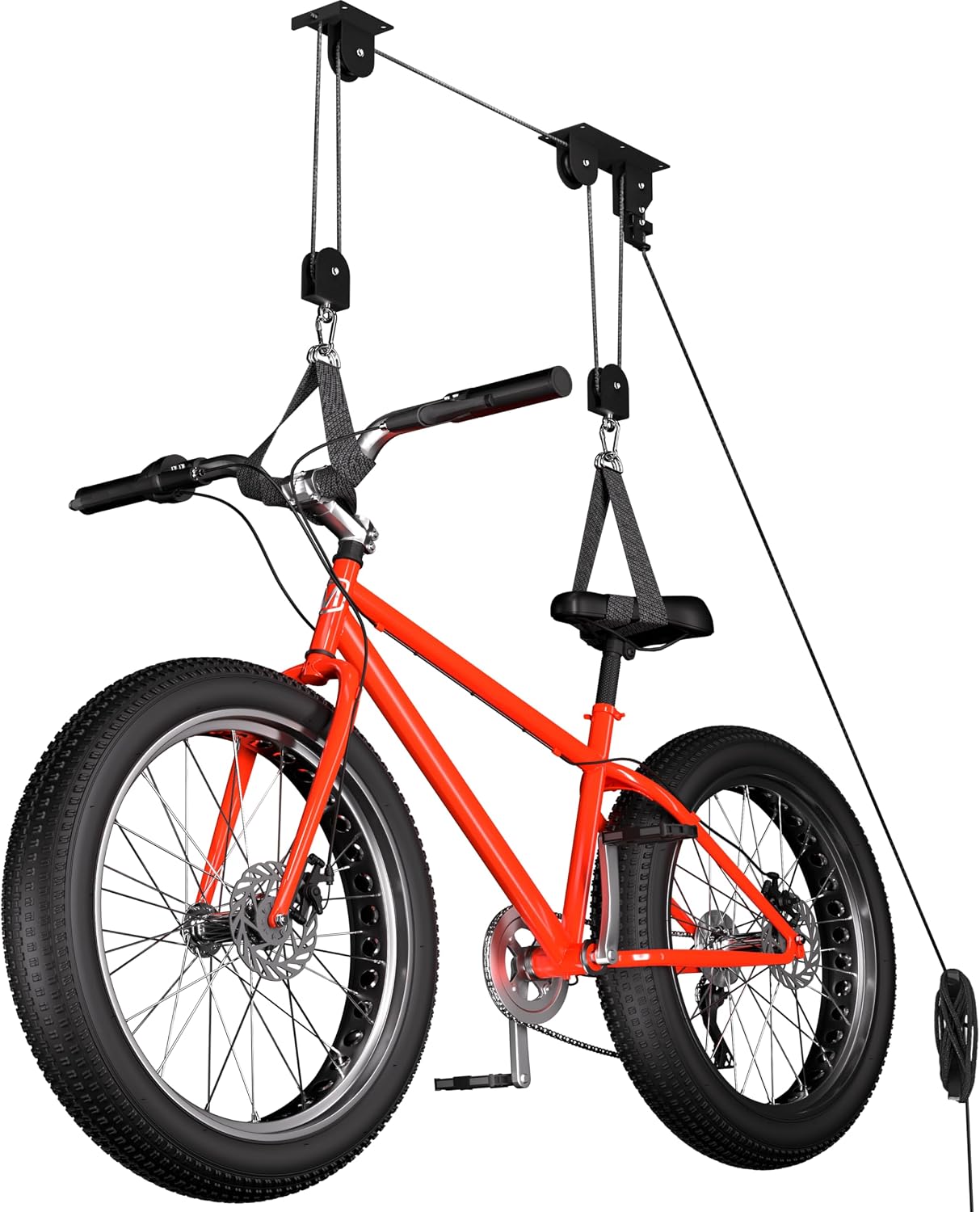
Overhead Garage Storage Lift Kit with 3/16 Galvanized Cable, 42:1 Winch
A 42:1 winch ratio does the heavy lifting for you, and galvanized cable is the right call for a garage that swings between humid and freezing
The biggest install of the four, it needs solid framing and a clear ceiling bay, and it is the unit I would least want to mount wrong
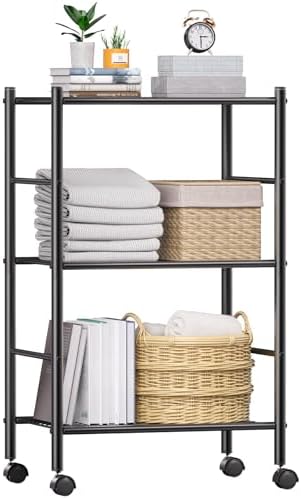
BolDuck 3 Tier Shelf Organizer Rack, Metal Shelving Unit with Wheels/Leveling Feet
Wheels or leveling feet, an 18.11 inch by 12.6 inch footprint, and three tiers that roll out of the way when you need the floor back
Light duty next to the wire unit, only three short tiers, and it is not the rack you load with a tool chest
Prices and availability were captured from Amazon Creators API and may change.
The three questions I ask before I mount anything
Every storage decision in a garage comes down to the same three checks, and none of them are printed on the box.
What is behind the drywall? A stud finder is the most important tool in this whole article, and it is the one everybody skips. Garage walls are often insulated and drywalled over framing you cannot see, and garage ceilings are worse because half the bays are interrupted by door tracks and headers. If you cannot find a stud, you find a different spot.
Does the hardware match the rating? Weight ratings are honest only when the bracket and the fasteners match them. A 200 pound shelf hung with the wrong anchors is a 40 pound shelf with a nice label. This is the single most common failure I get called to fix.
Can I reconfigure it later? A garage system you cannot move is just expensive shelving. Bikes multiply, kids move out, and the lawn equipment gets bigger. Anything that locks you into one layout costs you more in two years than it saved on day one.
Freestanding wire shelving: the Amazon Basics unit
The Amazon Basics 4-Shelf Steel Wire Storage Shelves is the one I recommend to homeowners first, and it is not because it is fancy. It is because the shape is right. At 23.2 inches wide, 13.4 inches deep, and 48 inches tall, it slides into the dead zone beside a garage door or along a wall without blocking a car door. Four shelves at 200 pounds each is a real amount of capacity, and the shelves adjust, which is the part that matters long term.
Wire has two honest drawbacks. Small items fall through, so screws, drill bits, and loose hardware need bins. And wire racks need to be level, which is harder than it sounds in a garage, because garage floors are poured with a pitch toward the door so water drains out. That slope means almost every freestanding unit needs shims under the front legs. Skip the shims and the load leans, and a leaning rack is a rack that eventually walks.
Rolling racks: the BolDuck three tier
The BolDuck 3 Tier Shelf Organizer Rack solves a different problem. At 18.11 inches wide, 12.6 inches deep, and 31.5 inches tall, it is a small-footprint unit, and it comes with both wheels and leveling feet, which tells you the manufacturer understands garages and laundry rooms have uneven floors. I would put this in the detailing corner, the paint corner, or the mudroom-adjacent zone where you want supplies to roll out, get used, and roll back.
What it is not is a heavy-duty rack. Three short tiers at this footprint are for the things you touch weekly: fluids, rags, car care, seasonal decor, pantry overflow. A tool chest belongs on something with a wider stance. The wheels are only an advantage if you keep the path clear, and in most garages the floor is the first thing to fill up.
Overhead storage: pulley hoists versus winch lifts
This is where most garages have free real estate, and it is also where most installs go wrong.
The TRUSOON Bike Hoist is the simpler of the two overhead options. It is a pulley system rated to 85 pounds, which matters because a modern ebike is not a 25 pound road bike. The pulleys give you mechanical advantage, the straps cradle the frame, and the bike ends up against the ceiling instead of leaning against your wife's car. The catch is the ceiling. Garage ceilings are not all framed the same, and the included hardware is not a substitute for lag bolts into real joists. One hoist carries one bike, so a family of four riders is four installs.
The Overhead Garage Storage Lift Kit is the bigger commitment and the bigger payoff. The 42:1 winch ratio is the headline, because it means you can raise a loaded platform with one hand instead of hauling on a rope. The 3/16 inch galvanized cable is the detail I care about more. Garage air is wet in the summer and freezing in the winter, and galvanized cable handles that cycle the way bare cable does not. A platform also holds more than bikes: bins, lumber, holiday boxes, the stuff that currently lives on the floor.
The trade-off is the install. This is the unit that needs a clear ceiling bay, solid framing, and a cable path that will not rub on a door track. If you are not confident about your joists, this is the one to hire out. Mounted right, it is the single biggest space gain in a two-car garage. Mounted wrong, it is a hazard hanging over your head.
The trade-offs nobody prints on the box
Ceiling height is not the same as ceiling space. Door tracks, openers, and light fixtures all interrupt the bays you thought were empty. Measure with the door up, not down.
Proprietary accessories are a trap. Buy systems that take standard hooks, standard bins, and standard shelving clips. Anything that requires a brand-specific bracket to expand gets expensive fast.
Pitch beats level. Garages drain. Assume every floor unit needs shims and every rolling unit needs a clear path.
The bracket is the weak point, not the shelf. Steel beats plastic every time, and bolts beat anchors every time.
Open shelves collect sawdust. Wire and open steel are right for bins, tools, and anything you want to see. Anything you want clean belongs behind a door.
What I would buy, and in what order
If you are starting from a garage floor that looks like a yard sale, buy the wire shelving first. It is the cheapest way to get four tiers of vertical storage, and it handles the widest range of stuff. Add the rolling rack second if you have a corner that needs mobile storage, or a laundry and pantry overflow problem that follows you around the house. Go overhead last, once you know which ceiling bay is actually clear and what you want to store up there.
If bikes are the problem, flip the order. The bike hoist goes up first, because floor space is what you are buying, and the shelves can wait.
Questions I get from homeowners
Do I really need to find the studs? Yes. Every time. A drywall anchor on a garage ceiling is a failure waiting for a warm day.
Can I mount a hoist in a rental? Technically, with permission and patching. Practically, a rolling rack and a freestanding shelf unit are the smarter call when the walls are not yours.
How much can my ceiling hold? That is a dead load question, and it is about the framing, not the product. If you cannot identify the joists, do not hang anything heavy.
Will the wire shelf hold my tool chest? The unit is rated at 200 pounds per shelf, but a loaded chest is a concentrated load. Spread it across two shelves or put it on a wider stance.
Do I need two people? For the hoist and the lift kit, yes. Holding a platform overhead while you thread cable is not a one-person job.
What is next on my bench
I am running overhead racks through a full season with real loads and a level check at 30 days, because the only sag test that counts is the one after the garage has been through temperature swings. Overhead storage is free real estate until the ceiling sags, and the mounting hardware is the whole game.