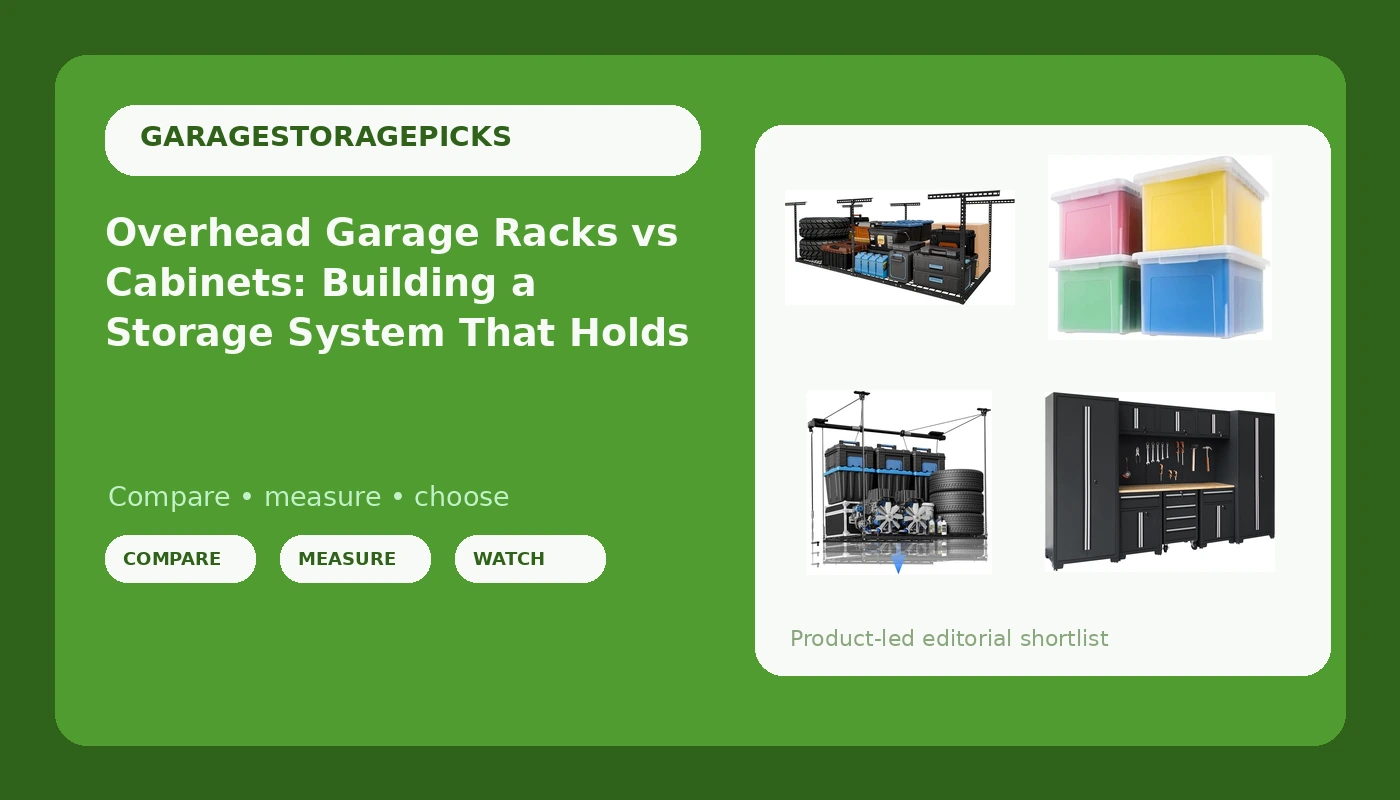
Garages fill up in a predictable order. The mower goes against the wall, the bikes lean beside it, the holiday bins stack in the corner, and within a year you are parking in the driveway. Fixing that is not about buying more shelves. It is about deciding which layer of the room each item belongs in before you spend a dollar, then choosing an overhead garage storage rack, a cabinet run, or a mobile cart that can genuinely carry that layer. The order matters because the ceiling, the wall, and the floor each have different limits. A system that ignores those limits will sag, pull out of drywall, or turn into expensive shelving you cannot change when the bike collection grows.
Related: Garage Wall Storage Systems Compared: Track, Rail, and Panel →
Quick answer
Work top down. Use the ceiling for seasonal and bulky items you touch twice a year, cabinets for tools and anything you do not want covered in sawdust, and the floor for one mobile surface you can roll to the job. An overhead garage storage rack is the right first purchase when your ceiling framing is sound, because it clears floor space without consuming wall space. A cabinet system is the right first purchase when the problem is clutter and dust rather than volume. When you are unsure, measure your ceiling height, locate your joists, and count how many items you move more than once a month before buying anything.
4 useful options
| Model | Best fit | What stands out |
|---|---|---|
| FLEXIMOUNTS GL1 Overhead Garage Lifting Storage Rack | Ceilings with verified joists and bulky seasonal gear | 4x4 ft heavy-duty metal deck, 71 inch axle, 350 lb figure in the listing |
| FLEXIMOUNTS 4x8 Overhead Garage Ceiling Storage Rack | Long, light, awkward items like ladders and trim stock | A 4x8 ft overhead deck, the larger of the two ceiling footprints here |
| Garage Storage Cabinet System 12-Pcs Workshop Set | Tools and supplies you want closed away from dust | Twelve matching pieces sold as one workshop set |
| IRIS USA 6-Drawer Rolling Storage Cart | Small parts and hardware you move around the shop | Six drawers on a rolling frame with clear fronts |
Overhead lifting rack: FLEXIMOUNTS GL1 Overhead Garage Lifting Storage Rack
The lifting design is the interesting part here. Instead of loading a fixed deck from a stepladder, the rack is built to raise and lower the platform, which changes who can use overhead space. If you have ever balanced a tote on your shoulder while climbing a ladder, you already understand the appeal. The trade-off is the same one every ceiling rack carries: the rack is only as strong as the structure above it. The 350 lb figure in the listing describes the rack, not your joists, and it assumes the mounting hardware is matched to the load and driven into framing rather than drywall.
Wide ceiling deck: FLEXIMOUNTS 4x8 Overhead Garage Ceiling Storage Rack
A 4x8 ft deck is roughly the footprint of a sheet of plywood, and that is exactly how to think about it. It suits ladders, lengths of trim, kayak paddles, pipe insulation, and the long cardboard boxes that never fit anywhere else. Long items spread their weight across more framing, which is a good thing, but they also tempt you to overload the middle of the deck. Keep the heavy totes near the mounting points and the light, bulky shapes out toward the edges. If your garage ceiling is already crowded with a door track or ductwork, measure the clear span before you commit.
Cabinet system: Garage Storage Cabinet System 12-Pcs Workshop Set, Black
Cabinets solve a different problem than racks. Open shelving is cheap and fast, but every surface in a working garage collects dust, overspray, and lawn clippings. Anything you care about, meaning anything with a motor, a cutting edge, or a finish, belongs behind a door. A twelve-piece set also forces a layout decision up front, which is usually good. Measure the wall first, check for outlets and the pitch of the floor, and plan to shim. Garage slabs slope toward the door, so a run of cabinets set level will show a gap at one end. That gap is normal and it is what shims are for.
Rolling cart: IRIS USA 6-Drawer Rolling Storage Cart, Black/Clear
Every garage needs one thing that moves. Screws, sandpaper, zip ties, and the odd bracket all live somewhere, and if that somewhere is a fixed shelf across the room, you will leave them on the bench instead. A rolling cart keeps small parts at the point of use and rolls back to the wall when you are done. Clear fronts matter more than they sound, because a drawer you can read through is a drawer you will actually put things back into. The limitation is capacity. This is a cart for parts and supplies, not for a benchtop tool or a stack of lumber.
Prices and availability may change. Product images, names, and retailer links are matched to verified listings. No current price, rating, stock status, or measured result is stated here without current evidence.
How much weight your ceiling will actually take
Ceiling storage fails for one reason far more often than any other: the rack was fine and the mounting was not. Garage ceilings are usually framed with joists on 16 or 24 inch centers, covered in drywall. Drywall holds almost nothing in tension, which is why the anchors that ship in some ceiling rack boxes are the single most common mistake in this category. The rack has to be fastened into the framing itself, with structural screws or lag bolts long enough to bite into solid wood, or into a properly sized and fastened blocking span when the layout does not line up.
There is also a difference between what a ceiling holds on install day and what it holds forever. A dead load is the weight that hangs there permanently, season after season, through summer heat and winter cold. A rack rated for a few hundred pounds is not a license to hang a few hundred pounds of engine blocks. Keep overhead loads to bulky, light, and seasonal items, distribute weight toward the mounting points, and leave the dense stuff, the paint cans and the concrete mix, at floor level where it belongs.
If you cannot identify what is above the ceiling, stop. A finished room, a bathroom, or a run of ductwork changes the plan, and drilling blind into a ceiling with plumbing above it is an expensive afternoon. Attic access, a stud finder, and a look from above solve the question in ten minutes.
Matching storage to how often you touch it
The layout rule that works in every garage is frequency. What you use weekly lives at eye level and within arm's reach of the door you walk in through. What you use monthly lives at waist height. What you use once or twice a year goes overhead. What you use once a decade, or never, should not be in the garage at all.
That rule decides the order of purchase. If most of your clutter is seasonal, ceiling storage buys back the most floor. If most of it is tools and supplies, cabinets do more work because they close things away. If most of it is small parts that migrate around the bench, a rolling cart fixes it for the least money. Buying in that order also means each piece you add later fits a system instead of fighting it.
Reconfigurability is the other test. A storage piece you cannot move, adjust, or repurpose becomes expensive shelving the moment your needs change. Adjustable racks, modular cabinet sets, and rolling carts all pass that test. Fixed assemblies with proprietary hooks and clips usually do not.
- Measure ceiling height, wall length, and the clear span above the car.
- Locate the joists and confirm what is above the ceiling before drilling anything.
- Sort your gear into weekly, monthly, and seasonal piles, then weigh the seasonal pile roughly.
- Buy for the biggest pile first, and match mounting hardware to the load rather than trusting what is in the box.
- Install, load it gradually, and check the mounting points again after a month of real use.
Practical rules that keep a system working
- Fasten ceiling racks into framing with structural hardware, never into drywall alone.
- Keep dense items low and bulky items high, because the ceiling handles volume better than mass.
- Shim cabinets level and anchor them to the wall so a loaded run cannot tip forward.
- Leave one rolling surface free so small parts travel instead of piling up on the bench.
- Re-check every overhead mounting point after the first month, then once a season.
Which option should you choose?
Choose the FLEXIMOUNTS GL1 Overhead Garage Lifting Storage Rack when your seasonal pile is the real problem and you want a deck you can raise and lower instead of loading from a ladder. Choose the FLEXIMOUNTS 4x8 Overhead Garage Ceiling Storage Rack when you are storing long, light, awkward items and want the largest deck footprint in this group. Choose the Garage Storage Cabinet System 12-Pcs Workshop Set when the clutter is tools and supplies that need to stay clean and out of sight. Choose the IRIS USA 6-Drawer Rolling Storage Cart when the mess is small parts and you need storage that follows you to the work.
One caveat applies to all four: none of them solve a mounting problem. The rack figures and the cabinet set are only meaningful once the framing behind them has been verified. If you rent, or if your ceiling is finished with no access above, confirm what you are fastening into before you buy anything overhead.
The bottom line
Garage storage works when the layers are assigned deliberately. Ceiling for seasonal and bulky, cabinets for tools and dust-sensitive gear, one rolling cart for the small stuff that moves. An overhead garage storage rack is the biggest single win in most garages, because it uses space nothing else can, but it is also the piece most likely to be installed badly. Buy the rack you can mount correctly, add cabinets when the clutter is dust and tools rather than volume, and keep one cart loose so the bench stays clear. Check current Amazon price on any of these before you commit, and spend the saved hour finding your joists. That hour is the difference between storage that holds and storage that sags.