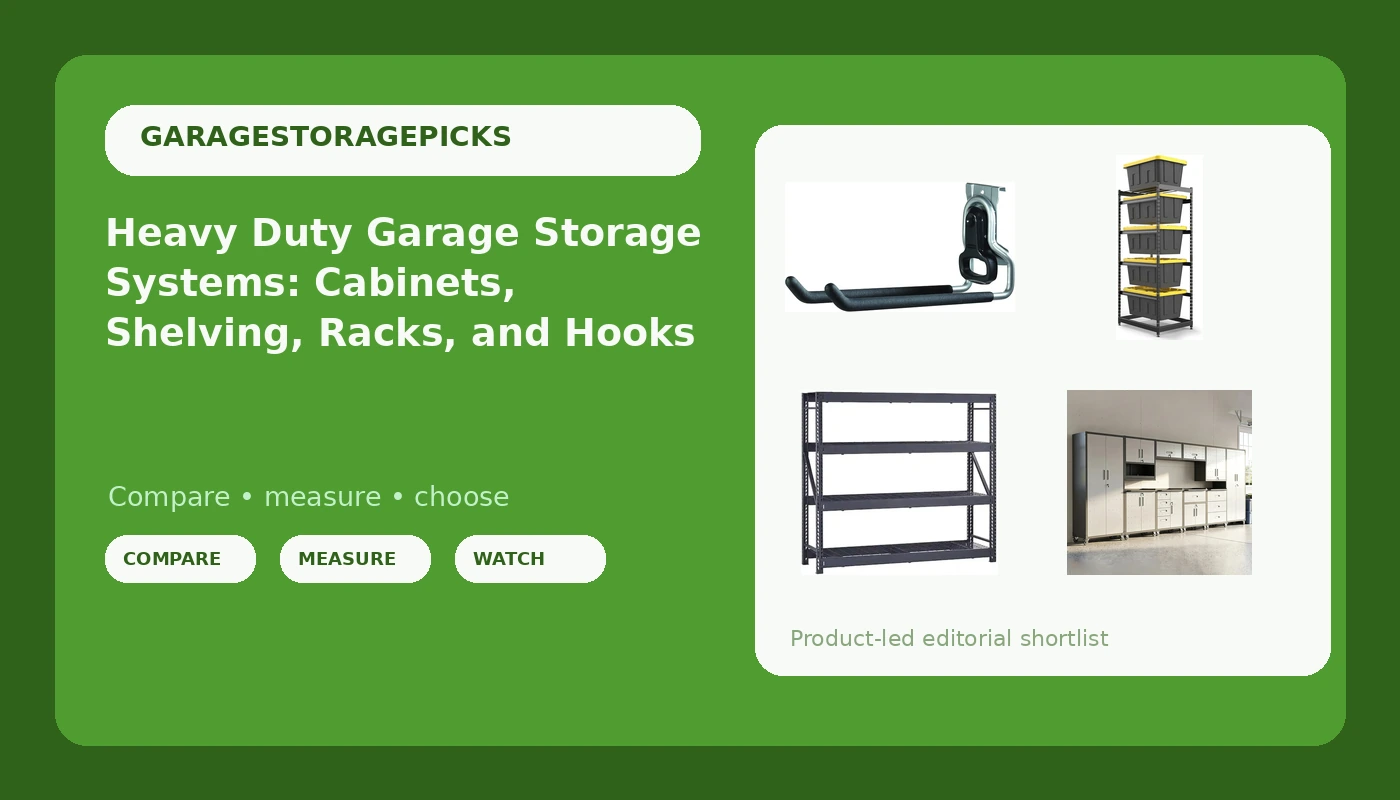
Most garages do not fail at storage because the owner picked the wrong color. They fail because the system was chosen by price instead of by load, or because the system was fine and the mounting hardware was not. Heavy duty garage storage systems come in four basic shapes: enclosed steel cabinets, open industrial shelving, bin racks, and rail-mounted hooks. Each one solves a different problem, and most garages end up needing more than one of them.
This is a breakdown of what each type is actually for, what the stated ratings do and do not promise, and how to decide which piece your garage needs first. The order matters more than the brand. Get the structure right and the storage will outlive the drywall it hangs on.
Related: How to Find Garage Ceiling Joists Before You Hang Anything →
Quick answer
Match the storage to the load, and match the mounting to the structure behind it. Enclosed steel cabinets are for anything you do not want covered in sawdust. A welded industrial shelving unit carries the heaviest open loads. A tote rack turns a stack of 27-gallon bins into a wall of pull-out drawers. A rated wall hook handles the brooms, cords, and ladders you reach for every week. Before any of it goes up, find the studs and read the capacity rating for the shelf, not the picture on the box.
Four useful options
| Model | Best fit | What stands out |
|---|---|---|
| 10-Piece Heavy Duty Steel Garage Cabinet System | A workshop that needs closed storage plus a work surface | Ten modular steel pieces including a tool bench in one all-in-one set |
| Husky Industrial Duty Steel Garage Shelving Unit | Heavy open loads like lumber, engines, and bulk stock | Stated 2,500 lb capacity per shelf with adjustable tiers and a welded frame |
| 27 Gallon Tote Storage Rack | Standardizing a garage full of mismatched plastic bins | Five standing tiers sized for 27-gallon totes with a stated 250 lb capacity |
| Rubbermaid FastTrack Multi-Purpose Hook | Long-handled tools and cords on an existing rail | Stated 50 lb capacity, satin nickel finish, mounts directly into the rail |
The all-in-one system: 10-Piece Heavy Duty Steel Garage Cabinet System
A set like this is a layout decision, not just a purchase. Ten pieces lock you into a footprint, so measure the wall, the depth, and the swing of your garage door before anything ships. Cabinets with doors beat open shelving for anything you do not want wearing a coat of sawdust, which in a working garage is most things. The tool bench becomes the anchor of the whole run, so place it where you actually work, not where the leftovers fit.
Two practical notes. Garage floors have pitch, and that angle decides whether the cabinets sit flat or need shims at the front feet. And steel cabinet sets are heavy and awkward to move once assembled, so build them near their final position rather than dragging them across a coated floor. If you want to reconfigure later, modular pieces are the reason to pay for a set instead of building boxes out of plywood.
The heavy hauler: Husky Industrial Duty Steel Garage Shelving Unit
Read a per-shelf rating as exactly that: per shelf, evenly loaded, sitting on a level floor. A rack like this carries its load down through the posts to the concrete, not into your wall, which is why it can be rated so much higher than anything you hang. That also means the weak point is the floor and the setup, not the shelf. Level feet, heavy items on the bottom tiers, and lighter bulk up top.
The trade-off with open shelving is dust and visibility. Everything you own becomes part of the room. That is fine for lumber, coolers, and bulk goods, and wrong for tools and anything with a finish. It is also worth anchoring a tall rack to the wall as a tip-over safeguard, especially in a garage where kids, bikes, and ladders share the floor. Adjustable tiers are what let you adapt when the thing you store changes, which it will.
The bin rack: 27 Gallon Tote Storage Rack
Most garages do not have a storage problem, they have a bin problem. Somebody bought one tote, then another brand that stacks differently, and now there is a leaning tower in the corner that nobody wants to touch because pulling the bottom one out starts an avalanche. A dedicated tote rack fixes that by giving every bin its own slot at a workable height.
Two things to plan for. Totes are not included, so price the rack and the bins together if you are standardizing from scratch, and pick one tote size so the rack stays useful. And a loaded 27-gallon tote is not light, so spread the heavy ones across the lower tiers and keep the seasonal stuff up top. Label the ends, not the lids. You will thank yourself the first time you need the Christmas lights in July.
The wall hook: Rubbermaid FastTrack Multi-Purpose Hook
Be clear about what this is: an accessory, not a system. The hook clips into the rail, and the rail is the part that has to be fastened into studs. That is the whole game with wall storage. The 50 lb rating means nothing if the rail behind it is hanging on drywall anchors. When it is done right, a handful of these hooks gets ladders, cords, and long-handled tools off the floor for very little money, and you can slide them along the rail when the layout changes.
This is also the cheapest first step in the whole category. If you are not ready to commit a wall to cabinets or a corner to a rack, a rail plus a few hooks buys you real floor space in an afternoon. Just keep the load honest. Fifty pounds is a stepladder and some extension cords, not a stack of winter tires.
Prices and availability may change. Product images, names, and retailer links must be matched by verified ASIN. Do not state a current price, rating, stock status, or measured result without current evidence.
What a weight rating actually promises
A capacity number is a static rating under ideal conditions. It usually assumes the weight is spread evenly across the shelf or hook, that the mounting hardware matches the rating, and that the structure behind it can take the pull. Change any one of those and the real limit drops, sometimes by a lot. The box is a claim. The bracket is the truth.
For anything floor-standing, the load path runs down through the posts to the slab. For anything wall-mounted, it runs through the fasteners into a stud. That difference explains why a shelving unit can be rated in the thousands of pounds while a wall hook is rated in the tens. Overhead storage is the strictest case of all, because it is a dead load that hangs there forever, and drywall anchors are not designed for it no matter what the package says.
How to plan the layout before you buy anything
Storage that stays organized is organized by frequency, not by category. The stuff you touch weekly goes at eye level and waist height. Seasonal items go up high or into totes at the back. Heavy items go low, always, both for your back and for stability. Once you accept that rule, the shopping list writes itself.
Then think in zones instead of pieces. A wall zone for rail hooks and long-handled tools. A closed zone for cabinets and anything that needs protecting. An open zone for the rack and bulk goods. A bin zone for totes. Most garages only need two or three of those zones, and picking the right two beats buying all four badly.
- Measure the wall from corner to corner, the ceiling height, and the depth you can give up without blocking a car door.
- Find the studs with a stud finder and mark them with painter's tape so the marks survive until install day.
- Add up what you actually store and how heavy the heavy items are, then compare that to the stated ratings.
- Decide closed versus open for each zone, because sawdust does not care how good the shelf looks.
- Buy the mounting hardware before you buy the accessories, and confirm it matches the rating you are relying on.
Practical guidance for installation day
- Keep floor-standing racks and cabinets level with shims at the feet, then check the doors or shelf edges, not the floor.
- Drive structural fasteners into studs for any wall-mounted rail, bracket, or cabinet, and use hardware rated for the load.
- Anchor tall shelving units and cabinets to the wall to prevent tip-over.
- Load the bottom tiers first and work upward, keeping the heaviest items as low as possible.
- Leave a walking lane and enough clearance to open a car door, or the best layout in the world becomes a maze.
- Recheck the fasteners and shelf clips after the first month of real use, then twice a year after that.
Which option should you choose?
Choose the 10-Piece Heavy Duty Steel Garage Cabinet System when you want a finished workshop wall with closed storage and a built-in work surface, and you are willing to plan the footprint before it arrives. Choose the Husky Industrial Duty Steel Garage Shelving Unit when the load is the problem, meaning lumber, engines, bulk goods, and anything too heavy or too dusty to live behind a door. Choose the 27 Gallon Tote Storage Rack when you already own a pile of bins and need them stacked in a way you can actually use. Choose the Rubbermaid FastTrack Multi-Purpose Hook when you have an existing rail, or you want the cheapest possible win and you are willing to install one properly.
A sensible order for most garages is the cheap structural work first: clear the wall, find the studs, hang a rail and hooks, then add closed storage where dust is an issue, and add the heavy rack where the weight lives. The cabinet set is the last piece, not the first, because it is the one that locks in a layout.
The caveat on all of this: the capacities here are the ratings stated by the manufacturers for each product, not measured results, and they assume proper mounting into sound structure. Every garage is different. A wall that sounds solid might be furring strips over concrete block, and a ceiling that looks like joists might be something else entirely. Verify what you are fastening into before you trust a number printed on a box.
The bottom line
The storage product is rarely the weak link. The mounting is. Pick the piece that matches the load and the room you actually have, find the studs, use hardware that matches the rating, and keep the heavy stuff low. Do that and a cabinet set, an industrial rack, a tote rack, and a few hooks stop being a shopping list and start being a garage you can park in.