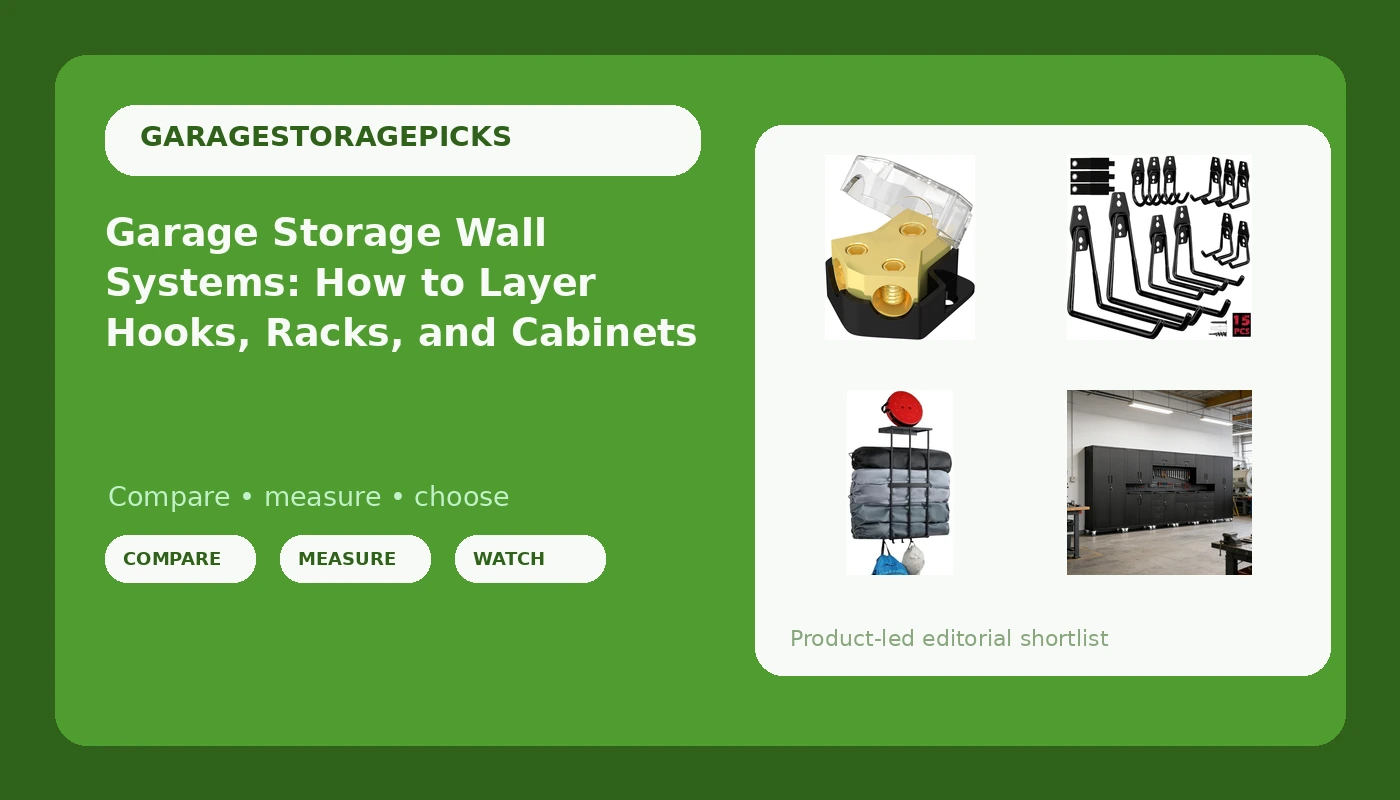
Garage storage wall systems fail for a boring reason: people buy the wrong layer first. A cabinet set shows up before anyone has checked where the studs are, or a bag of hooks goes into drywall and starts pulling out under the weight of a shovel. The wall is the cheapest square footage in the house, and it is also the part that punishes guesswork.
The useful way to think about it is in layers. There is a hanging layer for the things you touch every week: ladders, bikes, shovels, garden tools. There is a bulky layer for awkward gear that stacks badly, like folding camping chairs. There is an enclosed layer for anything you do not want coated in sawdust. And on some walls there is a wiring layer, because a garage that runs lighting or a 12 volt circuit needs a proper place to split power.
This guide covers four pieces that map to those layers, what each one is actually for, and how to decide which one to buy first.
Related: Garage Wall Storage: Track Systems vs. Individual Hooks →
Quick answer
Match the product to the layer, not to the sale. A steel hook assortment handles weekly-use items like ladders, bikes, and yard tools. A camping chair rack handles bulky folding gear that will not sit on a hook. A lockable cabinet set handles tools, chemicals, and anything that should stay enclosed. A 12 volt distribution block handles the wiring side if you are running shop lights or accessories. None of these replaces the others, and none of them is worth installing until you have located the studs and confirmed the mounting hardware matches the load.
Four useful options
| Model | Best fit | What stands out |
|---|---|---|
| Garage Tool Storage Wall Hook Assortment Set: 15PCS Heavy Duty Large Hanger Garden Tool Organizer Ladder Bike Rack Yard Tool Holder Shed Shovel Metal Screw Organization Bicycle Steel Bracket | Weekly-use hand tools, ladders, bikes, and yard equipment | 15-piece assortment of heavy duty hangers with steel brackets |
| Camping Chair Rack for Garage Storage,Garage Organization Wall | Folding chairs and other bulky gear that stacks badly | Purpose-built wall rack for camping chairs |
| Garage Storage Cabinet System 10pcs Heavy Duty Workshop Set Wall Mount Cabinet Lockable Rolling Tool Cabinets with Adjustable Shelves Tall Metal Garage Storage Cabinets | Tools, chemicals, and anything you want enclosed and lockable | 10-piece set with wall mount and rolling cabinets, lockable doors, adjustable shelves |
| Joinfworld 12V Power Distribution Block Car Audio 2 Way Ground Distribution Block 0/2/4 Gauge in 4/8/10 Gauge Out 12 Volt Amp Distribution Block Splitter for Marine Automotive Car Boat | Splitting a 12 volt feed for shop lighting or vehicle wiring | 2-way block with 0/2/4 gauge input and 4/8/10 gauge output |
The wall layer: Garage Tool Storage Wall Hook Assortment Set: 15PCS Heavy Duty Large Hanger Garden Tool Organizer Ladder Bike Rack Yard Tool Holder Shed Shovel Metal Screw Organization Bicycle Steel Bracket
This is the layer most garages should start with, because it is the cheapest way to clear floor space and it is the easiest to reconfigure later. The catch is that a hook is only as strong as what it is threaded into. Steel brackets screwed into a stud will hold a ladder for years. The same bracket into half-inch drywall with the anchors that came in the bag will not, and the failure usually happens at the worst possible moment, which is to say while you are standing under it.
If your studs do not line up with where you want the hooks, do not compromise the mounting. Run a horizontal ledger board across the studs first, fasten that properly, and screw the hooks into the ledger. It costs one board and twenty minutes, and it turns a scattered set of hooks into something that behaves like a system.
The bulky layer: Camping Chair Rack for Garage Storage,Garage Organization Wall
Folding camping chairs are the classic garage problem item: light enough that you underestimate them, bulky enough that they never stack, and awkward enough that they end up leaning in a corner where they fall over every time you walk past. A dedicated rack is the fix, because a general-purpose hook cannot grip a folded chair frame without either bending the chair or dropping it.
This is a specialty piece, and it earns its place only if you actually own the gear. If you have four camp chairs and a folding table, it clears real floor space. If you have one chair you use twice a year, a hook on the wall is enough and this is money you do not need to spend yet.
The enclosed layer: Garage Storage Cabinet System 10pcs Heavy Duty Workshop Set Wall Mount Cabinet Lockable Rolling Tool Cabinets with Adjustable Shelves Tall Metal Garage Storage Cabinets
Open shelves are fine until you cut a single piece of lumber, and then everything on them wears a coat of sawdust. Cabinets solve that, and they also solve the two other things hooks cannot: they hide clutter, and they lock. If your garage holds power tools, solvents, or anything you would rather not have a kid or a visitor rummaging through, doors matter more than shelf count.
Two practical notes on a set like this. First, garage floors are pitched toward the door, so rolling cabinets will almost always need shims if you want them to sit level and their doors to close cleanly. Second, wall mount cabinets carry the same rule as every other wall product: they go into studs, and if the studs do not line up with the cabinet layout, you add blocking behind the drywall or you change the layout. A ten-piece set is a bigger commitment than a hook, so it is worth doing the stud layout on paper before anything gets uncrated.
The wiring layer: Joinfworld 12V Power Distribution Block Car Audio 2 Way Ground Distribution Block 0/2/4 Gauge in 4/8/10 Gauge Out 12 Volt Amp Distribution Block Splitter for Marine Automotive Car Boat
This one is not a storage product, and it does not belong on a shelf next to the hooks. It belongs in the category of things you buy when you are wiring the garage rather than organizing it: 12 volt lighting runs, a trickle-charge setup, accessory circuits in a work trailer, or a boat or vehicle that lives in the bay and needs its electrical sorted. The value of a distribution block is that one heavy cable comes in and several smaller circuits leave from a single, serviceable point, instead of a stack of ring terminals bolted to a battery post.
Buy it only if you have a 12 volt project in front of you and you know your wire gauges. It is a specific part for a specific job, and it does nothing for a garage full of unorganized shovels.
Prices and availability may change. Product images, names, and retailer links must be matched by verified ASIN. Do not state a current price, rating, stock status, or measured result without current evidence.
What actually holds a wall system up
Every wall-mounted product in this guide, hooks, racks, and cabinets alike, hangs on the same two questions: what is behind the drywall, and what is the bracket made of?
Studs in a residential garage are typically spaced 16 or 24 inches on center, and a stud finder is the tool that decides your entire layout. Drywall alone carries almost nothing in shear once you start hanging weight out from the wall on a lever arm. Toggle anchors and the plastic plugs that come in the box with cheap hooks are not a substitute for a stud, and they are absolutely not acceptable for anything mounted overhead.
The bracket is the second half of the equation. Weight ratings printed on the outside of a box describe the product at its strongest point under ideal conditions. The bracket, the weld, and the fastener are what actually fail. When you compare two hangers, compare the steel thickness and the mounting plate size, not the number on the front of the package.
Ceiling storage deserves its own warning. A garage ceiling is usually carrying drywall, insulation, and whatever the builder intended, and the joists were not sized for your lumber rack. Any overhead load is a dead load, meaning it sits there forever rather than for a moment, so it needs hardware rated for permanent hanging and joists you have actually verified.
Finally, remember the pitch. Garage slabs slope toward the overhead door for drainage. That slope is why freestanding and rolling cabinets need shims, why a level is not optional, and why a set of cabinets installed on a sloped floor can look crooked even when the walls are square.
How to plan the layers before you buy
- Inventory by how often you touch things. Weekly items, seasonal items, and once-a-year items are three different storage problems, and they belong at three different heights.
- Find and mark every stud on the wall you intend to use. Mark them with painter's tape above the height you will be working at so the marks survive the project.
- Assign layers. Weekly gear goes at eye level and below, seasonal gear goes up high, and heavy items stay low so you are never lifting a tool chest above your shoulders.
- Match the hardware to the load before you mount anything. If the fastener is not rated for the weight and the substrate, change the fastener or change the wall.
- Leave room to reconfigure. A wall system that cannot be rearranged when the bike collection grows or the kids move out is just expensive shelving.
Practical rules that keep a wall system honest
- Hang a ledger board when studs do not line up with your layout, rather than spacing hooks to match the studs and wasting wall.
- Keep the heaviest items closest to the floor and closest to a stud, so the wall is loaded in compression, not peeled outward.
- Leave clearance for car doors, garage door tracks, and the swing of any cabinet door before you commit to a position.
- Use the same fastener standard everywhere on the wall. Mixed anchors are how one hook fails while the rest hold fine.
- Test a new mount with a light load first, then add weight gradually, so a bad fastener shows itself before it is holding a ladder.
Which option should you choose?
Choose the Garage Tool Storage Wall Hook Assortment Set: 15PCS Heavy Duty Large Hanger Garden Tool Organizer Ladder Bike Rack Yard Tool Holder Shed Shovel Metal Screw Organization Bicycle Steel Bracket when your floor is the problem and you need ladders, bikes, and long-handled tools off it this weekend. Choose the Camping Chair Rack for Garage Storage,Garage Organization Wall when folding chairs and camp furniture are the specific clutter that keeps falling over in the corner. Choose the Garage Storage Cabinet System 10pcs Heavy Duty Workshop Set Wall Mount Cabinet Lockable Rolling Tool Cabinets with Adjustable Shelves Tall Metal Garage Storage Cabinets when you want tools, chemicals, and shop supplies behind lockable doors and you are ready to plan a stud layout for a full set. Choose the Joinfworld 12V Power Distribution Block Car Audio 2 Way Ground Distribution Block 0/2/4 Gauge in 4/8/10 Gauge Out 12 Volt Amp Distribution Block Splitter for Marine Automotive Car Boat when you are wiring a 12 volt circuit in the shop, trailer, or a vehicle stored in the garage and need a proper distribution point.
One caveat worth repeating: the mounting hardware decides the outcome for every wall-mounted item here, and none of these products ships with a guarantee about your studs, your drywall, or your ceiling. Verify the substrate and the fasteners before you load anything, and treat any weight figure you see as a starting point for your own inspection rather than an answer.
The bottom line
A garage wall works when the layers are in the right order. Hooks and steel brackets first, because they are cheap, reversible, and they clear the most floor for the least money. A specialty rack next, if bulky folding gear is a real problem for you. Cabinets after that, when you want storage that stays clean and locks. And wiring components only when you have an actual 12 volt project to feed. Buy the layer you are missing, mount it into studs, and the wall will outlast the stuff hanging on it.