Every garage has the same three zones, whether the owner thinks about them or not: the ceiling, the walls, and the floor. Garage storage systems are simply the hardware that lets you use all three without turning the space into a pile. The trouble is that most people buy in the wrong order. They grab a shelving unit because it is cheap and available, fill it up, and only then notice that the bikes, the ladder, and the holiday bins never had a home to begin with. Sorting out garage storage systems starts with the structure, not the catalog: what your studs and ceiling joists can carry, and where the mounting hardware is actually going to land.
Related: How to Find Ceiling Joists Before You Hang an Overhead Rack →
Quick answer
There is no single best garage storage product, because ceiling, wall, and floor storage solve different problems. An overhead rack takes bulky, seasonal items off the floor and puts them above the car. A wall rail system holds bikes, ladders, and long-handled tools at eye level. Steel shelving handles boxes and bins you need to see and reach. Small hook-and-loop straps deal with the cords and hoses that tangle no matter how carefully you coil them. Choose the mounting surface first, then the product.
Four useful options
| Model | Best fit | What stands out |
|---|---|---|
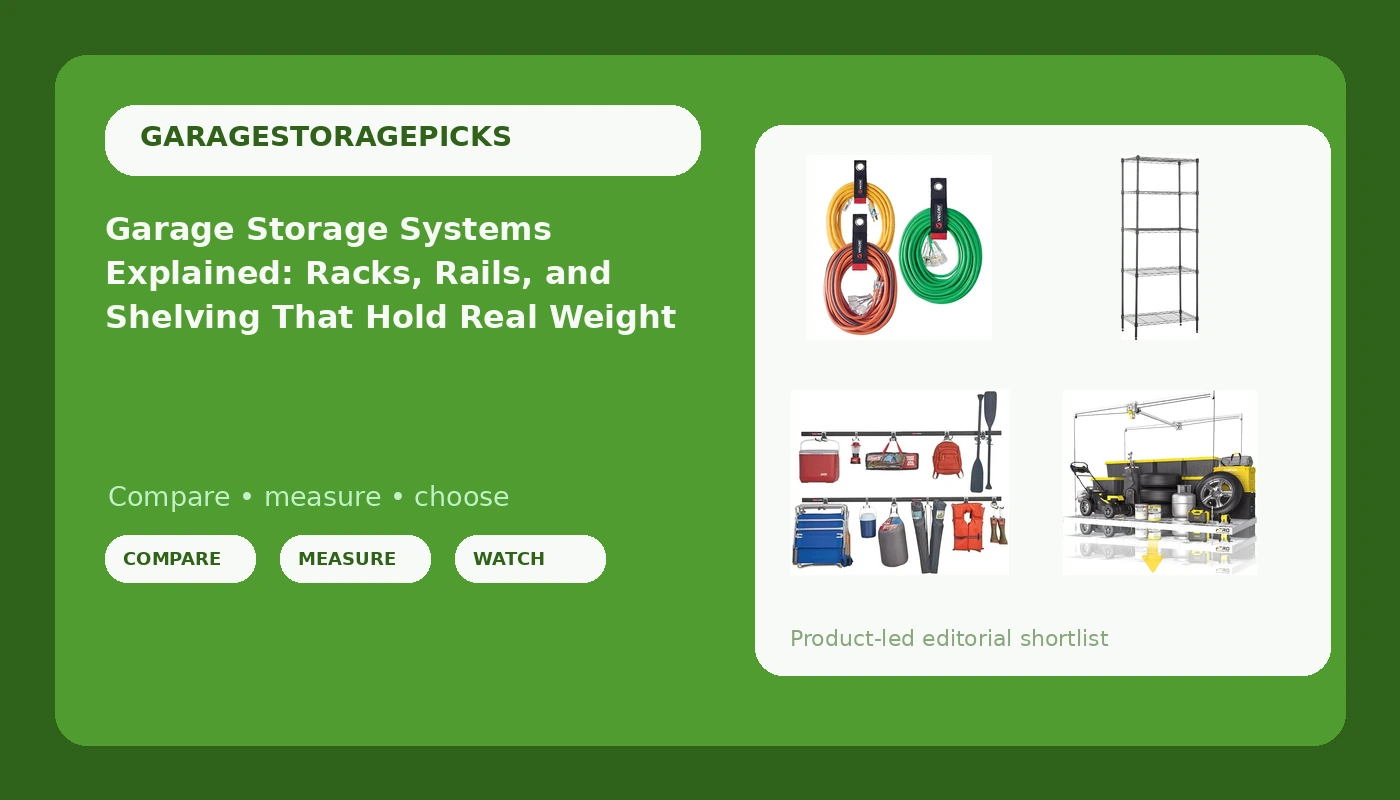
| FERO Overhead Garage Storage Rack 4x8, 500 lb Heavy-Duty Capacity | Bulky seasonal items that belong off the floor | 4x8 footprint with a stated 500 lb capacity |
| Rubbermaid 15-Piece FastTrack Garage Wall-Mounted Storage Kit, 4 Rails and 11 Hooks | Bikes, ladders, shovels, long-handled tools | 4 rails and 11 hooks in one kit |
| Amazon Basics 5-Shelf Multipurpose Adjustable Steel Garage Shelving Unit | Boxes, bins, and bulk goods on the floor | 5 adjustable shelves, 200 lbs per shelf |
| VELCRO Brand Easy Hang Extension Cord Holder Straps Variety Pack, Black | Cords, hoses, and cable that tangles | Variety pack of hook-and-loop hanging straps |
The overhead option: FERO Overhead Garage Storage Rack 4x8, 500 lb Heavy-Duty Capacity
An overhead rack is the highest-value square footage in the garage, and also the one that fails most spectacularly when it is installed wrong. The rack itself is rarely the weak point. The connection between the rack and the house is the weak point. A stated 500 lb capacity is a claim about the steel, not about your ceiling. Garage ceilings are typically drywall over joists, and the fasteners that come in the box are frequently not the fasteners the job needs. If the rack is going into joists, the load is limited by the joist and the lag hardware. If it is going into drywall alone, the honest answer is that it should not go there at all. Plan the rack location around the garage door tracks and the opener rail before you drill anything, and keep the underside clear of your tallest vehicle plus a margin.
The wall option: Rubbermaid 15-Piece FastTrack Garage Wall-Mounted Storage Kit, 4 Rails and 11 Hooks
Wall systems earn their keep because they are reconfigurable. A rail screwed into studs gives you a horizontal track, and the hooks slide or clip anywhere along it, so when the bike collection grows or the ladder gets replaced, you move a hook instead of patching drywall. The trade-off is that a rail only holds what its mounting screws can transfer into the studs. Space the fasteners into stud centers, not into the drywall between them, and treat the rail as a load path rather than a shelf. This kit is aimed at the everyday garage load: bikes, garden tools, extension ladders, hoses. It is not the tool for a loaded tool chest hanging in midair.
The floor option: Amazon Basics 5-Shelf Multipurpose Adjustable Steel Garage Shelving Unit, Storage Rack for Kitchen, 200 lbs Per Shelf, Easy Assembly, 13.4"D x 23.2"W x 60"H, Black
Shelving is where most garages start, and it is still the right answer for anything you need to look at and grab. The per-shelf rating matters more than the total, because weight in a garage is never distributed evenly. One shelf holds paint cans, the next holds empty coolers, and the one below that quietly becomes the heaviest thing in the building. Adjustable shelf positions let you drop a shelf to fit tall totes and raise the others to fit shallow bins, which is how you actually use the vertical space instead of leaving a foot of dead air above every box. Keep heavy items low, keep the unit on a level spot, and remember that a garage floor has pitch for drainage, so a unit against the wall may need a shim under one leg.
The small-parts option: VELCRO Brand Easy Hang Extension Cord Holder Straps Variety Pack, Black
Cords are the reason a well-planned garage still looks chaotic. They are light, they are long, and they refuse to stay coiled. Straps solve this at almost no cost and almost no risk, because a coiled cord weighs nothing compared to a bike or a ladder. The point of hook-and-loop over a zip tie is that you can undo it in January with cold hands. Loop the cord in a figure eight rather than a tight circle, strap it, and hang it from the same rail that holds the tools. This is also the category where people overspend on specialty racks when a strap would have done the job.
Prices and availability may change. Product images, names, and retailer links are matched to verified listings. No current price, rating, stock status, or measured result is stated here without current evidence.
Where the weight actually goes
Every storage decision in a garage is a structural decision wearing a shopping costume. The ceiling carries dead load, which is weight that stays there permanently, and that is a different question from what the ceiling can survive for five minutes during installation. Wall storage transfers load into studs, which are typically spaced on 16 inch or 24 inch centers, and a rail that spans between two studs behaves differently than one screwed into the middle of a bay. Floor storage is the simplest, because the slab carries everything, but it costs you the square footage you were trying to reclaim in the first place. The useful mental model is a triangle: heavy and rarely used goes overhead, medium weight and used weekly goes on the wall at eye level, and everything you need to read a label on goes on shelving.
Reading a weight rating honestly
A capacity number printed on a box describes the product, not your installation. A rack rated for hundreds of pounds assumes its load reaches the building through hardware and structure that can take it. That assumption is where most garage storage fails, and it usually fails quietly, with a sag you notice months later. The practical rule is to size the fastener to the load and the structure to the fastener. Lag screws into solid framing are a different animal from expanding anchors into drywall, and the hardware in the box is often chosen for the widest possible range of buyers rather than for your specific ceiling. When in doubt, add blocking between joists or run a ledger board across several studs so the load spreads out. That is cheap insurance and it takes an afternoon.
- Find the framing first. Locate ceiling joists and wall studs with a stud finder, then confirm by drilling a small pilot or probing with a thin nail. Mark centers with painter's tape.
- Decide what goes overhead before you buy an overhead rack. If it does not fit in a 4x8 footprint or it is not seasonal, it probably belongs on a wall or a shelf instead.
- Match the mounting hardware to the load and the structure. Replace included anchors with lag hardware into framing where the load is real, and add blocking when a rail spans between studs.
- Check clearances before drilling. Garage door tracks, opener rails, and the arc of a raised door all cross the ceiling and the upper wall.
- Plan for reconfiguration. Rails and adjustable shelves let you change your mind. Fixed hooks and welded brackets do not.
Practical guidance
- Keep the underside of an overhead rack above your tallest vehicle with margin to spare, and never store items that overhang the rack edge.
- Hang wall rails into stud centers, not into the drywall between them, and use a level so hooks do not walk downhill along a sloped rail.
- Put the items you touch weekly at eye level and push seasonal bins to the top shelf, which is the whole organizing principle in one sentence.
- Respect the per-shelf rating rather than the total unit rating, and load the heaviest bins on the lowest shelf.
- Shim shelving units on a pitched garage floor so they sit flat, and strap tall units to the wall if the garage is in an earthquake or high-wind area.
Which option should you choose?
Choose the FERO Overhead Garage Storage Rack 4x8 when your floor is the bottleneck and you have verified ceiling joists to fasten into. Choose the Rubbermaid 15-Piece FastTrack Garage Wall-Mounted Storage Kit when bikes, ladders, and long-handled tools are the recurring problem and you want a wall layout you can rearrange later. Choose the Amazon Basics 5-Shelf Multipurpose Adjustable Steel Garage Shelving Unit when boxes and bins need to be visible and reachable, and the wall run is narrow. Choose the VELCRO Brand Easy Hang Extension Cord Holder Straps Variety Pack when cords and hoses are the last source of clutter after everything else has a home.
No current price, rating, or availability is stated for any of these products here. Weight capacities are the figures published with each listing, and actual performance depends on the fasteners, framing, and installation, which are not part of the product listing. Verify your own structure before hanging anything overhead.
The bottom line
A garage storage system is only as good as the connection between the hardware and the house. Start by finding the framing, decide which items belong overhead, on the wall, and on a shelf, and buy in that order. Overhead racks reclaim floor space but demand real fastening into joists. Wall rails give you flexibility at eye level and reward careful spacing into studs. Steel shelving is the honest workhorse for boxes, and a handful of hook-and-loop straps finishes the job for the cost of lunch. Get the mounting right and any of these will outlast the garage. Get it wrong and none of them will.