Related: Best Garage Wall Storage Systems for Heavy Tools
Every garage I walk into has the same three problems. Stuff on the floor. Shelves that sag under weight they were never rated for. And a stack of boxes nobody wants to open. None of that gets solved by a weekend of matching bins. It gets solved by a small number of garage storage systems rated for real weight and mounted into real framing.
I have spent 20 years hanging things on walls for a living, and the rules do not change. Steel beats plastic. The bracket is the weak point, not the shelf. A weight rating printed on a box means nothing if the hardware behind it is a drywall anchor. Garage storage fails at the wall, not in the middle of the span.
So this list is deliberately short. Four products cover almost every garage I have worked in: a heavy-duty wall rack for tools and long-handle gear, two welded steel cabinet sets for anyone who wants the garage to look finished instead of improvised, and one unglamorous item that decides whether your stacked boxes survive a season out there.
The tape looks out of place on a list like this. It is not. The boxes are the reason most garages are unusable, and a box that opens on a shelf undoes a weekend of work in about four seconds.
Two of these are big decisions and two are not. Here is how I think about each one, and what I check before anything goes on a wall.
The 64-Inch Wall Tool Organizer: Buy This First
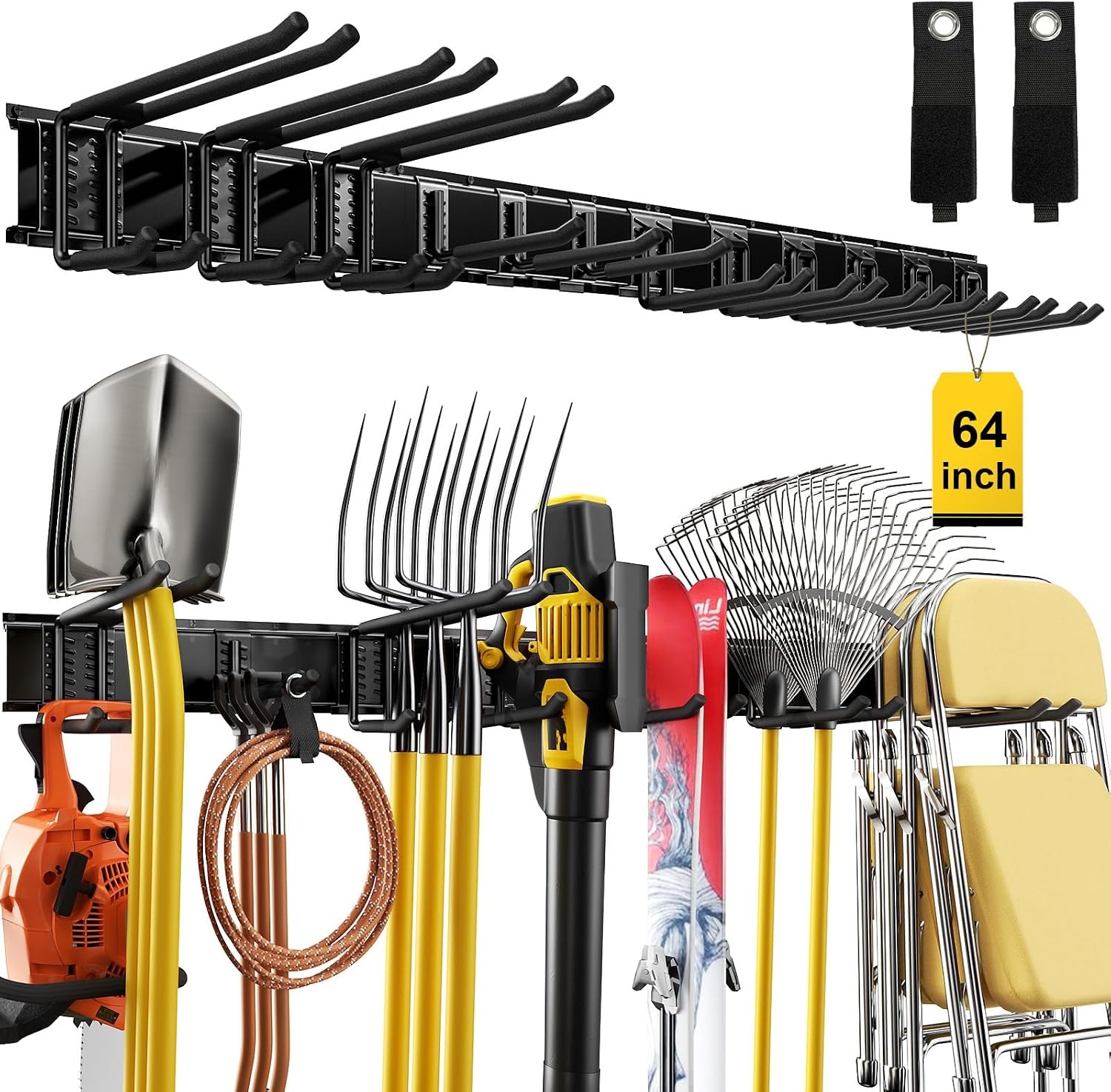
If you only do one thing to a messy garage, do this. A 64-inch steel wall organizer with 12 hooks and 2 straps handles the long-handle stuff that eats floor space: rakes, shovels, extension poles, hoses, cords, ladders. It is rated at 900 pounds, which you should treat as a ceiling, not a target.
The hooks are described as longer and thicker than the usual hardware, and that matters more than the rack itself. Thin hooks bend into a smile the first time you hang a full string trimmer on them. Thick hooks in a decent gauge will hold a ladder without opening up. The two straps are for the awkward items that will not sit on a hook, mostly coiled hose and cord.
Mounting is the entire job. Sixty-four inches means you need to hit at least two studs, and three is better. Mark the studs, drill pilot holes, and use lag bolts long enough to bite into framing, not just drywall. I find a stud by sound first and confirm with a small nail. If you hit air, move over and try again.
Placement matters as much as hardware. Put the rack at eye level or a little above for the tools you grab weekly, and put seasonal gear higher. Long-handle tools hang handle down so you can grab and go. That is the whole system, and it is the cheapest square footage in the garage.
One more thing: buy the wall rack before the cabinets, not after. Once a welded cabinet run is against the wall, the space above it is all you have left for hooks, and the rack is the piece that absorbs everything that does not fit in a drawer. Hang the rack first and the cabinets have less to swallow.
NewAge Red Bold Series 9-Piece Set: The One-Wall Answer
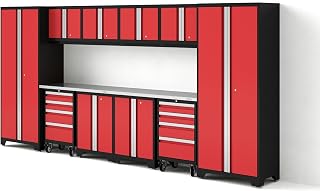
Twenty-four gauge steel, fully welded, 132 inches wide, 18 inches deep, 76.75 inches tall. Read that spec sheet the way a contractor does. Fully welded means the frame arrives as one piece, so there is no wobble to chase and no flat-pack hardware to lose in the driveway. Twenty-four gauge is a real cabinet skin, and it takes a hit from a lawnmower handle without denting into a joke.
132 inches is 11 feet. That is one wall of a two-car garage, comfortably. Eighteen inches of depth leaves parking space in front of it, which is the number that actually matters when both cars have to fit. Just under 77 inches tall clears a standard 8-foot ceiling with room to run an overhead rack above it later.
Two things to plan for. First, garage floors are pitched toward the door. Nearly every one I have measured slopes, and a level cabinet run on a sloped floor needs shims. That is normal, not a defect. Second, decide now whether you want base cabinets with a worktop or just tall storage, because you cannot add that decision later without buying more pieces.
If you are comparing this against open shelving, the math is closer than the price tag suggests. Open shelves are cheaper up front and cost you every spring when you wipe them down, and they show the neighborhood exactly how much unlabeled clutter you own.
The 9-piece set is sized for a two-car garage that still has to park two cars. If you have a three-car garage, or a shop you want to look like a showroom, the next one is the same steel in a much longer run.
NewAge Red Bold Series 15-Piece Set: For the Long Wall
Same 24-gauge steel, same fully welded construction, same 18-inch depth and 76.75-inch height. The difference is footprint: 276 inches wide, which is 23 feet of cabinet run. That is not a wall, that is most of a two-car garage or one long wall of a three-car garage.
Measure twice on this one. Twenty-three feet is longer than most people picture, and a run that overshoots the wall by a foot is an expensive mistake. Walk the garage with a tape and mark the run in pencil. Account for the door swing, the water heater, the electrical panel, and anything the previous owner built that you are not allowed to move.
Plan the run around interruptions, too. A side door, a service panel, a workbench you are not moving: three of those break 23 feet into pieces, and you are no longer getting 23 feet of cabinets. If that happens, the 9-piece may cover the same wall with money left over.
The reason to go bigger is not storage volume alone. It is that a long run lets you sort by zone instead of by pile. Yard chemicals and the mower on one end, tools in the middle, sports gear and the outgrown kid stuff on the far end. Zones only work if the run is long enough to have them.
If your wall is 20 feet, buy the 9-piece and put a wall rack above it. If your wall is 23 feet or more, the 15-piece is the version that will not leave the overflow stacked on the floor.
Scotch Heavy Duty Packing Tape: The Boring One That Matters
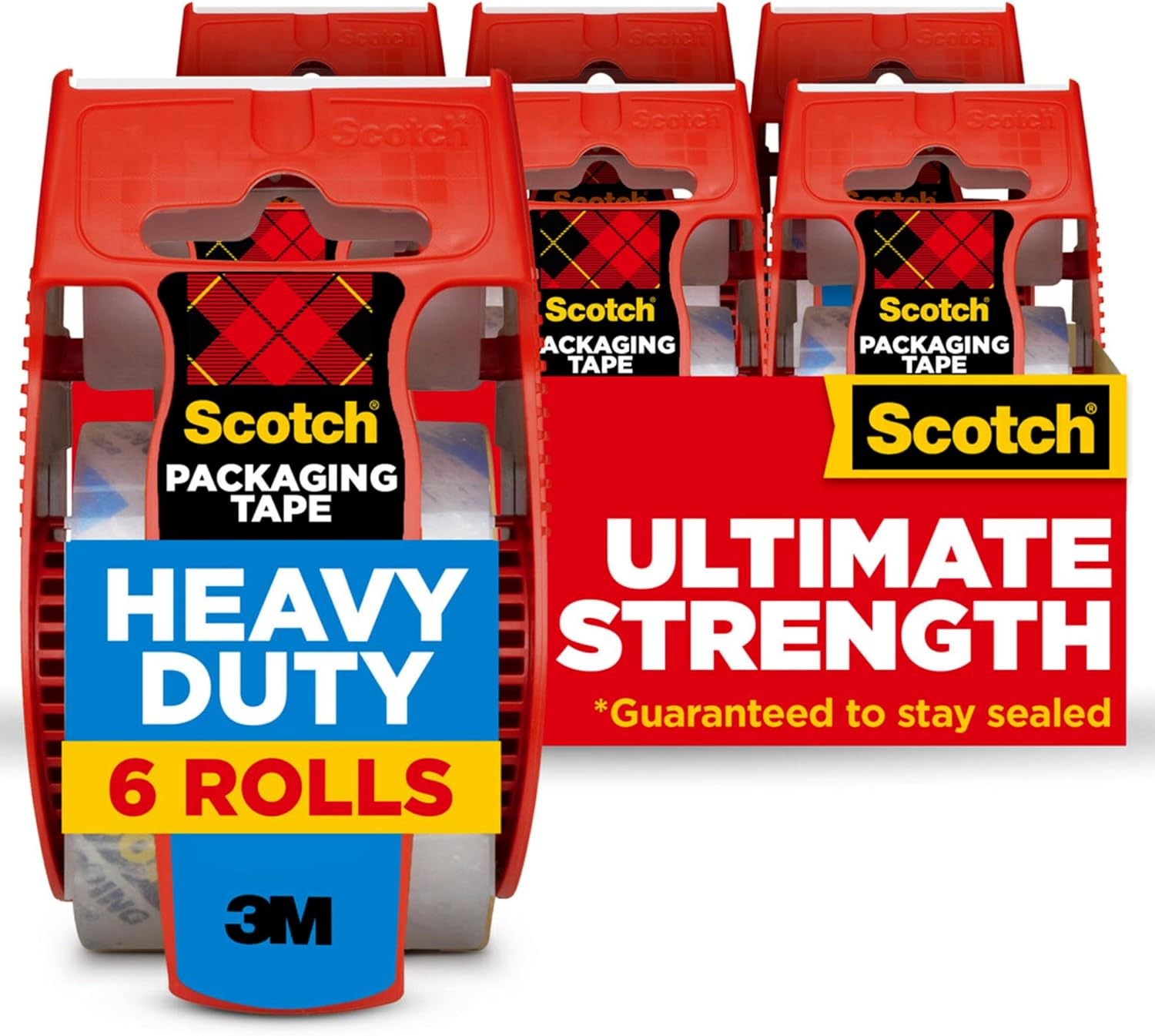
Nobody puts packing tape on a wish list, and everybody needs it the week they finally deal with the boxes. Six rolls at 1.88 inches wide and 800 inches per roll is a real working quantity, not a stocking stuffer. Heavy duty matters here, because the tape is what holds a full box closed when it is stacked three high and moved twice.
Here is the part people skip: label the box on the tape with a marker before it goes on a shelf. The tape is the label surface, and it does not peel off in a cold garage the way a paper sticker does. Write the contents and the month on the seam. In two years, you will thank yourself.
Cheap tape splits down the middle when a box is heavy, the box opens on the shelf, and everything you organized is on the floor again. That is the entire reason this makes the list. A roll of tape lives in the garage for years, so buy the six pack once and stop thinking about it.
What I Check Before Anything Goes on a Wall
This is the checklist I run through before a rack, a cabinet, or a shelf gets mounted.
Find the studs first. The stud finder is the most important tool in garage storage and the one everybody skips. A 900-pound rating is a claim about the rack, not about the two drywall anchors you were about to use. Steel into framing, or nothing.
Check what the bracket is made of. Ratings get printed on the box; the bracket is what carries the load. Plastic track is fine for bikes and shovels. Anything holding a tool chest, a stack of lumber, or a ladder wants steel.
Count the load you will still have in ten years. A rack that holds 250 pounds today is a dead load hanging there for a decade. That is a joist question, and it is a different calculation from the wall.
Ask whether you can reconfigure it. A system you cannot move is just shelving. Hooks that slide along a track, cabinets that accept a different door or a worktop, and racks you can reposition without patching drywall all earn their price over ten years.
Decide cabinets versus open shelves honestly. Cabinets beat open shelves for anything you do not want covered in sawdust, and they hide the mess that open shelves advertise to the whole neighborhood. Open shelves win for the handful of things you grab every single day.
Plan for the pitch. Garage floors slope toward the door. Shims are part of the job.
The Garage Storage Reference Table
This is the table I keep in my notes. Dimensions and ratings come from the spec sheets, not from marketing copy. Check current Amazon price on any of these before you commit, because they move.
| Product | Best for | Key specs | Notes |
|---|---|---|---|
 Visit on Amazon → 64" Garage Wall Tool Organizer |
Tools, cords, hoses, long-handle gear | 900 lb rating, 64 in wide, 12 hooks and 2 straps | Mount into studs with lag bolts, never drywall anchors |
 Visit on Amazon → Scotch Heavy Duty Packing Tape |
Sealing and labeling stacked boxes | 1.88 in x 800 in, 6 rolls | Write contents and month on the seam |
 Visit on Amazon → NewAge Red Bold Series 9PC |
One wall of a two-car garage | 24-gauge steel, 132 in W x 18 in D x 76.75 in H, fully welded | Shim the run for floor pitch |
 Visit on Amazon → NewAge Red Bold Series 15PC |
Full-length run or three-car garage | 24-gauge steel, 276 in W x 18 in D x 76.75 in H, fully welded | Measure the wall before ordering |
Should you buy the wall tool organizer?
Yes, and it should probably be first. It is the cheapest way to get long-handle tools and cords off the floor, and 64 inches of steel with 12 hooks covers more than you think. Just do the mounting right: studs, lag bolts, and no drywall anchors, ever.
Should you buy the 9-piece cabinet set?
If you have about 11 feet of clear wall and you want the garage to stop looking improvised, yes. Fully welded 24-gauge steel at 18 inches deep is the right spec for a two-car garage that still has to park two cars. Budget for shims and a level.
Should you buy the 15-piece cabinet set?
Only if you have measured. Twenty-three feet of run is a serious commitment, and it is the better buy for a three-car garage or a shop where you want zones instead of piles. If your wall is 20 feet, take the 9-piece and add a wall rack above it instead.
Should you buy the packing tape?
It is packing tape. Buy it, use it, and label every box on the seam. The day you stop guessing what is in the stack above the mower is the day your garage stops being a storage unit and starts being a room.