Related: Overhead Garage Storage: What Your Ceiling Joists Can Actually Hold
Most garage storage systems fail for the same boring reason: the bracket, not the shelf. I have been a general contractor in Columbus for twenty years, and I have taken down more sagging shelves than I have installed. The shelf was almost never the problem. The problem was a plastic anchor in drywall holding up a weight rating that a marketing department printed on a box.
So when I compare garage storage systems, I start at the wall and work outward. What is the bracket made of? What is it fastened to? Can I move a shelf in two years when the bike collection grows and the Christmas bins multiply? Those three questions eliminate most of what is for sale, and they are why this guide has four products in it instead of forty.
The four pieces below do four different jobs. A steel cabinet set for everything you want behind a door. A wall-mounted wire shelf kit for the wall space above the cars. A freestanding five-tier steel rack for the corner. And the totes that everything loose goes into. None of them replaces the others, and buying the wrong one first is how a garage ends up with more storage and no more room.
The 10-piece steel cabinet system: where the tools live
This is the piece that turns a garage into a shop. The 10-piece modular set is a full run of steel cabinets plus a tool bench, sold as one all-in-one package, and it answers the question every homeowner asks me after their first winter: where do I put everything that should not be sitting out on an open shelf?
Cabinets beat open shelving for anything you do not want covered in sawdust. That is the entire argument. A circular saw, a router, a box of screws, a can of stain. All of it collects dust on an open shelf, and all of it stays clean behind a door. If your garage doubles as a cutting station, doors are not a luxury.
Three things to check before you order a set like this. First, whether the tall units are meant to anchor to the wall. Anything over waist height should be fastened into studs, because a loaded cabinet is a tipping hazard, especially near a garage door track. Second, whether the run uses a back rail or a cleat system. A rail lets you reposition cabinets later without filling the wall with new holes, and reconfigurability is what separates a system from expensive shelving. Third, measure your floor pitch. Garage slabs slope toward the door, so almost every cabinet run needs a shim under one end. A cabinet that rocks will rack its doors out of square within a season, and no warranty covers that.
Assembly is a two-person job and a Saturday, not an afternoon. Doors have to be hung and adjusted, and adjusting one door usually means adjusting its neighbor. 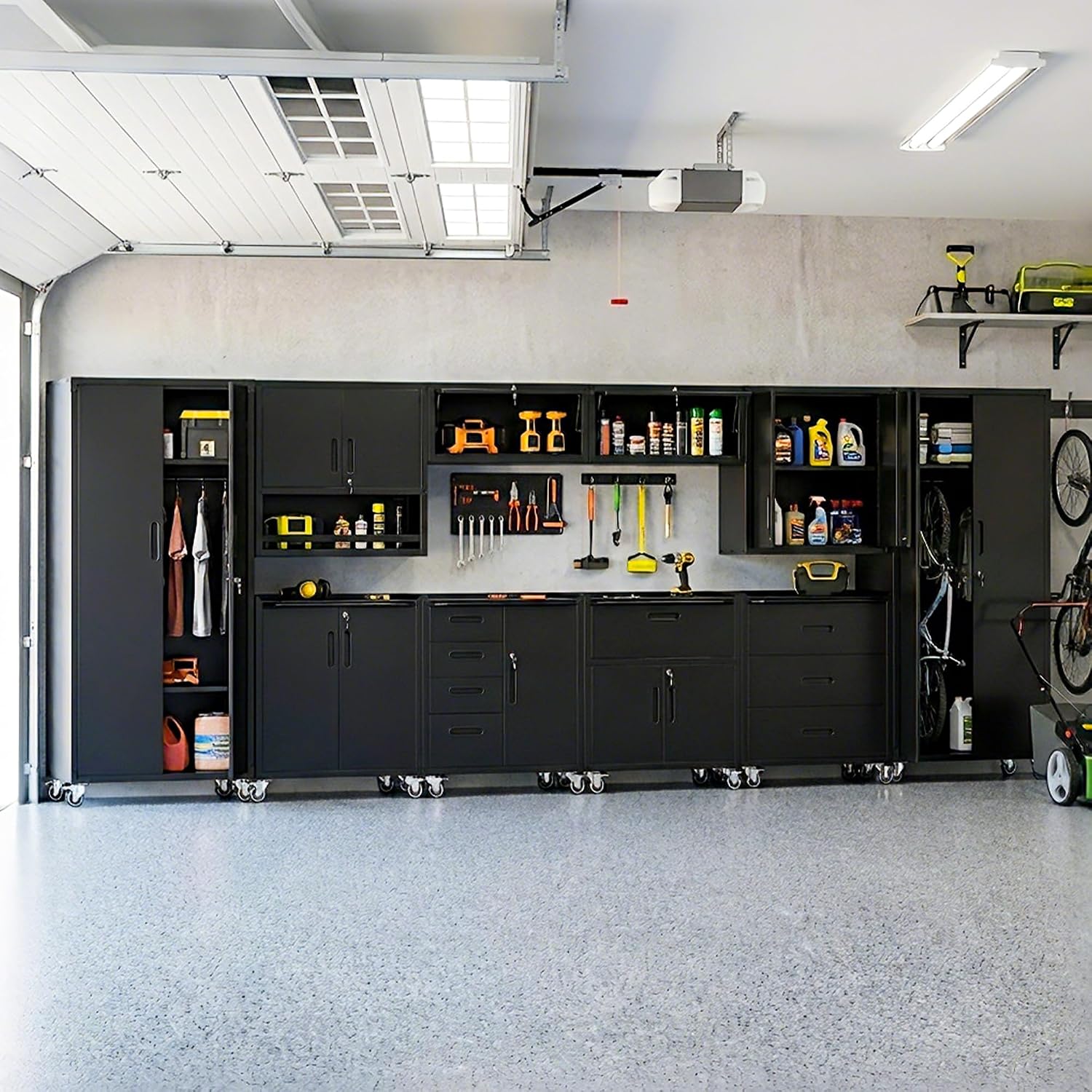 Visit on Amazon → and read the hardware list before you commit, because that list tells you more about the set than the photos do.
The wall-mounted wire shelf kit: the wall you already have
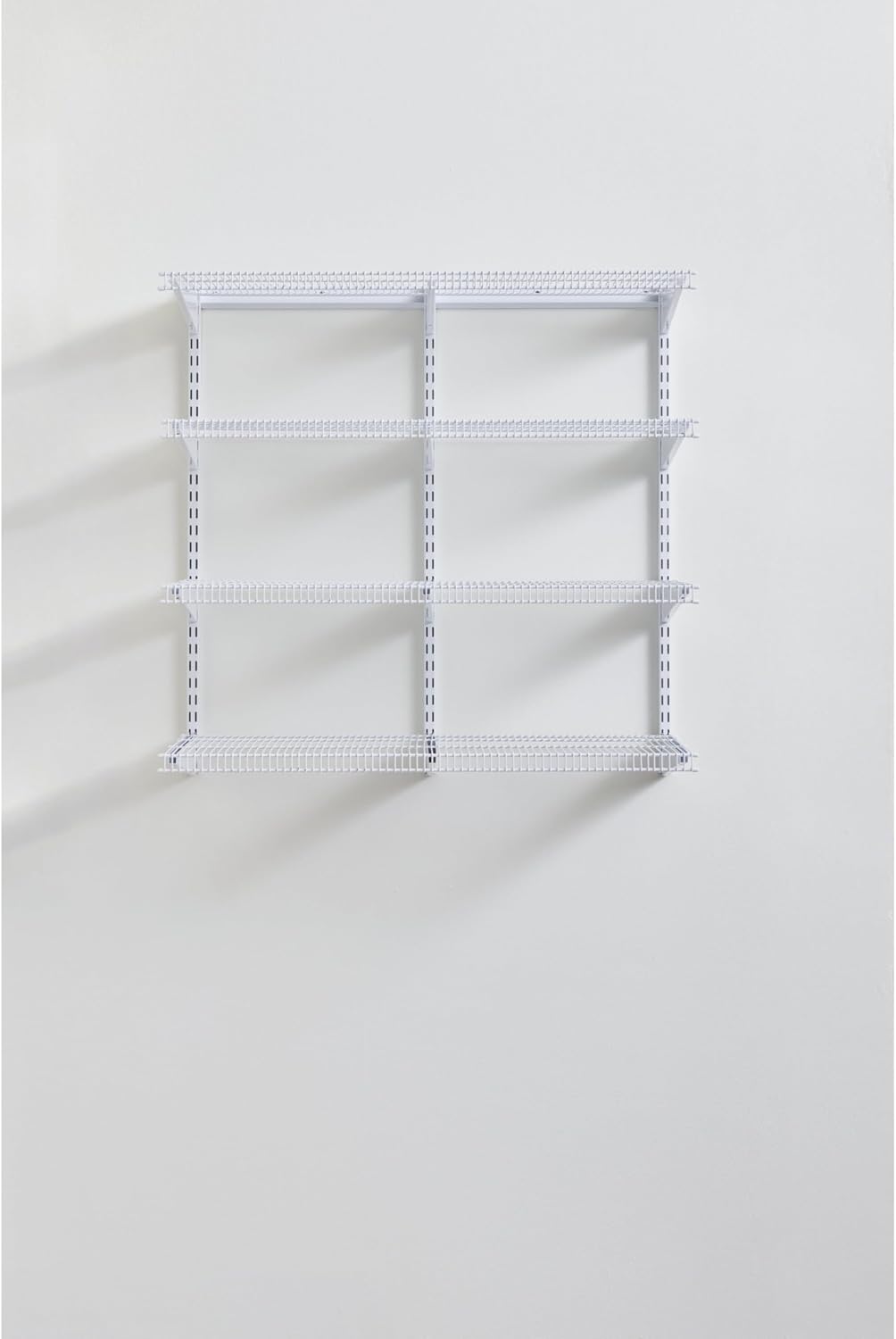
The 36-inch direct wall mount system with four shelves is the value play, and it is the one most people should buy first. Direct wall mount means the brackets fasten straight to the wall, and the kit includes the mounting hardware. That hardware is the part that decides whether the shelf holds or fails.
Included anchors are for drywall, and drywall is not a structural material. On a garage wall, find the studs. Most walls are framed 16 inches on center, some are 24, and a 36-inch shelf has to land on two of them to be worth anything. If your studs are spaced wide or you are mounting to a block wall, that changes the fastener, not the shelf.
Wire is the right material for this job. It lets dust fall through instead of collecting on top, it does not rot or warp with humidity, and it wipes down. It is also honest about its limits. Wire shelves flex, and a flexing shelf eventually works its brackets loose. Keep paint cans, seasonal bins, and light tools up there. Do not hang a loaded tool chest on a wire shelf, no matter what the packaging suggests.
White wire also disappears against a painted wall, which sounds cosmetic until you notice how much calmer a garage looks when the shelving does not announce itself. This is pantry-style storage applied to a garage wall, and it installs in an afternoon if you own a stud finder and a level. If you are working through a garage wall organization plan, this is the layer that goes up after the layout is marked.
The five-tier steel wire shelving unit: the freestanding workhorse
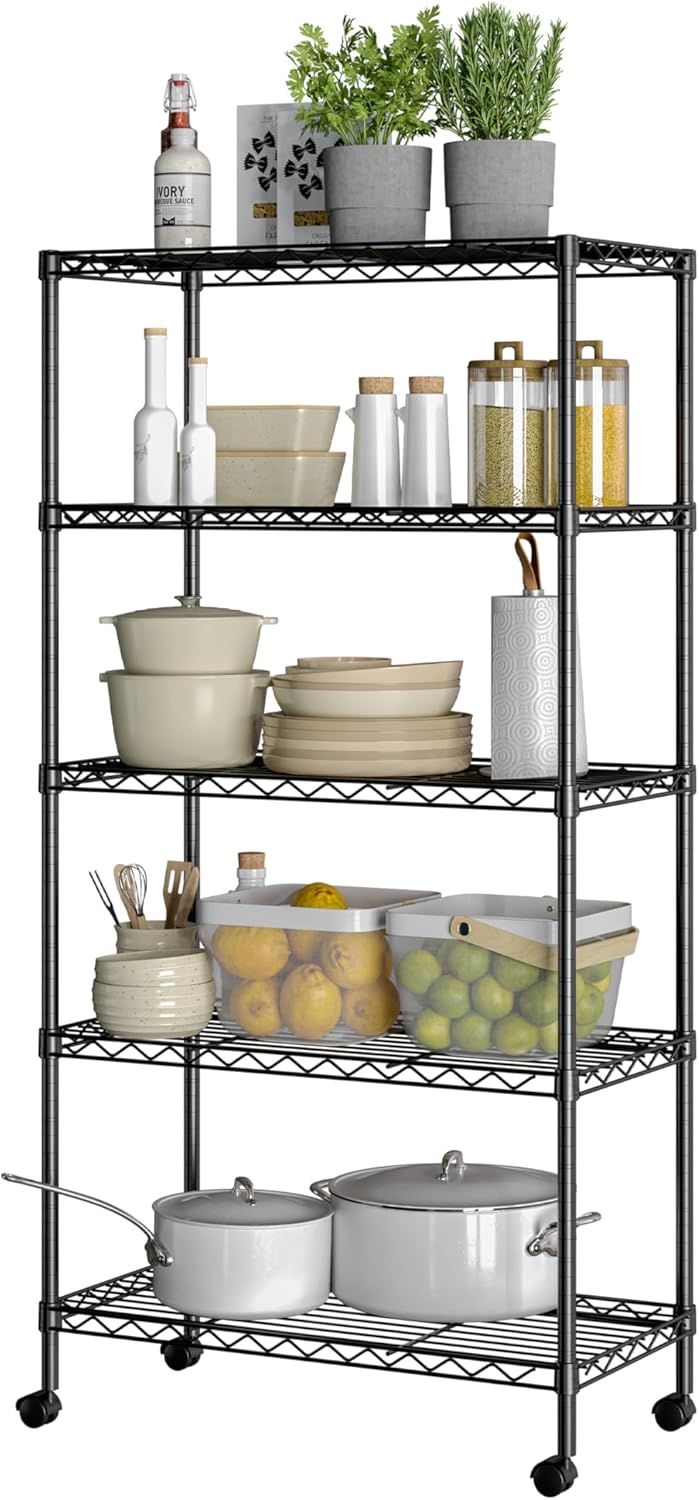
The 30 by 14 by 61.5 inch five-tier unit is the rack I point people toward when they want capacity without touching the walls at all. The narrow 14-inch depth means it sits against a wall and still leaves room to park. Five shelves at adjustable heights mean you can set the spacing to match the totes you actually own instead of the totes a photo shoot used.
Freestanding racks live or die on two things: the sleeves that lock each shelf to the posts, and whether the unit sits level. On cheap racks those sleeves are plastic, and plastic is where a load rating quietly goes to die. Steel posts with steel or thick split sleeves are what you want, and you can feel the difference when you assemble it. Put the heavy items on the bottom shelf, always. A tall narrow rack with weight up top is a lever waiting for a nudge from a bumper.
This rack is not a workbench and it is not a cabinet. It is open storage for bins, coolers, and the things you need to see at a glance. If you want a surface to cut on and doors to close behind, that is the cabinet set above. If you want the wall back, this is the one that asks nothing of your framing.
The 30-gallon totes: what actually goes in the system
The last piece is the least glamorous and the one that decides whether any of the rest works. The 30-gallon snap-lid totes come as a six-pack, and the value of that is uniformity. Six identical totes stack, label, and slide onto a shelf as a set. Six mismatched bins accumulated over ten years do not, and that is how a garage ends up looking messy even after you buy shelving.
Snap lids matter in a garage more than in a closet. Sawdust, garage door grit, and the occasional mouse are all looking for a way in. A lid that snaps down on all four sides is the difference between a tote of camping gear and a tote of nesting material. Clear or labeled totes also save you the worst garage habit there is, which is opening four bins to find the one thing you needed.
The rule I give everyone: buy the storage system first, the totes second, and label both. Totes are the last step of organizing a garage, not the first. Fill them before you have shelves to put them on and you have simply built a smaller pile in a nicer container.  Visit on Amazon → before you stock up, because buying them in matched batches later is harder than it sounds.
How I evaluate a garage storage system
I do not trust a load rating printed on a box. I trust the bracket. So when I look at a system, here is the order I go in.
Find the studs. Sound and a stud finder, both, because a stud finder gets confused near a garage door header and a wall with foam board behind the drywall. Mark every stud across the wall before anything gets drilled.
Read the mounting hardware. If the kit ships drywall anchors as the primary fastener, treat the published weight rating as fiction. Anchors are for pictures and towel bars. Structural loads go into framing.
Check the load path. The shelf transfers weight to a bracket, the bracket to a screw, the screw to a stud, and the stud to the foundation. Any weak link in that chain sets the real limit, and it is usually the second one. This is also why ceiling racks get people in trouble, since the hardware matters more than the rack.
Plan for change. A system you cannot reconfigure is just expensive shelving. Rails, adjustable shelf heights, and standard-width totes let you move things when the household changes.
Then live with it for a month and check it with a level. A shelf that has dropped a quarter inch in thirty days is telling you what it will do in three years.
Analysis: where these four products fit
These four products are not competitors. They are a sequence, and the order you buy them in matters more than the brand on the box.
The cabinet set handles the valuables and the mess: tools, chemicals, anything that should be closed away. It is the biggest single purchase in a garage, and it is the one where steel gauge, door hardware, and wall anchoring decide whether you get ten years or two.
The wall-mounted wire kit handles the wall above the cars, which is otherwise dead space. It is the cheapest way to add real capacity, and it is the most commonly botched install, because people trust the anchors in the box instead of finding studs.
The five-tier rack handles volume: coolers, bins, and the odd-shaped gear that will not fit on a wall shelf. It needs no studs at all, which makes it the right answer for a renter or a block wall.
The totes handle everything loose, and they are what make the other three look organized instead of merely full.
One thing all four share: none of them is a substitute for a stud finder, a level, and an hour of measuring before you drill. I have watched people spend real money on cabinets and then mount them with whatever came in the bag. The cabinet was never the problem.
Garage storage reference table
| Product | Type | Best for | What to verify before you buy |
|---|---|---|---|
| Visit on Amazon → 10-Piece Heavy Duty Steel Garage Cabinet System |
Modular steel cabinet set with tool bench | Tools, chemicals, anything behind a closed door | Steel gauge, door hardware, wall anchoring for tall units, floor pitch and shims |
 Visit on Amazon → Rubbermaid 36 Inch Pantry Organization Shelf System |
Direct wall mount wire shelving, 4 shelves | Wall space above the cars, paint, light bins | Stud spacing, bracket material, replacing drywall anchors with structural fasteners |
 Visit on Amazon → 5-Tier Steel Wire Shelving |
Freestanding steel rack, 30 x 14 x 61.5 inches | Bins, coolers, volume storage, renters | Shelf sleeves, post gauge, level floor, heaviest items on the bottom |
| Visit on Amazon → Sterilite Tote, 30 Gallon, 6-Pack |
Plastic storage totes with snap lids | Loose gear, seasonal items, matched stacking | Lid seal, stackability, matching footprint to your shelf depth |
Should you buy the 10-piece steel cabinet system?
Yes, if you are going to anchor it and you want your garage to work like a shop instead of a storage unit. Doors keep sawdust off your tools, the tool bench gives you a place to actually cut and assemble, and a modular set lets you add or move units later instead of starting over. Visit on Amazon → and check the hardware list against the anchoring plan for your wall.
The honest caveats: it is a full-day assembly with two people, your slab pitch will decide whether you need shims, and any tall cabinet near a garage door track needs to be fastened into studs. If you are not willing to do those three things, spend the money on the wall shelf kit and the rack instead. Cabinets that wobble are worse than no cabinets at all.
Should you buy the wall-mounted shelf system?
Yes, for most garages, and buy it before anything else. It uses space you are already paying for, it installs in an afternoon, and it holds the awkward stuff like paint and seasonal bins that nothing else in the garage wants to deal with.
The one condition is studs. Find them, mark them, and fasten the brackets into wood. If your wall is masonry or your studs are spaced oddly, budget for the right anchors and a masonry bit, because the shelf is only as good as what holds it. Skip the tool chest on this one. That is what the cabinet set and the freestanding rack are for.
Should you buy the wire rack and the totes?
Yes, and they are the pair that finishes the job. The five-tier rack gives you volume storage without touching the framing, which makes it the right first purchase for renters and the right second purchase for everyone else. The snap-lid totes give you a uniform footprint that stacks, labels, and slides onto those shelves.
Buy the rack, then buy the totes to fit the shelf spacing you set. Put heavy items low, keep the top shelf for light seasonal gear, and label every tote. That is the whole system, and it will still be working in ten years.