Related: How to Find a Stud in a Finished Garage Wall Without Guessing
I have hung a lot of things on garage walls: rails, shelves, cabinets, bike hooks, a 200-pound ladder I regret buying. The failure is almost never the shelf. It is the fastener, and it is the stud behind it. So when I evaluate a garage wall storage system, I start with the bracket and the mounting hardware, not the marketing photo.
That is the premise here. Four systems, four different jobs. A wall rail for the things you touch every week. A tool organizer for the long-handled yard equipment. A cabinet set for anything you do not want covered in sawdust. A freestanding rack for boats and boards. None of them is a universal answer, and picking the wrong one means drilling holes you will be patching later.
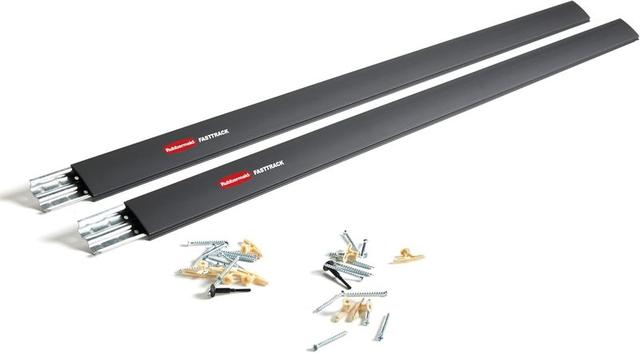
Best Overall Wall System: Rubbermaid FastTrack 48-Inch Rail, 2-Pack
Every garage should start with a rail. It is the most reconfigurable thing you can put on a wall, and reconfigurable is the entire point. A rail gives you a horizontal spine. Hooks, brackets, and baskets clip onto it. When the bike collection grows or the ladder gets replaced, you slide things sideways instead of patching drywall.
The FastTrack two-pack gives you two 48-inch horizontal rails, and the manufacturer rates each one to hold up to 1,750 pounds. Read that number the way a contractor reads it. That is the rail. It is not the screw you dug out of a coffee can, and it is not the half-inch of drywall behind it. Hang it into studs with hardware that matches the rating and you have a system that outlives the garage.
This is the value pick, not the heaviest-duty pick. If you plan to hang a loaded tool chest from a single hook, go look at a pro-grade steel track system and pay for it. For bikes, shovels, hoses, cords, and the folding chairs nobody puts away, this is plenty, and it goes up in an afternoon. Two 48-inch rails also give you a chance to plan: one at eye level for the weekly stuff, one higher for the seasonal bins.
The catch with any rail system is accessories. Before you commit, check what clips are available for the rail you are buying, because a rail with three hook options is a shelf with extra steps. FastTrack has a deep accessory line, which is a real part of the value.
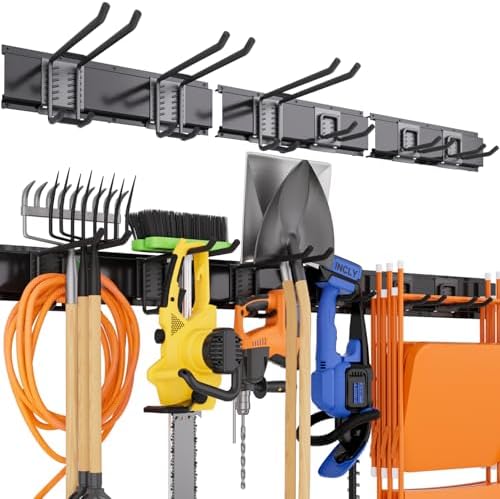
Best for Yard Tools: INCLY 48-Inch Garden Tool Organizer
Long-handled tools are the worst thing to store and the easiest thing to store badly. Rakes, shovels, and edgers end up leaning in a corner, and leaning in a corner means falling on your truck every time you pull in.
This unit is a 48-inch wall mount with three storage racks and six adjustable hooks, and it is rated to carry 390 pounds. That is a real number for rakes and shovels. Six hooks that move means you can space them to the tools you actually own instead of fighting a fixed pattern.
Two things I would check before buying. First, the hook spacing needs to fit your tool heads, and adjustable hooks are the fix for that, so use the adjustment instead of forcing a shovel into a gap that does not fit. Second, 390 pounds is a distributed number across a 48-inch span, not a number for one hook. Do not hang a 60-pound post hole digger on the end hook and call it a test.
If you already run a rail system, this overlaps with it, so pick one and commit. If your wall is bare and your problem is specifically yard tools, this is the shorter path. It also mounts above a workbench well, which keeps the floor clear without eating wall space you need for a bench.
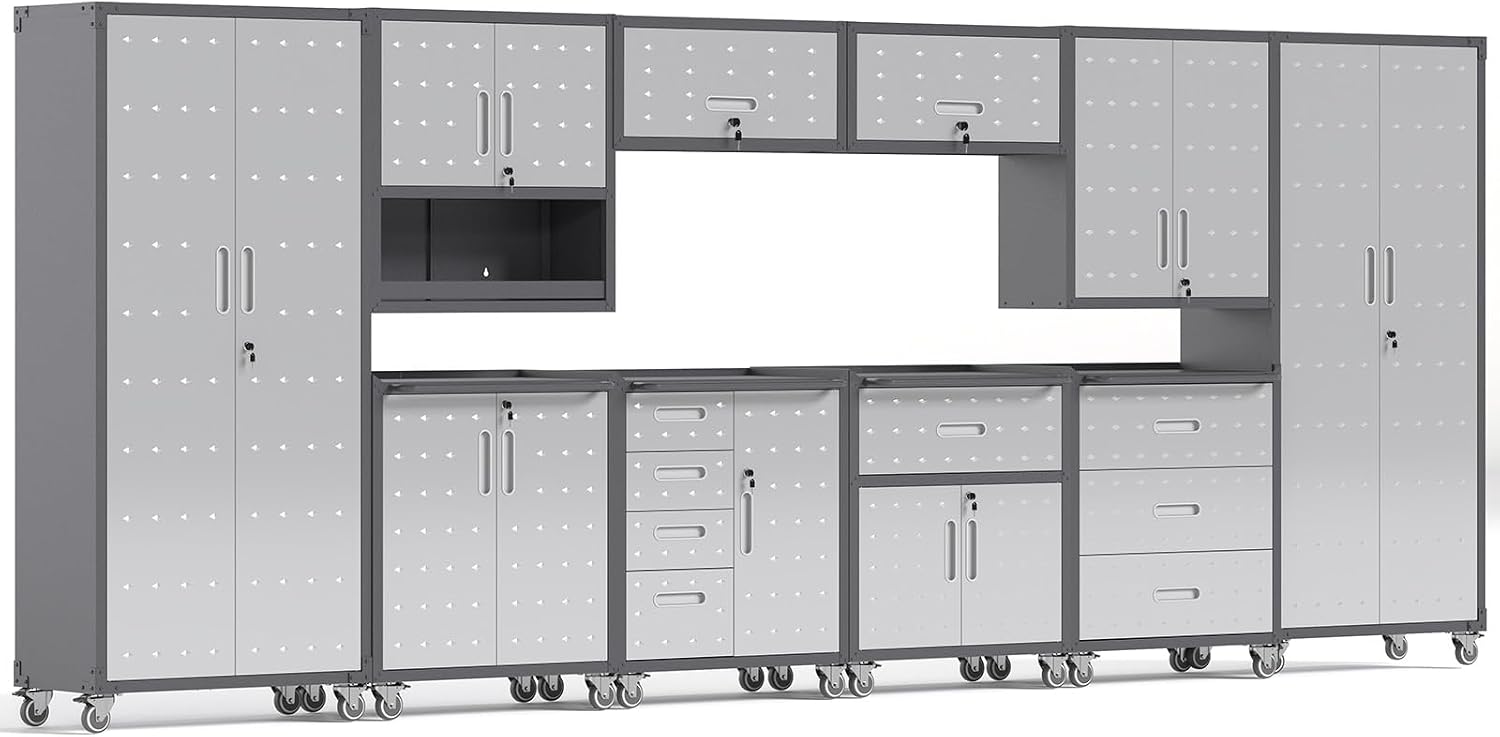
Best for Cabinets: 10-Piece Garage Storage Cabinets System
Cabinets beat open shelving for anything you do not want covered in sawdust. That is not a style opinion, it is a workshop fact. Anything with a finish, anything with oil on it, anything you want to find without moving three bins first belongs behind a door.
This is a 10-piece system, which is the part people underestimate. Ten pieces is not a cabinet, it is a layout. Measure your wall, mark the doors, and figure out the swing before anything gets assembled, because a cabinet door that opens into a parked car is a daily annoyance you will live with for a decade.
Budget for two extras. A level, because garage floors have pitch and a run of cabinets installed level to the floor will look wrong at the top. And shims, because the pitch means one end of the run sits on the concrete and the other end does not. Shim it, anchor it, then load it.
A 10-piece set is the right call if you are organizing a whole wall at once and you want it to look deliberate. If you only need one cabinet, buy one cabinet. Systems are cheaper per piece and more annoying to expand later.
Best for Boats and Boards: 2 Canoes + 4 Kayak/SUP Freestanding Rack
This is the one I recommend most often to people I do not trust to find a joist. It is freestanding, which means it stands on the floor and carries its own load. No ceiling hardware. No dead load added to joists you have never inspected. No guessing whether the previous owner used the right anchors, because there are no anchors.
The rack holds two canoes plus four kayaks, paddleboards, or surfboards. That is a serious footprint of boats off the floor and out of the way, and it works in a garage with a low ceiling, which overhead racks do not.
Freestanding does mean floor space, so this is a trade, not a free lunch. You give up a few square feet of concrete in exchange for not touching the structure of the building. In a two-car garage where one bay is already spoken for, that is usually the right trade. It also means you can move it, which matters if you ever reorganize.
One note: freestanding racks still want to be loaded sensibly. Heaviest boats low, lighter boards high, and keep the load roughly even side to side so it does not lean. A rack that tips is worse than a rack that is not there.
How I judge a wall system: studs, brackets, dead load
Three questions decide whether a system is worth your Saturday.
What are the brackets actually made of? Steel beats plastic, always, but plastic is not automatically disqualifying. It is disqualifying when the rating assumes steel. A rail rated to 1,750 pounds per rail is a rail number, and the hooks you add are the parts that actually bend.
Does the mounting hardware match the rating? This is where most installs fail, and it is why I have a standing rule: no ceiling racks unless I can verify the joists and the hardware. Weight ratings printed on the box describe a test rig, not your wall. The bracket is the weak point, and the fastener is the weakest point of all. Drywall anchors sold for ceiling storage are a scam, and I will say that to anyone who asks.
Can I reconfigure it later? A system you cannot change is expensive shelving. That is the difference between a rail with a deep accessory line and a cabinet you have to empty and unbolt to move.
Two more things that come up on every job. Find the stud. It is the most important tool in garage storage and the one everyone skips. And think about dead load, which is what your ceiling or wall can hold forever, not just on install day. A rack that holds on day one and sags by day thirty was never rated for what you put on it.
The garage storage reference table
| Product | Mounting | Stated capacity | Best for |
|---|---|---|---|
 Visit on Amazon → Visit on Amazon →Rubbermaid FastTrack 48-inch rail, 2-pack |
Wall, into studs | Up to 1,750 lbs per rail, per the listing | Bikes, ladders, hoses, seasonal bins |
 Visit on Amazon → Visit on Amazon →INCLY 48-inch garden tool organizer |
Wall, into studs | 390 lbs, per the listing | Rakes, shovels, edgers, long-handled tools |
 Visit on Amazon → Visit on Amazon →10-piece garage storage cabinet system |
Freestanding cabinet set | See product page | Tools, paint, chemicals, finished surfaces |
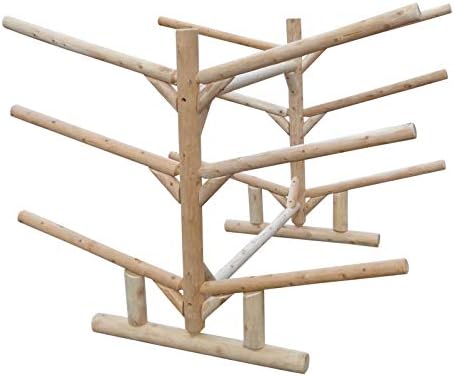 Visit on Amazon → Visit on Amazon →2 canoe plus 4 kayak/SUP freestanding rack |
Freestanding, no wall or ceiling hardware | See product page | Canoes, kayaks, paddleboards, surfboards |
The pattern in that table is simple. The two wall-mounted units publish a number and they earn it by going into studs. The cabinet set and the freestanding rack do not need your structure to cooperate, which is exactly why I recommend them to people with finished walls and unknown framing.
Should you buy the Rubbermaid FastTrack rails?
Yes, if you want a reconfigurable wall instead of fixed shelves. Two 48-inch rails rated to 1,750 pounds each is more spine than most garages ever use, and the accessory line means the system grows with your stuff instead of locking you into one layout. Mount it into studs with hardware that matches the rating and stop worrying about it.
Skip it if you need a single heavy hook for a loaded tool chest. That job wants steel track and a bigger budget.
Should you buy the INCLY garden tool organizer?
Yes, if long-handled tools are your specific problem. Three racks, six adjustable hooks, and a 390-pound rating on a 48-inch span is a sensible answer for rakes and shovels, and the adjustable hooks are what keep it from becoming a fixed rack you outgrow.
Skip it if you already run a rail system with tool hooks. You would be paying twice for the same wall space.
Should you buy the 10-piece cabinet system?
Yes, if you are doing a whole wall and you want closed storage. Ten pieces means plan the layout first, measure the door swings, and budget for a level and shims because garage floors have pitch. Do that and it reads as a workshop instead of a pile of boxes.
Skip it if you need one cabinet. Buy the one cabinet.
Should you buy the freestanding kayak and canoe rack?
Yes, if you have boats and you do not want to touch your ceiling. Two canoes and four kayaks or paddleboards off the floor, no joists to verify, no anchors to get wrong. It costs you floor space, and that is the honest trade.
Skip it if floor space is the thing you are shortest on. Then you are back to overhead storage, and overhead storage only works when you verify the joists and the hardware first. No exceptions on that one.